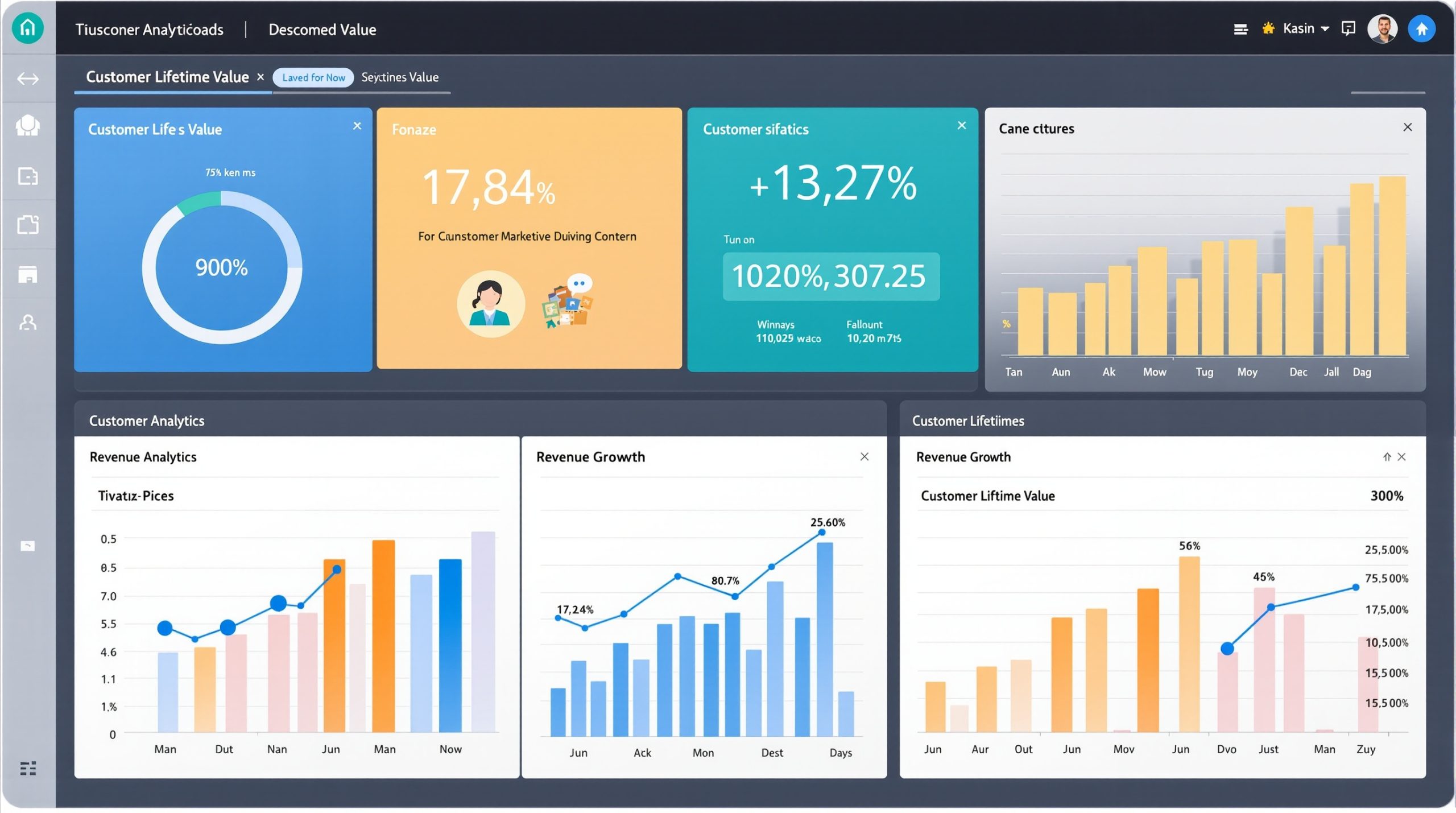
Most marketing teams optimize for the wrong number. They celebrate low CPAs, high click-through rates, and impressive ROAS figures — metrics that look good in weekly reports but tell you almost nothing about whether you’re actually building a sustainable business. Customer lifetime value is the metric that cuts through the noise and reveals the real economics of your marketing. Every major strategic decision — channel allocation, acquisition cost targets, retention investment, pricing — should flow from CLV. If it doesn’t, you’re flying blind.
What Customer Lifetime Value Actually Measures
Customer lifetime value (CLV, also called LTV or CLTV) represents the total revenue a business can expect from a single customer account throughout their entire relationship. More precisely, it should represent total profit rather than revenue — gross profit lifetime value — because revenue without margin tells you nothing useful.
At its most basic:
CLV = Average Purchase Value × Purchase Frequency × Customer Lifespan
But this simplified formula misses too much. A more complete model looks like:
CLV = (Average Order Value × Gross Margin × Purchase Frequency × Customer Lifespan) − Customer Acquisition Cost
Even this has limitations. It treats all customers as the same, ignores churn probability curves, and doesn’t account for referral value. The best CLV models are probabilistic — they calculate expected lifetime value based on actual behavioral data and churn risk, not averages.
Why Most CLV Calculations Are Wrong
The most common error is using average customer lifespan as if it applies equally to all customers. In reality, customer lifespan follows a highly skewed distribution: a small number of customers stay for years, most churn within the first few months. Averaging these together produces a number that accurately describes no actual customer segment.
The second most common error is excluding acquisition costs. A customer worth $500 lifetime with a $400 CAC is barely profitable — a very different business than one with the same CLV and $50 CAC. Always calculate CLV net of acquisition costs when making strategic decisions.
Calculating CLV Correctly by Segment
Generic CLV calculations are interesting. Segment-level CLV calculations are actionable. When you break down CLV by acquisition channel, customer type, geography, or product purchased, you discover the specific combinations that drive your most valuable customers — and can optimize accordingly.
Acquisition Channel CLV Analysis
Not all acquisition channels produce equivalent customers. A customer acquired through organic search may have very different retention behavior than one acquired through paid social — and the difference often isn’t obvious from first-purchase data. Channel-level CLV analysis frequently reveals:
- Channels with low CPA but high churn (looks efficient, destroys value)
- Channels with high CPA but exceptional retention (looks expensive, creates value)
- Channels producing one-time buyers vs. repeat purchase customers at dramatically different rates
When you shift budget allocation to reflect these CLV differences rather than CPA differences, overall business economics improve significantly.
First Product CLV Analysis
In businesses with multiple products, the first product purchased is often the strongest predictor of long-term value. Customers who enter through premium products often have higher retention and greater total spend than those who enter through discounted or entry-level offerings. Knowing this changes both your acquisition strategy and your conversion path design.
Cohort-Based CLV Tracking
CLV at a point in time is a snapshot. CLV tracked by cohort shows you how the business is actually performing over time. Are customers acquired this year more or less valuable at 6 months than customers acquired two years ago? Cohort degradation (newer cohorts performing worse than older ones) is an early warning of declining product-market fit or increasing competition that aggregate metrics hide.
The CLV:CAC Ratio: Your North Star Metric
The relationship between customer lifetime value and customer acquisition cost is arguably the most important ratio in any marketing-driven business. It tells you how efficiently you’re converting marketing investment into durable business value.
What CLV:CAC Ratios Mean
- Below 1:1 — You’re destroying value. Every customer you acquire costs more than they’ll ever return.
- 1:1 to 2:1 — Marginally viable but not scalable. No room for operational costs or reinvestment.
- 3:1 — The commonly cited benchmark for healthy SaaS. Covers operations and leaves room for growth.
- 4:1 to 5:1 — Strong unit economics. You have room to increase acquisition spend aggressively.
- Above 6:1 — You may be underinvesting in acquisition. You’re leaving growth on the table.
Note: these benchmarks were developed for SaaS. E-commerce, retail, and service businesses have different economics. Know your industry’s benchmarks, not just generic ones.
Payback Period: The Cash Flow Dimension
CLV:CAC tells you about value. Payback period tells you about cash flow. A 4:1 CLV:CAC ratio is excellent — but if payback period is 36 months, you need substantial working capital to fuel growth. Businesses that understand payback period alongside CLV:CAC make better financing and growth rate decisions.
Using CLV to Make Better Marketing Decisions
Once you have reliable CLV data by segment, it should drive every major marketing allocation decision.
Setting Maximum Acquisition Cost Targets by Channel
Your maximum acceptable CAC isn’t a single number — it’s different for every acquisition channel, because each channel produces customers with different CLVs. If organic search customers are worth $800 lifetime and paid social customers are worth $400 lifetime, your maximum CAC targets should reflect that difference, not use the same blended number for both.
Formula: Target CAC = CLV × (1 – Target Margin Percentage)
If you want a 3:1 CLV:CAC ratio and your organic search CLV is $900, your target organic acquisition cost is $300. If your paid social CLV is $450, your target paid social CAC is $150. Running both channels to a blended $225 target produces worse outcomes than optimizing each to its segment-appropriate target.
Retention Investment Decisions
CLV gives you a rational basis for retention investment. If extending average customer lifespan from 18 months to 24 months increases CLV from $600 to $800, you can invest up to $200 per customer in retention programs and still maintain the same unit economics. Without CLV data, retention investment decisions are guesses.
Pricing Strategy
Pricing decisions look very different when you account for CLV effects. A price increase that improves short-term margin but increases churn may reduce overall CLV — the opposite of what the margin math suggested. A discount that reduces first-purchase margin but dramatically improves retention (because customers experience the product more deeply) may increase CLV substantially. CLV modeling turns pricing strategy from instinct-based to data-driven.
Product Development Prioritization
Features that improve retention — even modestly — have massive CLV impact. A 10% improvement in monthly retention rates compounded over 24 months produces a dramatically different CLV than that 10% improvement suggests in isolation. CLV-weighted product prioritization systematically favors retention-improving features over acquisition-oriented features.
Advanced CLV Models for Serious Operators
Basic CLV formulas work for getting started. Serious operators need more sophisticated approaches.
Probabilistic CLV Models (BG/NBD)
The Beta Geometric / Negative Binomial Distribution model is the gold standard for non-contractual businesses (e-commerce, retail). It models individual customer churn probability based on purchase history, producing CLV predictions that account for the reality that different customers have different propensities to churn at different rates. More accurate than average-based models, especially for predicting CLV of individual customers at various stages of their lifecycle.
Machine Learning CLV Prediction
With sufficient purchase history data, machine learning models can predict CLV with significant accuracy at the individual customer level. These models incorporate hundreds of behavioral signals — purchase frequency, recency, category breadth, discount sensitivity, return rates, support interactions — to produce personalized CLV scores. This enables truly 1:1 marketing economics: spend proportionally to each customer’s predicted lifetime value, not to blended averages.
Incorporating Referral Value
Standard CLV models miss referral value — the economic contribution of customers who generate new customers. For businesses where word-of-mouth or referral programs drive meaningful acquisition, network-adjusted CLV (sometimes called customer lifetime network value) provides a more complete picture. Some customer segments generate referrals at 3-5x the rate of others; ignoring this understates their true value significantly.
Operationalizing CLV Across the Organization
CLV as a dashboard metric is interesting. CLV embedded in operating decisions is transformational. Here’s how to make it operational:
Marketing Automation Based on CLV Scores
Integrate CLV predictions into your marketing automation workflows. High-CLV prospects get different onboarding sequences, more personal touchpoints, and greater retention investment. Low-CLV customers get optimized for efficiency — automated sequences, self-serve support, lower-cost retention programs. This isn’t about ignoring lower-value customers; it’s about allocating resources proportionally to expected returns.
Sales Team Incentives Aligned with CLV
If your sales team is paid purely on deals closed, they’ll optimize for deal volume and first-year contract value — not for customer quality or long-term retention. Rebalancing sales compensation to include CLV-correlated metrics (12-month retention rates, upsell performance, NPS scores) aligns sales incentives with actual business value creation.
Regular CLV Reporting at the Executive Level
CLV belongs in executive reporting alongside revenue and EBITDA. Specifically: CLV by cohort over time (are newer customers more or less valuable?), CLV:CAC ratios by channel (where is acquisition efficient?), and CLV distribution (what percentage of revenue comes from the top 20% of customers?). These questions tell you whether the business is improving its fundamental economics.
Frequently Asked Questions
How often should I recalculate CLV?
For growing businesses, recalculate CLV at minimum quarterly. Monthly recalculation is better, especially when you’re making significant channel or product changes. The goal is to catch CLV degradation early — cohort analysis lets you identify problems before they compound across your entire customer base.
What data do I need to calculate CLV accurately?
You need purchase history (dates, amounts, products), customer acquisition source and cost, gross margins by product/category, and customer status (active/churned). For e-commerce, 18+ months of transaction data produces reliable models. For SaaS with subscription data, meaningful CLV calculations are possible within 6 months.
My business is early-stage with limited data. Can I still use CLV?
Yes, but use it carefully. With limited data, use industry benchmarks to create CLV assumptions, then update those assumptions as real data accumulates. Mark early CLV calculations as provisional and make decisions with wider uncertainty ranges. Even directionally correct CLV estimates are more useful than optimizing solely for short-term metrics.
Should CLV include the cost of serving customers?
Yes. Customer service costs, support costs, account management overhead — all of these reduce actual lifetime value. A technically “high-value” customer who requires constant hand-holding and generates significant support costs may have lower net CLV than metrics suggest. Fully-loaded CLV calculations include cost-to-serve for your most accurate picture.
How does CLV change during economic downturns?
CLV typically declines during economic downturns as customer churn rates increase and average order values drop. Businesses that have invested in CLV-based retention infrastructure — loyalty programs, proactive customer success, value-added services — typically see smaller CLV declines than those optimizing purely for acquisition. The retention investment made during good times pays dividends during contractions.
-
 By Guy Sheetrit
- May 21, 2026
 By Guy Sheetrit
