
Keyword research is an essential part of any successful SEO strategy. It helps you identify the most relevant keywords for your content and also helps you understand how people are searching for your content. For a deeper dive, explore our guide on AI-generated content good SEO.
To get the most out of your keyword research, it’s important to use the right tools. In this blog, we’ll talk about these tools and their working and we will also take a look at some of the best keyword research tools on the market. For a deeper dive, explore our guide on Keyword Mapping Tools.
Importance of Choosing The Right Keywords
Choosing the right keywords in your blog is essential for driving traffic to your website. Keywords are the words and phrases that users type into search engines to find content related to their query. Selecting the right keywords is a crucial part of SEO and can be the difference between the success and failure of your blog. One tool that can help you with keyword research and optimization is google search console.
When you choose the right keywords, you will be able to target the right audience, increase your SERP rankings, and drive more organic traffic to your website. Furthermore, the right keywords will also help you to create content that is highly relevant to your target audience, which will help you to establish yourself as an authority in your niche.
Top 10 Keyword Research Tools
Here are the 10 best Keyword research tools that will help you in finding the most relevant keywords for your page, blog, or even website. So go through the list and choose one that perfectly fits your needs.
1. OTT’s Long Tail Keyword Generator

Long-tail Keyword Generator tool from OTT helps marketers quickly and efficiently identify profitable long-tail keywords from the competition. It can generate hundreds or thousands of keyword ideas in a matter of seconds, and narrow down the list of potential keywords using filters such as search volume, keyword difficulty, and more. With this free keyword generator tool, users can quickly identify long-tail keywords that are more specific and targeted than traditional keywords, enabling them to optimize their content for better search engine rankings including organic ctr. For a deeper dive, explore our guide on Google Analytics.
2. Google Keyword Planner

Google’s Keyword Planner is a great tool for both keyword research and PPC campaigns. It provides detailed information about monthly search volume, competition, and related keywords. It can also be used to generate keyword ideas and find new keywords related to your existing ones, helping you optimize your SEO metrics effectively.
3. SEMrush

SEMrush is an all-in-one SEO and digital marketing suite. Its free keyword research tool allows you to identify the most popular keywords in your niche and also provides insights into your competitors’ keyword strategies. It includes features such as keyword difficulty, search volume, and related keywords.
4. KWFinder

KWFinder is a great tool for keyword research and SEO. It provides detailed information about keyword difficulty, search volume, and related keywords, including keyword data. It also includes features such as SERP analysis, keyword rankings, and backlink analysis.
5. KeywordTool.io

KeywordTool.io is a powerful keyword research tool that helps users find the best and most relevant keywords for their projects. It is designed to generate hundreds of keyword ideas from Google, YouTube, Bing, Amazon, eBay, and the App Store. With KeywordTool io, users can get an overview of the competitive landscape for any keyword, and get detailed search volume data for each keyword. The tool also includes features like keyword difficulty, search trends, and keyword suggestions. KeywordTool io is an invaluable resource for anyone looking to optimize their website or content for search engine optimization.
6. Ahrefs
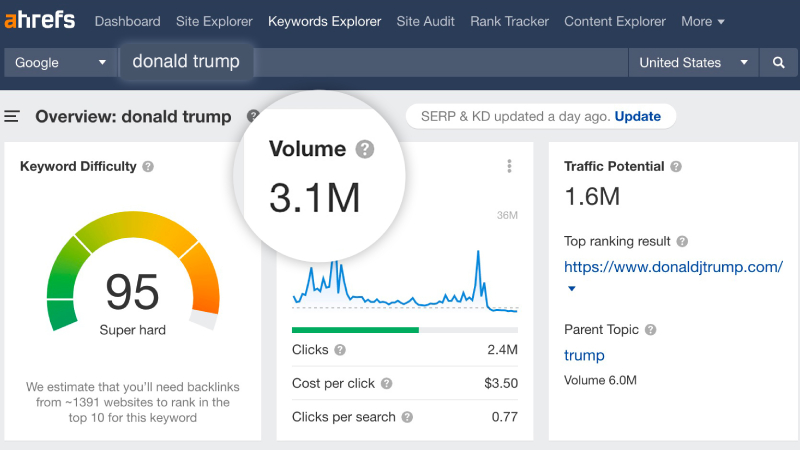
Ahrefs is another popular keyword research tool known for providing detailed information about keyword difficulty, search volume, and related keywords. It also includes features such as SERP analysis, keyword rankings, and backlink analysis, making it an essential tool to enhance your content strategy with target keywords.
7. Moz Keyword Explorer

Moz keyword explorer is a popular SEO and digital marketing suite. Its keyword research tool provides detailed information about SEO difficulty, keyword difficulty, search volume, and related keywords. It also includes features such as SERP analysis and keyword rankings.
8. Ubersuggest

UberSuggest is a great tool for keyword research. It is a powerful tool that can help you find great keywords to target in your website content and other marketing efforts. UberSuggest provides an easy-to-use interface that allows you to quickly search and filter through millions of keywords. You can also get an idea of how competitive a keyword is, as well as its search volume, cost per click and more. Additionally, UberSuggest provides a number of helpful features such as keyword suggestions, related keywords and keyword trends. With just a few clicks, you can get the data you need to optimize your SEO content and campaigns for the given keyword.
9. AnswerThePublic

AnswerThePublic is a free online research tool that provides visual answers to questions people are asking about a given topic. It collects questions from various sources, such as Google Autocomplete, Twitter, and forums, and organizes them into categories to provide users with an easy-to-browse list of questions. AnswerThePublic also includes data visualizations that help users quickly identify Google trends and hot topics related to organic search. By using AnswerThePublic to collect data, marketers, and researchers can discover the questions people are asking about a particular topic, determine the best keywords to target, and gain valuable insights into consumer behaviour.
10. SpyFu
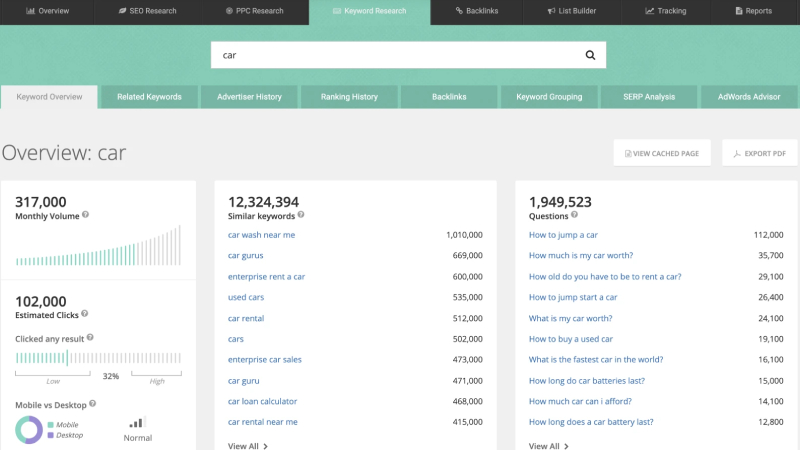
SpyFu is an all-in-one keyword research and SEO tool that provides data on keyword search volume, competition, cost-per-click, and more. SpyFu is a subscription-based online service that allows you to uncover the secrets of your competition and outrank them in search engine results.
With SpyFu, you can track your competitors’ keyword strategies and gain insight into the tactics they use to get more clicks and conversions. You can also use the data to build better campaigns and stay ahead of the competition. SpyFu also offers additional features such as competitor backlinks and analysis, keyword research, and a PPC research tool. With SpyFu, you can easily identify opportunities and make sure that your website always ranks at the top of the search engine results.
Bonus Keyword Research Tool: Amazon Keyword Tool
The Amazon A10 algorithm is a proprietary search engine algorithm that only Amazon uses. It was only recently that it was upgraded from its predecessor i.e. Amazon A9. In comparison to Amazon A9, which is more focused on influencing people to purchase more profitable products, the new Amazon A10 algorithm prioritizes buyer searches. As a result, the system now tends to show the searcher more relevant products than it did previously.
We at OTT SEO understand this, which is why we have created a free tool for Amazon keyword research. It can assist you in identifying possible Amazon products to sell as well as the techniques buyers use to find your current products. Find popular and highly relevant keywords for Amazon with OTTSEO’s Amazon Keyword Tool.
Even if you run an affiliate website, knowing the Amazon searches that consumers do, makes it straightforward to create content and copy that stands out from the crowd. You will be able to improve organic traffic to your website as long as your products are relevant to actual Amazon searches.
Keyword Density Checker by OTT
After finding the right keywords and using them on your page or blog. You will also need a tool to check the density of your set of keywords. For that purpose this keyword density checker is perfect. Keyword Density Checker by OTT is free and very easy to use.
Just enter the URL of the page you want to check and click “Submit.” The results will show you the number of times each keyword appears on the page, as well as the total number of words on the page.
These are just some of the many keyword research tools on the market. Depending on your SEO and digital marketing needs, you may find that one tool is better suited to your needs than another. It’s important to take the time to explore each tool and find the one that best fits your needs.
If you want to improve your online visibility and attract more traffic to your website, OTT SEO is the perfect choice for you. As a leading SEO company, we offer a wide range of best SEO services to help businesses achieve top rankings in search engine results pages (SERPs), resulting in increased credibility, visibility, and revenue.
Frequently Asked Questions
Q: What is this guide about?
This comprehensive guide provides strategies and best practices for achieving success. Following these approaches can help improve your results and competitive advantage.
Q: How long does it take to see results?
Results vary. Most strategies require 3-6 months before significant improvements. Ongoing optimization and consistency are essential for sustainable success.
Q: Do I need professional help?
While basic implementation can be done independently, professional guidance often accelerates results and helps avoid costly mistakes.
Q: What are the most important factors for success?
Key factors include thorough research, consistent execution, quality over quantity, regular performance monitoring, and adapting to industry changes.
Q: How do I measure success?
Track KPIs like traffic, conversions, revenue, and engagement rates. Regular analysis helps identify areas for improvement.
Q: What channels should I focus on?
Most businesses benefit from SEO, content marketing, social media, and paid advertising. Start where your target audience is most active.
For a deeper dive, explore our guide on Answer Public Optimise Content.
The Evolution of Digital Marketing: From Traditional to Modern Approaches
Digital marketing has undergone a remarkable transformation over the past two decades, evolving from simple banner advertisements and email campaigns to sophisticated, data-driven strategies that leverage artificial intelligence and machine learning. Understanding this evolution provides valuable context for developing effective modern marketing strategies that resonate with today’s consumers.
The early days of digital marketing were characterized by interruptive advertising tactics that prioritized visibility over relevance. Companies spent significant budgets on display ads that reached broad audiences but delivered limited engagement. As consumer behavior shifted and technology advanced, marketers began recognizing the value of permission-based marketing and targeted approaches that delivered personalized messages to specific audience segments.
Today’s digital marketing landscape demands integrated approaches that combine multiple channels and tactics into cohesive customer experiences. The most successful businesses recognize that modern consumers interact with brands through complex, non-linear journeys that span multiple devices and platforms. Meeting customers where they are requires sophisticated targeting capabilities, real-time personalization, and seamless cross-channel experiences.
The integration of marketing technology has enabled unprecedented levels of automation and optimization, allowing marketers to deliver the right message to the right person at the right time. These capabilities have transformed marketing from an art to a science, enabling continuous improvement based on real-time performance data and predictive analytics.
Strategic Content Development for Search Engine Success
Content remains the foundation of successful digital marketing, serving as the primary mechanism for attracting organic traffic, building brand authority, and engaging target audiences. Developing a comprehensive content strategy requires understanding search intent, creating valuable resources, and optimizing for both search engines and human readers.
Effective content addresses specific search queries while providing genuine value to readers. This requires deep understanding of your audience’s needs, questions, and pain points. The best content answers questions comprehensively, provides actionable insights, and offers unique perspectives that readers cannot find elsewhere.
Content optimization extends beyond keyword placement to include structural elements, readability, and multimedia integration. Well-structured content with clear headings, bullet points, and visual elements performs better in search results while delivering superior user experiences. Mobile optimization is particularly critical as mobile traffic continues growing.
Content promotion and distribution are equally important as creation. Even excellent content delivers limited results if target audiences cannot discover it. Strategic distribution leverages social media, email marketing, influencer partnerships, and paid promotion to maximize content reach and impact.
Data Analytics and Performance Measurement Fundamentals
Modern marketing success depends heavily on sophisticated analytics capabilities that enable data-driven decision making. Understanding which metrics matter most and how they connect to business outcomes allows continuous optimization of marketing efforts and improved return on investment.
Essential marketing metrics include traffic volume and sources, engagement rates, conversion rates, customer acquisition costs, and lifetime value. Each metric provides insights into different aspects of marketing performance, and comprehensive analysis reveals the full picture of marketing effectiveness.
Attribution modeling helps marketers understand how different touchpoints contribute to conversions. Multi-touch attribution provides more accurate pictures of customer journeys than last-click attribution, enabling better allocation of marketing budgets across channels and campaigns.
Advanced analytics approaches segment data by multiple dimensions to identify patterns and opportunities that aggregate data might miss. Understanding audience segments, channel performance, and campaign effectiveness enables continuous optimization and improved results over time.
Building Brand Authority Through Thought Leadership
Establishing thought leadership in your industry provides significant competitive advantages, including increased brand awareness, customer trust, and organic visibility. Thought leadership requires consistent creation of valuable content that demonstrates expertise and unique insights.
Effective thought leadership content addresses emerging trends, challenges conventional wisdom, and provides actionable guidance that readers can apply to their own situations. This type of content positions your brand as an authority that audiences can trust for reliable information and guidance.
Building thought leadership requires sustained effort over time, with consistent publication of high-quality content that addresses relevant industry topics. The most successful thought leadership strategies identify unique perspectives and expertise areas that differentiate your brand from competitors.
Distribution amplifies thought leadership impact. Strategic promotion through social media, email marketing, industry publications, and speaking opportunities extends reach and builds recognition among target audiences.
Maximizing Return on Marketing Investment
Proving and maximizing marketing return on investment requires clear objectives, sophisticated tracking, and continuous optimization. The most successful marketing organizations treat marketing as an investment that must deliver measurable returns rather than an expense that cannot be quantified.
ROI calculation requires understanding customer lifetime value, acquisition costs, and the contribution of marketing activities to revenue generation. These calculations enable informed budget allocation decisions and help identify the most effective marketing tactics for your specific business.
Continuous testing and optimization improve marketing performance over time. A/B testing, multivariate testing, and iterative improvement processes enable identification of optimal approaches and continuous enhancement of marketing effectiveness.
Marketing automation improves efficiency while enabling personalization at scale. Automating routine tasks frees marketing teams to focus on strategic initiatives while maintaining consistent customer experiences across touchpoints.
Future-Proofing Your Digital Marketing Strategy
The digital marketing landscape continues evolving rapidly, with emerging technologies, changing consumer behaviors, and new platforms creating both challenges and opportunities. Future-proofing your strategy requires staying current with trends while maintaining focus on fundamental marketing principles.
Artificial intelligence and machine learning continue transforming marketing capabilities, enabling more sophisticated targeting, personalization, and optimization. Businesses that embrace these technologies gain competitive advantages through improved efficiency and effectiveness.
Privacy regulations and changes to third-party cookies require adaptation of tracking and targeting approaches. First-party data strategies and consent-based marketing become increasingly important as the industry transitions to a privacy-focused environment.
Voice search, visual search, and AI-powered search experiences create new optimization requirements. Adapting content and technical strategies for these emerging search modalities positions businesses for success in evolving search environments.
Conclusion: Embracing Digital Marketing for Sustainable Business Growth
The digital marketing landscape presents unprecedented opportunities for businesses willing to invest in building their online presence. Success requires strategic approach, consistent effort, and willingness to adapt to changing technologies and consumer behaviors. By focusing on delivering genuine value to your audience and continuously optimizing based on data, your business can achieve sustainable growth through digital marketing.
Remember that digital marketing is an ongoing commitment rather than a one-time effort. The businesses that succeed view marketing as a strategic investment that delivers compounding returns over time. Stay focused on your objectives, measure results consistently, and maintain patience required for building lasting success in the dynamic digital environment.
The Evolution of Digital Marketing Strategy
Digital marketing has transformed dramatically over the past decade, evolving from simple banner advertisements to sophisticated, data-driven strategies that leverage artificial intelligence and machine learning.
Modern digital marketing requires integrated approaches combining multiple channels into cohesive customer experiences.
Content Marketing Best Practices
Content remains the foundation of successful digital marketing, serving as the primary mechanism for attracting organic traffic, building brand authority, and engaging target audiences.
Data-Driven Marketing Decisions
Modern marketing success depends on sophisticated analytics enabling data-driven decisions.
Building Brand Authority
Establishing thought leadership provides significant competitive advantages including increased brand awareness and customer trust.
Maximizing Marketing ROI
Proving marketing ROI requires clear objectives, sophisticated tracking, and continuous optimization.
Learn More: Home
Frequently Asked Questions
How do I create content that ranks in Google?
Content that earns top Google rankings shares five characteristics: (1) Comprehensively answers the search intent — not just the keyword, but the full range of related questions a searcher would have; (2) Demonstrates first-hand experience or expertise (E-E-A-T) — original insights, data, or case studies that syndicated content can’t replicate; (3) Matches search intent precisely — informational intent requires educational content, not sales pages; (4) Well-structured for scannability — H1, H2, H3 hierarchy, short paragraphs, bullet points, tables; (5) Better than what’s currently ranking — analyze the top 3 results and ask ‘what does this content do that theirs doesn’t?’ Outranking requires being demonstrably better, not just similar.
How long should a blog post be for SEO?
Optimal blog post length depends on the topic and competitive landscape. General benchmarks: informational how-to content (1,500–2,500 words), comprehensive guides and ultimate resources (2,500–4,500 words), news and opinion pieces (500–1,000 words), product comparisons (1,500–3,000 words). The right length is ‘as long as needed to be the best result for this query’ — not arbitrarily padded to hit a word count target. Run a content audit of the top 5 ranking pages for your target keyword — if they average 2,200 words, aim for 2,500–3,000 words of higher-quality content. Longer content earns more backlinks naturally (more citable), keeping other factors equal.
What is the difference between a pillar page and a blog post?
A pillar page is a comprehensive, authoritative resource covering a broad topic in depth — typically 3,000–8,000+ words covering all major subtopics of a subject. It serves as the hub of a topic cluster, linking to and receiving links from multiple supporting cluster articles. Blog posts (supporting cluster content) cover specific subtopics in depth (1,500–3,000 words), targeting more specific long-tail keywords within the pillar’s broader topic. Example: ‘Content Marketing’ pillar page → cluster articles on ‘Blog Writing Guide’, ‘Content Calendar Templates’, ‘Content Distribution Strategy’, etc. This architecture builds topical authority signals that help the entire cluster rank higher than isolated articles.
How do I measure the ROI of content marketing?
Content marketing ROI measurement framework: (1) Organic traffic from content (GA4 Source/Medium = organic/google to content URLs); (2) Lead generation from content (form submissions, content downloads attributed to organic content); (3) Conversion rate from organic content visitors vs. other channels; (4) Content-assisted pipeline (CRM attribution showing content touchpoints in closed deals); (5) Content cost per lead (total content investment / leads generated); (6) Lifetime value of content-acquired customers vs. paid-acquired. Benchmark: content marketing generates 3x as many leads as outbound marketing at 62% lower cost (DemandMetric). Track at minimum: traffic, leads, and customer attribution to content channels with monthly reporting.
What content types generate the most leads for B2B?
B2B lead generation content performance ranking: (1) Original research and data reports (highest backlink earning, high-value lead magnet, establishes authority); (2) Free tools and calculators (interactive, high engagement, captures emails naturally); (3) Webinars (live and on-demand, builds relationship depth, high conversion to demo); (4) Detailed case studies (bottom-funnel, high conversion, reduces purchase risk); (5) Comprehensive guides and ebooks (foundational lead magnet, broad middle-funnel reach); (6) Template and swipe file collections (high perceived value, practical utility drives downloads). Combine multiple content types in a content hub — visitors who consume 3+ content pieces convert at 5x the rate of single-piece visitors.

Top 10 Best GEO Optimization Agencies in the World (2026)
Top 10 Best GEO Optimization Agencies in the World (2026) Key Takeaways: The global GEO…
Read More →
Site Architecture for SEO: How to Structure Your Website for Maximum Rankings
The complete guide to site architecture SEO structure. Covers crawl budget optimization, internal linking strategy,…
Read More →
Technical SEO Audit: The 80-Point Checklist Used by Top Agencies
After auditing thousands of websites across 16 years, this is the technical SEO audit checklist…
Read More →
Schema Markup Guide: Every Type That Matters for SEO in 2026
Schema markup is no longer optional - it is the difference between showing up in…
Read More →
Core Web Vitals 2026: The Ultimate Technical SEO Checklist
Table of Contents Toggle Table of Contents Understanding the 2026 Core Web Vitals Framework LCP…
Read More →-
 By Guy Sheetrit
- Dec 23, 2022
 By Guy Sheetrit