It’s an easy mistake to focus your efforts solely on the Google search engine at the expense of everything else. They have the majority of the traffic, right? The fact is that you can work with a large range of other search engines out there to improve the results of your SEO efforts.
Some engines are particularly focused and efficient in certain areas that naturally draw different industries and users towards them. That kind of targeted work can help you enormously if you have a clearly defined target demographic for your work.
With organic results being moved further and further away from page one of the average SERP and new features like voice search rolling frequently, the game is changing. For a deeper dive, explore our guide on Free GEO Audit.
The sentiment is also moving against Google. A monopoly is well earned in this case but leaves users feeling uneasy about the stranglehold the company has over the web. Google features such as content filtering give even more power to users who end up in their own bubbles, and targeted advertising leaves many looking to alternative popular search engines. For a deeper dive, explore our guide on Google Ads.
In this article, we’ll go over a list of alternatives to the big G that you might find useful.
Advanced Optimization Techniques for Better Results
Taking your marketing efforts to the next level requires advanced techniques that go beyond basic implementation. These strategies leverage deeper insights and more sophisticated approaches.
Data-Driven Decision Making
Advanced optimization starts with robust data collection and analysis. Implement comprehensive tracking across all user touchpoints to understand customer journeys. Use cohort analysis to identify patterns in user behavior and lifetime value. A/B testing at scale becomes possible with sufficient traffic, enabling continuous improvement of every element.
Personalization at Scale
Deliver individualized experiences without manual intervention through dynamic content and machine learning. Segment users based on behavior, demographics, and preferences. Implement recommendation engines that serve relevant content automatically. Personalization increases engagement rates by an average of 20% according to McKinsey research.
Automation and Efficiency
Scale operations through strategic automation. Identify repetitive tasks that can be automated without sacrificing quality. Implement marketing automation for lead nurturing, scoring, and follow-up. Use AI tools for content optimization, subject line testing, and send-time optimization.
Future-Proofing Your Strategy for 2026 and Beyond
The marketing landscape evolves rapidly. Building resilient strategies requires anticipating future trends and adapting proactively.
Emerging Technologies
Stay ahead of the curve by understanding emerging technologies:
- AI and Machine Learning: Automate personalization, content creation, and optimization
- Voice Search: Optimize for conversational queries and featured snippets
- Privacy-First Marketing: Adapt to third-party cookie deprecation and privacy regulations
- First-Party Data Strategy: Build direct relationships and own your audience data
Sustainable Marketing Practices
Build marketing systems that last:
- Create owned media channels (email list, blog, community)
- Diversify traffic sources to reduce platform dependency
- Build brand authority that transcends algorithm changes
- Focus on retention and lifetime value over acquisition
Companies with diversified marketing channels and strong first-party assets show 40% more resilience during platform changes.
Bing

Not a huge surprise to see this one at the top of the list. While any SEO expert who wasn’t born yesterday will know about Bing, it’s straight fact that it’s often overlooked in terms of priorities.
Bing has a few key characteristics that make it an interesting prospect for your next piece of work.
Created and maintained by Microsoft this engine has a lot to offer and is being picked up more as people move away from Google.
Key points for Bing include its video search engine. It’s fantastic.
With a better view via a fast-loading grid layout than what Google offers people are commonly using this for their video search efforts by default. Reasons for needing a grid view vary from business to more personal requirements! This is a great feature that pulls a lot of traffic Bing’s way.
Bing is also very smart at providing auto corrections for your search requests. It averages about twice as many as Google can manage and they are often very accurate and intuitive to the nature of the original search.
A key point for SEOs is that Bing has a feature where it can highlight all best-ranked outbound links from a specific domain using the link from the domain line. Great for working out what traffic goes where.
DuckDuckGo

This engine was spawned from the discussion for greater internet privacy.
Search engines working to ensure your privacy, such as Tor, are often quite inconvenient and slow and not fit for the average user who is only interested in protecting an element of their privacy.
DuckDuckGo is a great all-around search engine whose main pull is that it doesn’t store search data from its users. This has meant a lot of traffic being sent its way as users shy away from the omniscient Eye of Mordor-style data retention of Google.
While the word hasn’t spread massively about this one outside of the tech and privacy-savvy crowd it’s picking up steam and is worth a look.
Quora

This is a very interesting and trendy site. It’s a cross between a tailored search engine and an Ask Yahoo-style community. Happily, the quality is a little higher than the question-and-answer madness often inhabiting the Yahoo site!
Quora is gathering quite a crowd to it that is drawn by its warm community feel. When you set up your profile and add in your preferred subjects and knowledge areas you are brought to a landing page that is a cross between a Facebook news feed and a Google search page. For a deeper dive, explore our guide on Google News Regulations Threaten.
It’s an interesting method where you put in your search query and it treats it like a question and provides links to previous questions and discussions as you might receive auto-correct suggestions.
If you can’t find anything you can then pose your search as a question to be answered by users with that area set as their interest or knowledge specialty.
There’s potential here for a lot of canny SEO work and organic link-building (franchise marketing experts have been using Quora for a while now). It’s worth a look.
Dogpile

Now, this is a clever one.
Dogpile might look a little bit messy at first glance but there is a method to the madness.
Dogpile’s offering is that it gathers search results from all other major search engines and curates and presents them on its own SERP.
Critically it also removes all ads. This means you can pull results from all the big players to get a comprehensive result for your query.
That combined with a lack of ads on the page means that this is a relatively little-known gem very suitable for research and business use.
There’s some potential for SEO here also in that you can check the rankings of a number of different engines in one go to see how your ranking is doing.
Creative Commons Search

This isn’t a run-of-the-mill search engine for general use. CCS is a clever little site where you can search among a range of different sites and topics to find images that aren’t yet copyrighted.
That can be useful for SEO image optimization and a plethora of other uses.
It’s very handy to have up your sleeve for a variety of reasons. If you’re building a site and don’t want to get sued for example!
Worth keeping in the bookmarks list.
WolframAlpha
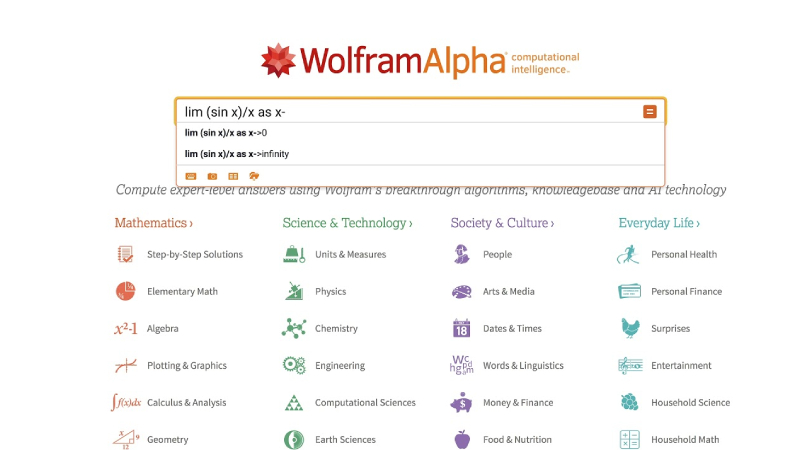
Wolfram is a fantastic community and site that has been around for some time now.
Referred to as a computational knowledge form of engine this one has a clever knack where it will calculate any available data and details to provide a tailored answer to your search.
It’s great for academic use as it has a feature where it can compute your answer in real-time and provide a referenced answer to a query.
Perhaps a little more on the niche side but well regarded and used within its area and very well designed and laid out.
Closing Thoughts
We hope you’ve found this small list helpful.
There’s a lot out there that can be of benefit to an SEO in a variety of ways. It’s good to think outside the box and be less reliant on Google!
As you can see these other search engines generally fall into two main categories.
You’ve got a general search engine that is similar to Google but used more by a certain demographic. DuckDuckGo is an example of this where the more tech-savvy and privacy-oriented have flocked towards it (put intentionally). That gives a good opportunity for targeted work.
Alternatively, you’ve got engines like CCS and Wolfram that are great for your own resource and research-gathering efforts. These ones can help arm you further for your future work.
There’s a lot out there and as the Google goliath rumbles on and dissent over privacy and metadata continues to be discussed the odds are high that users will look elsewhere.
Be sure to keep a finger on that pulse and you’ll be sure to do well.
Frequently Asked Questions
Q: What is this guide about?
This comprehensive guide provides strategies and best practices for achieving success. Following these approaches can help improve your results and competitive advantage.
Q: How long does it take to see results?
Results vary. Most strategies require 3-6 months before significant improvements. Ongoing optimization and consistency are essential for sustainable success.
Q: Do I need professional help?
While basic implementation can be done independently, professional guidance often accelerates results and helps avoid costly mistakes.
Q: What are the most important factors for success?
Key factors include thorough research, consistent execution, quality over quantity, regular performance monitoring, and adapting to industry changes.
Q: How do I measure success?
Track KPIs like traffic, conversions, revenue, and engagement rates. Regular analysis helps identify areas for improvement.
Q: What channels should I focus on?
Most businesses benefit from SEO, content marketing, social media, and paid advertising. Start where your target audience is most active.
The Evolution of Digital Marketing Strategy
Digital marketing has transformed dramatically over the past decade, evolving from simple banner advertisements to sophisticated, data-driven strategies that leverage artificial intelligence and machine learning. Understanding this evolution provides context for developing effective modern marketing strategies that resonate with today’s consumers.
Modern digital marketing requires integrated approaches combining multiple channels into cohesive customer experiences. The most successful businesses recognize that consumers interact with brands through complex journeys spanning multiple devices and platforms.
Content Marketing Best Practices
Content remains the foundation of successful digital marketing, serving as the primary mechanism for attracting organic traffic, building brand authority, and engaging target audiences. Effective content addresses specific search queries while providing genuine value to readers through comprehensive answers and actionable insights.
Data-Driven Marketing Decisions
Modern marketing success depends on sophisticated analytics enabling data-driven decisions. Understanding which metrics connect to business outcomes allows continuous optimization and improved return on investment through testing and iterative improvement.
Building Brand Authority
Establishing thought leadership provides significant competitive advantages including increased brand awareness and customer trust. Effective thought leadership addresses emerging trends, challenges conventional wisdom, and provides actionable guidance.
Maximizing Marketing ROI
Proving marketing ROI requires clear objectives, sophisticated tracking, and continuous optimization. The most successful marketing organizations treat marketing as an investment delivering measurable returns through continuous testing.
Learn More: Home
E-Commerce SEO in 2025: The Compound Effect of Technical and Content Excellence
E-commerce SEO is uniquely complex because you’re optimizing for three simultaneous goals: crawlability across potentially millions of URLs, keyword targeting across product/category hierarchies, and conversion optimization that turns traffic into revenue. A strategy that ignores any of these three pillars will underperform.
The brands dominating e-commerce SERPs in 2025 share common characteristics: exceptional site speed (Core Web Vitals in the top 25% of their niche), thorough category page optimization, and content programs that address the full purchase journey — not just bottom-funnel product keywords.
Category Page Optimization: The Highest-ROI E-Commerce SEO Activity
Category pages are the workhorses of e-commerce SEO. They typically target higher-volume, shorter-tail keywords and drive more organic revenue than any other page type. Yet most e-commerce sites have dangerously thin category pages — just a grid of products with a boilerplate H1.
A fully optimized category page includes:
- Opening editorial content (200-400 words): Above-the-fold text that establishes context for both users and search engines. Include the primary keyword naturally in the first paragraph, mention key buying considerations, and link to relevant subcategories or buying guides.
- Faceted navigation managed correctly: Faceted filters (size, color, price) can generate thousands of near-duplicate URLs. Use canonical tags to point filter variants to the canonical category URL, or use noindex for faceted pages without search volume.
- Bottom-page editorial content: After the product grid, include 300-500 words addressing common questions about the category, buying considerations, and internal links to related categories. This content doesn’t interfere with the shopping experience while providing keyword and topical depth.
- Schema markup: ItemList schema on category pages helps search engines understand the product inventory. Include product names, URLs, and ideally price ranges.
Product Page SEO: Converting Rankings Into Revenue
Product pages need to satisfy both ranking requirements and conversion requirements simultaneously. The optimization checklist:
- Unique product descriptions: Never use manufacturer descriptions verbatim. Duplicate content across multiple retailers using the same manufacturer copy is a systemic issue that holds back e-commerce rankings. Write unique descriptions that emphasize use cases, benefits, and specific differentiators.
- Product schema with reviews: Product schema with AggregateRating is one of the most impactful schema implementations in e-commerce — it triggers star ratings in search results, improving CTR by an average of 35%.
- Image optimization: Every product image needs descriptive alt text, compressed file sizes (WebP format, under 100KB for most product images), and ideally, multiple images showing different angles and use cases.
- User-generated content: Reviews, Q&As, and customer photos add unique content to product pages that can’t be duplicated by competitors, and directly improve conversion rates. BrightLocal data shows 87% of consumers read reviews before purchasing.
The Content Funnel: Capturing Research-Phase Traffic
The majority of purchase journeys start with informational searches: “best [product type] for [use case]”, “how to choose [product]”, “[product type] vs [product type]”. E-commerce sites that only target transactional keywords miss the opportunity to capture customers at the research phase and guide them toward purchase.
Build a content hub strategy: for each major product category, publish 3-5 supporting content pieces (buying guides, comparison articles, how-to content, expert roundups). Link these to relevant category and product pages. This creates topical authority signals that lift rankings across your entire product catalog, not just the pages with individual link equity.

Email Marketing in the AI Age: Open Rates, Personalization, Automation
The complete guide to email marketing AI personalization in 2026. Open rates, predictive automation, platform…
Read More →
Google Ads in 2026: The Complete Strategy Guide for Maximum ROI
Google Ads in 2026 is a fundamentally different platform than it was three years ago…
Read More →
Social Media Strategy That Actually Drives Revenue: The 2026 Framework
Table of Contents Toggle Table of Contents The Revenue-First Mindset Stop Optimizing for Engagement Map…
Read More →
Title Tag Optimizer
✏️ Table of Contents Toggle Title Tag Optimizer Optimization Checks How to Write SEO-Optimized Title…
Read More →
Structured Data Tester
🏗️ Table of Contents Toggle Structured Data Tester 📋 JSON-LD Input ✅ Validation Results 🔍…
Read More →-
 By Guy Sheetrit
- Feb 16, 2018
 By Guy Sheetrit