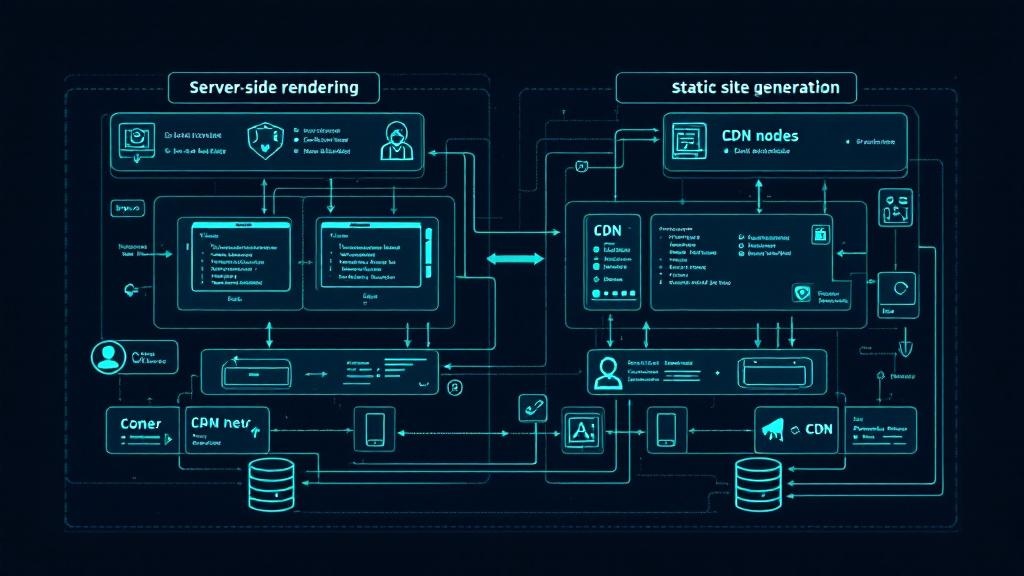
The rendering architecture you choose for your web application is no longer just a developer decision—it’s a strategic SEO decision with direct revenue implications. As AI-powered search reshapes how content gets discovered, indexed, and cited, the question of whether to use Server-Side Rendering (SSR) or Static Site Generation (SSG) has become one of the most consequential technical choices a growth-focused company can make in 2026.
We’ve audited the technical SEO performance of hundreds of websites across both architectures over the past two years. The short answer is that neither SSR nor SSG wins universally—but the factors that determine which architecture wins for your specific use case have changed significantly as Core Web Vitals have matured, Google’s crawl infrastructure has evolved, and AI search has added new performance dimensions that didn’t exist when most of these architectural debates were first codified.
This guide breaks down exactly where each approach wins, where it loses, and how to make the decision based on your actual content model and business requirements rather than framework evangelism.
How Each Architecture Actually Works
Before we get into SEO implications, let’s establish precise definitions—because the marketing language around these terms has become blurry in ways that matter for technical SEO.
Server-Side Rendering: The Mechanics
With SSR, each page request triggers server-side computation. The server receives the request, pulls data from databases or APIs, renders the HTML, and delivers a complete document to the browser. The rendered HTML exists only for that request—the next request triggers the process again.
Modern SSR frameworks like Next.js (with server components), Nuxt 3, and SvelteKit implement SSR with significant optimizations: streaming HTML delivery, partial hydration, and edge rendering that moves computation geographically closer to users. These aren’t your grandfather’s LAMP stack SSR solutions—they’re sophisticated systems that address many traditional SSR performance weaknesses.
Static Site Generation: The Mechanics
SSG pre-renders all pages at build time. When a user requests a page, they’re served a pre-built HTML file from a CDN edge node—no server computation required. The page was rendered once, during the build process, and those rendered files are distributed globally.
Modern SSG implementations like Next.js with static export, Gatsby, Eleventy, and Astro (in static mode) support Incremental Static Regeneration (ISR), which allows individual pages to be re-rendered on a schedule or triggered by content updates without rebuilding the entire site. This bridges much of the gap between SSG’s performance advantages and SSR’s freshness advantages.
The Hybrid Reality
In 2026, the choice is rarely purely one or the other. Most modern frameworks support page-level decisions about rendering strategy. Next.js allows you to use server components for dynamic pages, static generation for content pages, and edge rendering for personalized pages—all within a single application. Understanding SSR vs. SSG as a site-wide binary decision is outdated; the real decision is which strategy to apply to which pages based on their specific requirements.
Core Web Vitals: Where Each Architecture Stands
Core Web Vitals remain the primary SEO performance framework in 2026, with Interaction to Next Paint (INP) having fully replaced First Input Delay. Here’s how each architecture performs across the current CWV suite.
Largest Contentful Paint (LCP)
Static generation has a structural advantage for LCP. When a pre-built HTML file is served from a CDN edge node 20ms from the user, LCP times in the 1.0-1.5s range are routinely achievable for content-heavy pages. SSR adds server processing time before the first byte is delivered, which creates an unavoidable LCP floor that doesn’t exist with static files.
However, modern SSR with edge rendering narrows this gap considerably. Running SSR on edge infrastructure (Vercel Edge, Cloudflare Workers, AWS Lambda@Edge) cuts the server processing penalty to 50-150ms, which for pages with large LCP elements like hero images, the network time to load that image matters far more than the HTML delivery delta.
For pages where LCP is a hero image above the fold: SSG wins by 100-300ms typically. For pages where LCP is text-heavy content: the gap shrinks to 50-100ms with edge SSR.
Cumulative Layout Shift (CLS)
Both architectures can achieve excellent CLS with proper implementation. The risk factor differs: SSR pages that render content requiring client-side hydration can experience layout shifts if the hydration process causes DOM changes. SSG pages served with all content pre-rendered are less vulnerable but still susceptible to layout shifts from client-loaded resources (ads, embeds, dynamically sized images).
Interaction to Next Paint (INP)
INP is where client-side JavaScript architecture matters far more than server rendering strategy. Both SSR and SSG pages can have poor INP if they load excessive JavaScript that blocks the main thread. The rendering architecture determines how the initial HTML is delivered—INP is determined by what happens after that HTML loads.
Crawl Budget and Indexation: The Often-Overlooked Dimension
For large sites (100K+ pages), crawl budget management may be the most important SEO dimension of the SSR vs. SSG decision—and it strongly favors static generation.
How Static Generation Improves Crawl Efficiency
Pre-rendered static pages can be served from a CDN in milliseconds. When Googlebot crawls a static site, each page request is fulfilled almost instantly, allowing the crawler to process more pages per crawl session without hitting server resource limits. For sites with millions of pages, this can mean the difference between complete indexation and chronic under-indexation.
SSR pages require server computation for each Googlebot request, which means each crawl request consumes more server resources. Sites that don’t properly manage SSR server capacity can find that Googlebot’s crawl rate is throttled by the server’s response times, effectively penalizing their crawl budget.
Cache Headers and Crawl Strategy
Static files with long cache headers (cache-control: max-age=31536000, immutable) can be cached at CDN edge nodes globally, which means Googlebot hitting any of Google’s distributed crawl infrastructure gets a cached, fast response. SSR pages require careful cache-control implementation to achieve similar benefits—and dynamic personalized SSR pages may not be cacheable at all, creating crawl efficiency issues.
AI Search Rendering Requirements: The 2026 Factor
Generative AI search systems have introduced new rendering requirements that weren’t part of the SSR vs. SSG conversation when these debates were first established. AI crawlers—Anthropic’s ClaudeBot, OpenAI’s GPTBot, Perplexity’s PerplexityBot, and Google’s AI content crawlers—have different rendering capabilities and priorities than traditional search crawlers.
AI Crawlers and JavaScript Rendering
AI training and retrieval crawlers vary significantly in their JavaScript execution capabilities. Some AI crawlers don’t execute JavaScript at all, meaning client-side rendered content may be invisible to them. Static pages with pre-rendered HTML are universally accessible to all crawlers regardless of JavaScript capabilities—a significant advantage for GEO (Generative Engine Optimization).
SSR pages that deliver complete HTML without requiring client-side JavaScript execution are equally accessible. The risk is in hybrid implementations where critical content is loaded via client-side JavaScript after initial render—that content may not be indexed by AI systems with limited JS capabilities.
Content Completeness and AI Comprehension
AI systems building knowledge representations of your content benefit from receiving complete, structured HTML documents. SSG delivers this by default. SSR should deliver the same, but implementations that rely heavily on client-side data fetching may deliver incomplete documents to AI crawlers that don’t wait for client-side JavaScript to complete.
We’ve seen this cause measurable differences in AI citation rates. Sites with complete server-rendered HTML consistently see higher citation frequency in AI search responses than sites where content is partially loaded via client-side JavaScript, even when the final rendered output is identical in a browser.
Dynamic Content Requirements: Where SSR Has Genuine Advantages
SSG’s performance advantages are real, but they’re not universally applicable. There are specific content patterns where SSR is genuinely the right choice.
User-Specific Content
Any content that changes based on user identity—account dashboards, personalized recommendations, user-specific pricing, authentication-gated content—can’t be statically generated at build time. SSR is the correct architecture for these pages. The SEO implication is usually minimal for this content type since personalized pages typically shouldn’t be indexed anyway.
Real-Time Data Requirements
News sites, financial data platforms, sports scores, live event coverage—content that must reflect the current moment rather than build-time state genuinely requires SSR (or client-side fetching after static delivery). Modern ISR can handle content that needs to update on a schedule (every 60 seconds, every 5 minutes), but true real-time requirements need SSR.
Large Catalogs with Frequent Updates
E-commerce sites with hundreds of thousands of SKUs that update pricing, inventory, and availability constantly face a genuine SSG scalability problem. Build times that require 2+ hours to regenerate the entire catalog make ISR essential—but for catalog pages where prices change every hour, even ISR may not be sufficient, pushing toward SSR for those specific page types.
The Hybrid Architecture Playbook
Given that both architectures have genuine strengths, the optimal approach for most large sites in 2026 is a deliberate hybrid that routes different page types to the appropriate rendering strategy.
Page Type Classification Framework
Classify your pages into four categories:
- Evergreen content pages (blog posts, guides, product descriptions, location pages): Static generation with ISR for updates. These get maximum CDN performance and full AI crawler accessibility.
- High-traffic dynamic pages (category pages, search results, filtered views): Server-side rendering with aggressive CDN caching using cache tags for targeted invalidation.
- Real-time pages (live pricing, inventory, news feeds): SSR with short cache TTLs or no caching, accepting the performance trade-off for data freshness.
- User-specific pages (dashboards, account pages): Client-side rendering after authentication, no indexation expected or desired.
Technical Implementation Patterns
In Next.js App Router (the current standard), this maps to:
- Evergreen pages:
generateStaticParams+revalidate: 86400 - Dynamic content: Server Components with
cache: 'no-store'and CDN cache layer - Real-time:
revalidate: 0on server components or client-side fetching
For more on implementing this architecture across your technical stack, see our technical SEO services and full-service SEO offerings.
Migration Considerations: Moving Between Architectures
If you’re currently on a purely client-side rendered (CSR) architecture—a common scenario with older React SPAs—migrating toward SSR or SSG will produce significant SEO improvements. The migration path matters for minimizing disruption.
CSR to SSG Migration
Migrating a CSR application to SSG typically involves: identifying all routes that need static generation, ensuring data fetching can happen at build time, implementing ISR for content that updates, and managing the build pipeline for large sites. The SEO payoff is usually seen within 2-4 weeks of successful migration as crawl coverage improves and Core Web Vitals scores rise.
SSR Performance Optimization Before SSG Migration
If you’re on SSR but concerned about performance gaps relative to SSG competitors, optimize SSR before considering migration. Edge deployment, aggressive CDN caching, and streaming HTML delivery can close most of the gap while avoiding the complexity of a full architectural migration.
Measuring the Right Things
Whichever architecture you’re running or migrating to, the metrics that actually matter for SEO outcomes are measurable. Track these specifically:
- Time to First Byte (TTFB) by page type: The raw server response time before any browser rendering. Should be under 200ms for static, under 500ms for edge SSR.
- Crawl coverage: Percentage of URLs in your sitemap that have been crawled and indexed within 30 days of publication.
- LCP by rendering strategy: Compare LCP across your static vs. SSR pages to validate that your architecture is delivering expected performance.
- AI citation rate: Track which pages are being cited in AI search responses—this increasingly correlates with content completeness in rendered HTML.
For technical implementation guidance on tracking these metrics, see our SEO audit services.
Frequently Asked Questions
Is SSR or SSG better for SEO in 2026?
Neither is universally better—the optimal choice depends on your content model. Static generation (SSG) wins on performance, crawl efficiency, and AI crawler accessibility for evergreen content. Server-side rendering (SSR) is necessary for real-time data, user-specific content, and large catalogs with frequent updates. Most enterprise sites benefit from a hybrid approach that applies each strategy to the appropriate page types.
Does Google have trouble crawling SSR pages?
Google’s crawler (Googlebot) can render JavaScript and handle SSR pages, but SSR pages that require significant server processing time can consume crawl budget less efficiently than static pages. For large sites with millions of pages, this can lead to chronic under-indexation. Properly implemented SSR with edge rendering and appropriate cache headers minimizes this issue, but SSG has a structural crawl efficiency advantage for very large sites.
How do AI search crawlers handle SSR vs. SSG pages?
AI training and retrieval crawlers vary in their JavaScript rendering capabilities—some execute JavaScript fully, others don’t execute it at all. Both SSR and SSG pages that deliver complete HTML without requiring client-side JavaScript are accessible to all AI crawlers. SSG has an advantage because pre-rendered static HTML is universally accessible by definition. SSR pages are equally accessible if they deliver complete server-rendered HTML, but hybrid implementations relying on client-side data fetching may serve incomplete documents to AI crawlers with limited JavaScript capabilities.
What is Incremental Static Regeneration (ISR) and when should I use it?
Incremental Static Regeneration (ISR) allows you to update statically generated pages without rebuilding your entire site. Individual pages are regenerated either on a time-based schedule (e.g., every hour) or triggered by content updates via webhooks. ISR is ideal for content that needs to stay relatively fresh but doesn’t require real-time data—blog posts, product pages with periodic price updates, news articles after initial publication. It gives you most of SSG’s performance benefits while solving the staleness problem for frequently-updated content.
Should I migrate from client-side rendering to SSR or SSG for SEO?
Yes, if you’re running a client-side rendered (CSR) application where content is only rendered in the browser via JavaScript, migrating to SSR or SSG will almost certainly produce significant SEO improvements. CSR applications suffer from crawlability issues with many AI crawlers and less efficient Google indexation. The migration path—whether toward SSR or SSG—depends on your content model. Static content sites should target SSG; dynamic applications with real-time requirements should target SSR with appropriate CDN caching.
-
 By Guy Sheetrit
- Aug 23, 2026
 By Guy Sheetrit


