We all know that YouTube is a giant of the internet. It’s the second largest search engine out there right after Google and is responsible for over ninety billion page views every single month! Madness. It’s also a key player in driving traffic to other websites. It’s easy to see why you’d want a piece of the pie in such a case. For a deeper dive, explore our guide on Voice Search SEO.
The fact is that there are many nuances to YouTube and how you upload your content. As it’s a closed system these white hat techniques are helpful and perfectly benign – that doesn’t mean they are ineffective though. Quite the opposite.
It’s a common case that people will upload their videos to YouTube and not get views as they feel they should. This all comes down to search. YouTube videos are no different from pages in that they need to be optimized to reach the maximum amount of people.
We’ll assume your content is on point and of good quality to warrant a high view count and subscriber rate. Instead of worrying about the video content, we’. Ll go over five simple youtube seo tips you can’t afford to miss to get to the top of the youtube ladder in your chosen niche. For a deeper dive, explore our guide on Five Resources Learn SEO.
emerging trends and future outlook
the marketing landscape continues evolving rapidly. Understanding emerging trends positions you for future success.
Technology Trends
Watch these technological developments:
- AI advancement: Machine learning enables more sophisticated personalization and automation
- Voice interfaces: Growing adoption changes search behavior and content consumption
- Privacy evolution: Regulatory changes reshape data collection and targeting
- Immersive experiences: AR/VR creates new engagement opportunities
Consumer Behavior Shifts
Adapt to changing consumer expectations:
- Increased demand for authenticity and transparency
- Higher expectations for personalized experiences
- Greater emphasis on values and sustainability
- Changed information consumption patterns
Success Stories and Lessons Learned
Learning from successful implementations provides valuable insights for your own strategy.
Common Success Patterns
Successful implementations typically share these characteristics:
- Clear objectives: Well-defined goals aligned with business outcomes
- Data-driven approach: Decisions based on evidence rather than assumptions
- Consistent execution: Sustained effort over time
- Continuous optimization: Regular testing and improvement
Implementation Lessons
Key learnings from successful campaigns:
- Start with strategy before tactics
- Focus on quality over quantity
- Build sustainable systems, not依赖 quick wins
- Measure what matters to the business
Use These YouTube SEO Tips to Make Your Videos Searchable
Before we get started on these tips it’. S worth noting that youtube has its algorithm separate from google, which it uses to rank videos.
You can buy YouTube traffic but this alone isn’t enough to be sure that you will have a good organic ranking.
View time is a big part of your ranking on YouTube If someone starts watching. Quits out in a few seconds you are looking at a negative impact on your ratings.
Critically, the one-minute point is a desirable metric. Most YouTube videos now are designed around this to both bring in revenue and increase their rankings in one fell swoop.
Thumbnails play a part in this and are down to you – we’. Ll instead go over techniques that have more to do with good old keywords.
So let’s get started.
1. The Title

The big one. Your title is a critical part of your SEO strategy for YouTube You need to of course have a title that is attention-grabbing, succinct, and informative.
Your title needs to be friendly to a wide range of viewers and easily understood. It’s best to avoid overly technical language as a result unless your video is specifically referring to a product or the like. Will be specifically searched for.
A key tip is to take full advantage of the fact that YouTube auto-suggests as you fill in the search field. You can use this to fill in a few words along the lines of what your video is regarding to see what people are going for.
READ MORE: Engaging YouTube Title Generator Tool
2. The Description
Next on the table is the text body available to describe your video. This is a goldmine for SEO and links.
People will usually look at a video description on YouTube for further information mentioned in the video itself. Also for useful links to content and a brief run-down of the video without the need to view it fully.
The key here is that the first two to three lines are critical when it comes to ranking within the search engine.
You need to make sure that these first three sentences cover the full video content. It’s also a good opportunity to use keywords from your auto-complete work covered above. For a deeper dive, explore our guide on AI-generated content good SEO.
Important: if a keyword searched matches the first two lines of the description in your video you’ll get a higher ranking. Don’t miss out on that one.
It’s worth noting that while you need to maximize your SEO with the description it still needs to accurately reflect the content. Goals of the channel to increase organic ranking.
3. The File Name
The actual file name for your upload is, surprisingly, an important element to consider. You don’t want to make the mistake of uploading your video with the file name “movie001.mp4” or the like.
Make sure your video file names are in line with your keywords, as you will be using them in your descriptions and titles.
The reason for this is that the YouTube search engine can’t actually look at the video content itself. The algorithm will work off your video file name and will significantly contribute to the ranking and indexing you’ll receive.
This is a fantastic way to get your video on the way to listing, particularly as you can have an immediate boost. The video is tied up in processing.
Keep it in line with your keyword strategy and you’re good to go. Remember that it’s only you seeing this one but the benefit will impact your rankings.
4. Use the Closed Caption Feature
This feature as we all know is a text overlay, which can guide the viewer or point them toward different content. CC can be translated into various languages and can contain the actual text of what was being said in the video.
YouTube now has an algorithm that will convert any voice into a text transcript. It’s far from perfect and is often the butt of many a joke but it is there. With clear video content it can help your indexing.
The reason for this is again, down to keywords. It gives YouTube another way to index your video without having fully viewed the video file, which it can’t do just yet.
Working with this will help make sure that you are hitting those valuable keyword points wherever it’s possible. You can even use services such as captions for YouTube to help do this for you.
5. Tags and Researching Your Keywords
Finally, we come to the subject of tags. These again feed into the keyword strategy and help you hit that topic from all available angles.
There are a couple of brief tips to go over first.
Specific tags – you can use your keywords here first which will help you rank as YouTube’s algorithm sees fit.
General tags – You can put in a general. A matching keyword to help your video be picked up in related searches that don’t include your main keywords.
There’s a helpful tool called Tubebuddy that you can use to analyze. Tags are best to use with your video and its specific content. It’ll help show what your ranking for a keyword is as well. It’s a very powerful tool and could have a significant impact in guiding your keywords accurately.
With the above points in mind and the smart use of tools like Tubebuddy to guide you, you’. Ll find that your work will result in excellent serps. Keeping it consistent with guided and accurate keywords through hitting all these YouTube SEO Tips will give your videos a leg up over the competition without anyone having even clicked on your thumbnail. Great!
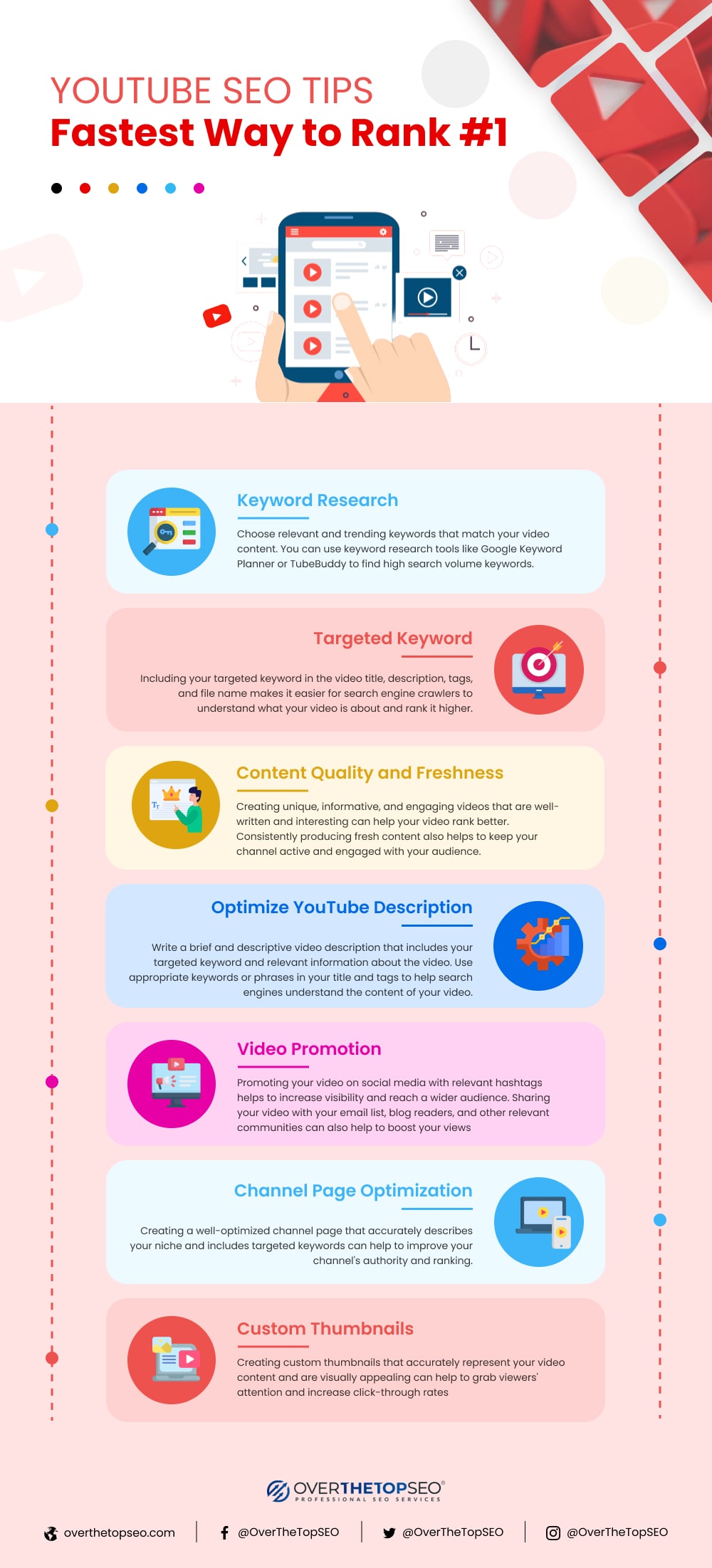
Infographic: Youtube SEO Tips – Fastest Way To Rank #1
For a deeper dive, explore our guide on SEO Nonprofits.
Frequently Asked Questions
Q: What is this guide about?
This comprehensive guide provides strategies and best practices for achieving success. Following these approaches can help improve your results and competitive advantage.
Q: How long does it take to see results?
Results vary. Most strategies require 3-6 months before significant improvements. Ongoing optimization and consistency are essential for sustainable success.
Q: Do I need professional help?
While basic implementation can be done independently, professional guidance often accelerates results and helps avoid costly mistakes.
Q: What are the most important factors for success?
Key factors include thorough research, consistent execution, quality over quantity, regular performance monitoring, and adapting to industry changes.
Q: How do I measure success?
Track KPIs like traffic, conversions, revenue, and engagement rates. Regular analysis helps identify areas for improvement.
Q: What channels should I focus on?
Most businesses benefit from SEO, content marketing, social media, and paid advertising. Start where your target audience is most active.
The Evolution of Digital Marketing Strategy
Digital marketing has transformed dramatically over the past decade, evolving from simple banner advertisements to sophisticated, data-driven strategies that leverage artificial intelligence and machine learning. Understanding this evolution provides context for developing effective modern marketing strategies that resonate with today’s consumers.
Modern digital marketing requires integrated approaches combining multiple channels into cohesive customer experiences. The most successful businesses recognize that consumers interact with brands through complex journeys spanning multiple devices and platforms.
Content Marketing Best Practices
Content remains the foundation of successful digital marketing, serving as the primary mechanism for attracting organic traffic, building brand authority, and engaging target audiences. Effective content addresses specific search queries while providing genuine value to readers through comprehensive answers and actionable insights.
Data-Driven Marketing Decisions
Modern marketing success depends on sophisticated analytics enabling data-driven decisions. Understanding which metrics connect to business outcomes allows continuous optimization and improved return on investment through testing and iterative improvement.
Building Brand Authority
Establishing thought leadership provides significant competitive advantages including increased brand awareness and customer trust. Effective thought leadership addresses emerging trends, challenges conventional wisdom, and provides actionable guidance.
Maximizing Marketing ROI
Proving marketing ROI requires clear objectives, sophisticated tracking, and continuous optimization. The most successful marketing organizations treat marketing as an investment delivering measurable returns through continuous testing.
Learn More: Home
Content Marketing Maturity: Moving From Output to Outcomes
Most content marketing programs plateau not because they run out of ideas, but because they confuse activity with results. Publishing 4 blog posts a week is not a strategy — it’s a production schedule. A mature content program is built around specific business outcomes: organic traffic to target buyer personas, conversion to leads, and acceleration of sales cycles.
The companies generating the highest content ROI in 2025 share one characteristic: they’. Ve narrowed their content focus to a tight set of topics where they can genuinely be the best resource on the internet, rather than trying to cover every trend in their industry.
The Topic Cluster Model: Building Topical Authority That Compounds
Google’s Helpful Content System and E-E-A-T framework both reward topical depth over breadth. The topic cluster model — popularized by HubSpot but now validated by years of SEO data — organizes content into pillar pages and supporting cluster pages:
- Pillar pages: Comprehensive, authoritative coverage of a broad topic (e.g., “The Complete Guide to Technical SEO”). Targets a high-volume, competitive keyword. Serves as the hub that links to all cluster content.
- Cluster pages: Deep dives into specific sub-topics (e.g., “How to Fix Crawl Errors”, “Core Web Vitals Optimization Guide”, “XML Sitemap Best Practices”). Each targets a more specific, lower-competition keyword while linking back to the pillar.
- Internal linking architecture: The consistent internal linking between pillar and clusters creates semantic signals that help Google understand the topical relationship between pages, lifting rankings across the entire cluster.
Sites that switch from random blog publishing to structured topic clusters typically see 30-50% improvement in organic traffic within 6 months, primarily driven by previously orphaned content beginning to rank because it’. S now embedded in a coherent topical structure.
Content Quality Signals Google Measures in 2025
Following the August 2023 and March 2024 core algorithm updates, Google has significantly improved its ability to assess content quality beyond simple E-A-T signals. Current quality indicators that influence rankings:
- Originality: Does the content provide information, perspective, or analysis that can’t be found verbatim elsewhere? This doesn’t require primary research on every post — but it does require a point of view, real examples, or synthesis that adds value beyond what’s already ranking.
- Demonstrated experience: The “first E” in E-E-A-T (Experience) is Google’s response to AI-generated content. Including personal experience, case studies, client examples, and outcome data signals real-world expertise in a way that AI-generated content cannot replicate.
- Depth-to-topic ratio: Content that covers 5 aspects of a topic in depth outperforms content that mentions 15 aspects superficially. Google’s helpful content documentation explicitly flags “breadth without depth” as a quality red flag.
- Update recency: Content that is regularly updated with current data, current examples, and current best practices maintains ranking longevity. Stale content — especially content with date-specific claims that become outdated — deteriorates in rankings over 12-18 months without updates.
Content Repurposing: Maximizing Return on Every Asset
The biggest efficiency gain in content marketing isn’t producing more — it’s extracting more value from what already exists. A single high-quality pillar piece can be repurposed into:
- A LinkedIn article or carousel post series
- A YouTube explainer video with the article as the script
- A podcast episode or audio summary (great for commuter audiences)
- An email newsletter sequence broken into 3-5 parts
- A downloadable checklist or one-pager for lead generation
- Short-form social content (10-15 micro-posts pulling key insights)
- An updated, expanded version 12 months later targeting evolved search intent
Teams that systematically repurpose content report 3-5x the content output from the same production budget,. Actually improving quality because each piece benefits from the research invested in the original.

Is AI-generated content good for SEO in 2023?
Artificial intelligence is changing the way we create and consume content online. AI software can…
Read More →
A Complete Step-by-Step Guide to Google Algorithm Updates
Google algorithm updates are a regular occurrence. Google makes around 800 changes to its search…
Read More →
SEO for Nonprofits: Fueling Growth with Optimization in Management
There are various sorts of search engine optimization that address unique corporate needs, just like…
Read More →
How Zero Search Volume Keywords Can Boost Your Traffic?
When it comes to SEO, it is important to target keywords that have a high…
Read More →
Keyword Research: The Ultimate Guide By OverTheTopSEO
The core of SEO is keywords. No matter how hard you try, you won’. T…
Read More →-
 By Guy Sheetrit
- Aug 19, 2016
 By Guy Sheetrit


