If you have ever engaged in affiliate marketing, you may already be familiar with CPA marketing. But what exactly is it, and how can you use it to grow your brand? For a deeper dive, explore our guide on Online Gaming Marketing.
What Do You Mean by CPA Marketing?

CPA, also known as cost per action or cost per acquisition, is an affiliate marketing or advertising approach that entails paying your CPA partners a predetermined commission upon the completion of a transaction or other desired activity. CPA marketing can effectively produce results if the affiliates and audience are proper. CPA marketing may create leads and push conversions rather than just driving impressions and clicks, allowing organizations to grow.
Explore more in our digital marketing guide and social media marketing resources.
CPA marketing can increase the number of money affiliates can make through advertising. The majority of affiliate marketers collaborate with other businesses to diversify their content and CPA offers, allowing them to give their followers and website visitors options and a range of remedies for their various problems.
CPA marketing has basically three main categories :
Pay Per Action
The leads that affiliates have generated are compensated. Pay per action entails a series of tasks that a visitor must carry out or finish, like watching a video, completing a form, or registering for a free trial.
Pay Per Sale
Pay per sale, as the name suggests, occurs when you, the marketer, are compensated when a customer clicks on your affiliate link and makes a purchase on a partner website.
Recurring Payments
Your partner website would be able to pay you recurring commissions from the monthly subscription costs if you can consistently bring in new subscribers.
CPA Networks

CPA networks provide a conduit between publishers and advertising. They are the organizations that decide whether or not you are a reputable company that can deliver quality leads to them as part of cost-per-action campaigns.
CPA marketing frequently gets abused since the idea of generating money online without necessarily selling anything is so alluring. Joining CPA networks might be difficult due to their stringent standards and criteria. It’s not impossible, though. Being open and taking proactive steps to help you be accepted is crucial in this situation. For a deeper dive, explore our guide on Email Marketing Age.
The use of CPA networks is not limited to seasoned affiliate marketers. Additionally, they work well for beginners. And although joining one can be challenging, there are many advantages, such as:
- Low barrier to entry—affiliate marketers can start with little to no upfront investment
- Listings that you can filter according to your expertise or niche
- Relatively high payouts
- A wealth of CPA offers
3 Points for Affiliate Marketers Looking to Join a CPA Network
- Make a website
The greatest time to build a website is right now if you don’t already have one. Create a website that showcases your brand, your affiliate marketing expertise, and your experience. You can use WordPress, a free and user-friendly CMS platform. You can also use a professional to design and build your website.
- In your email, use your domain name
Creating an email with your domain name and the format “[email protected]” may also be something you want to think about. Free email addresses are simple to create and don’t provide proof that you actually own the website, therefore some CPA networks may immediately reject applications that use them.
- Begin with your neighborhood CPA networks.
It’s a smart idea to start applying to local or smaller CPA networks when you’re first starting out. Once you’ve had enough experience with CPA marketing, you can apply for the bigger and more well-known ones. Larger CPA networks frequently receive plenty of applications, which can make it challenging for you to be accepted.
Once you’ve been approved by a CPA network, you can begin looking through offers that correspond to your market. You can begin promoting the offers on your website once you’ve
CPA Niches
Focusing on a specialty is one of the best methods to increase organic traffic and identify yourself as a subject matter expert, whether you’re launching a blog or selling on Amazon.
Not all markets have the potential to be successful. You must identify a profitable niche as an affiliate marketer where you may succeed. The following are some of the top CPA marketing niches to take into account:
- Finance
- Mobile apps
- Jobs or Career
- Health
- Relationship
Since these are wide categories, you can decide to select more specific sub-niches to produce material that is more tailored to your audience.
CPA Marketing vs. Affiliate Marketing
One kind of affiliate marketing is CPA marketing.
In the former, you are compensated every time a lead is generated or an action is performed, even though a visitor isn’t always required to make a purchase through your affiliate network. Only after a visitor makes a purchase do you receive a commission in affiliate marketing.
What is the CPA Marketing Process?
We’ve already shown that cost-per-action (CPA) marketing works. You, the marketer, are free to decide whatever offers—cost-per-sale (CPS) or cost-per-lead (CPL) offers—you wish to promote.
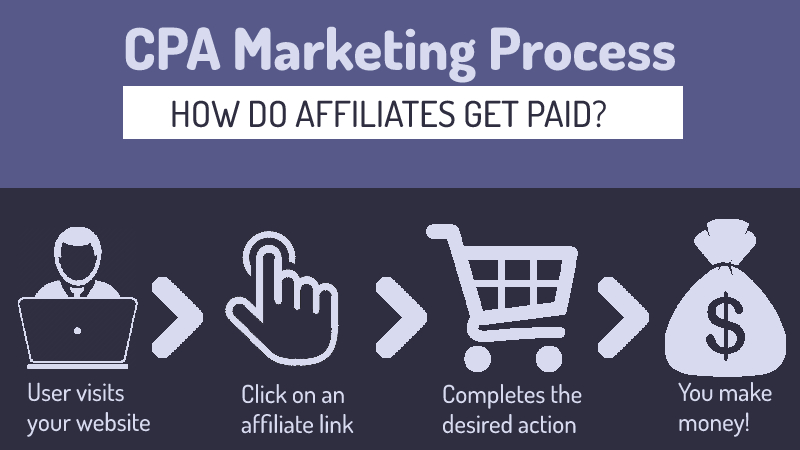
The procedure itself is rather simple:
- You register with a CPA affiliate network, where you can locate CPA offers from companies that provide goods or services.
- The next step is to choose whether you wish to promote a CPS or CPL offers.
- After that, construct a landing page to which traffic will be directed.
- Visitors will be taken to the original CPA offer page when they click the affiliate link on your landing page.
- Once a visitor completes a desired set of actions, such as making a purchase, signing up for a free trial, or filling out a form, the affiliate marketer will get paid.
The advantage of CPA Marketing
Through this article, we’ve noted the benefits of brands in CPA marketing –
- Fostering consumer-brand relationships and driving sales
- Increasing brand awareness
- Being a comparatively safe marketing technique
In addition to these advantages, CPA marketing also gives companies the following advantages:
- No upfront payment
It is not necessary to pay affiliate marketers upfront or for site views that do not result in conversions when using CPA marketing.
- Expanding your reach
Your audience may grow thanks to CPA marketing. You would effectively be putting your stuff in front of more people by collaborating with influencers. On social media, several influencers have already amassed sizable fan bases. This enables you to diversify your distribution, which can help your company grow more quickly.
- Ease of set up
Technically, CPA marketing simply needs a website and a CPA network. After you’ve created your website, you can sign up for a CPA network and start searching for offers in your specialized market.
- Potential to earn a higher ROI
It has a low entry barrier and is ultimately more cost-effective. You can concentrate on CPA marketing as opposed to digital ad campaigns for impressions or clicks, which may not always result in conversions.
A 58% increase in average customer income can be attained through affiliate marketing. Additionally, it can result in greater average order value and average order volume, which are 31% and 21% higher, respectively.
Frequently Asked Questions
Q: What is this guide about?
This comprehensive guide provides strategies and best practices for achieving success. Following these approaches can help improve your results and competitive advantage.
Q: How long does it take to see results?
Results vary. Most strategies require 3-6 months before significant improvements. Ongoing optimization and consistency are essential for sustainable success.
Q: Do I need professional help?
While basic implementation can be done independently, professional guidance often accelerates results and helps avoid costly mistakes.
Q: What are the most important factors for success?
Key factors include thorough research, consistent execution, quality over quantity, regular performance monitoring, and adapting to industry changes.
Q: How do I measure success?
Track KPIs like traffic, conversions, revenue, and engagement rates. Regular analysis helps identify areas for improvement.
Q: What channels should I focus on?
Most businesses benefit from SEO, content marketing, social media, and paid advertising. Start where your target audience is most active.
For a deeper dive, explore our guide on Casino Marketing 101.
The Evolution of Digital Marketing Strategy
Digital marketing has transformed dramatically over the past decade, evolving from simple banner advertisements to sophisticated, data-driven strategies that leverage artificial intelligence and machine learning. Understanding this evolution provides context for developing effective modern marketing strategies that resonate with today’s consumers.
Modern digital marketing requires integrated approaches combining multiple channels into cohesive customer experiences. The most successful businesses recognize that consumers interact with brands through complex journeys spanning multiple devices and platforms.
Content Marketing Best Practices
Content remains the foundation of successful digital marketing, serving as the primary mechanism for attracting organic traffic, building brand authority, and engaging target audiences. Effective content addresses specific search queries while providing genuine value to readers through comprehensive answers and actionable insights.
Data-Driven Marketing Decisions
Modern marketing success depends on sophisticated analytics enabling data-driven decisions. Understanding which metrics connect to business outcomes allows continuous optimization and improved return on investment through testing and iterative improvement. For a deeper dive, explore our guide on Proven Marketing Carpet Cleaning.
Building Brand Authority
Establishing thought leadership provides significant competitive advantages including increased brand awareness and customer trust. Effective thought leadership addresses emerging trends, challenges conventional wisdom, and provides actionable guidance.
Maximizing Marketing ROI
Proving marketing ROI requires clear objectives, sophisticated tracking, and continuous optimization. The most successful marketing organizations treat marketing as an investment delivering measurable returns through continuous testing.
Learn More: Home
Social Media’s Evolving Role in the SEO Ecosystem
The relationship between social media and SEO is more nuanced than either “social signals don’t matter” or “more shares = higher rankings.” Google has confirmed they don’t directly use social signals (likes, shares, followers) as ranking factors. However, social media indirectly powers SEO in ways that matter enormously:
- Content distribution: Social amplification gets content in front of journalists, bloggers, and researchers who may cite or link to it. The content doesn’t rank because it’s shared; it earns links because the shares put it in front of linkers.
- Brand search volume: Active social presence increases branded searches — people who see your content on social then search for your brand. Google treats rising branded search volume as a trust signal.
- Content indexing speed: Highly shared content gets crawled faster. For time-sensitive content, social promotion can mean the difference between ranking for a news cycle and missing it entirely.
Platform-Specific Strategies for 2025
Each major platform has distinct algorithmic priorities, content formats, and audience behaviors. Generic “post consistently” advice misses the platform-specific nuances that determine success:
- LinkedIn: The algorithm strongly favors native content — posts, articles, documents — over links to external sites. For B2B brands, LinkedIn is the highest-ROI social platform for organic reach. Text-based posts with personal insights from executives outperform promotional content by 3-5x. Video native to LinkedIn (not YouTube embeds) gets algorithmic priority.
- Instagram: Reels continue to dominate reach in 2025. Single-image posts have seen declining organic reach since 2022. Stories are critical for maintaining engagement with existing followers. The algorithm rewards accounts that use all format types (posts, Reels, Stories, Carousels) rather than specializing in one.
- TikTok: The interest graph (what you engage with) drives distribution, not just the social graph (who you follow). This means new accounts can achieve significant reach without existing followers — but content must hook viewers in the first 1-2 seconds. For SEO teams, TikTok’s search function is increasingly used by Gen Z for product research, making keyword optimization in captions more important than commonly recognized.
- X (Twitter): Despite audience fragmentation, X remains the primary platform for real-time industry discourse and journalist relationships. For link building and PR purposes, maintaining an active, expert-positioned X presence remains valuable even as consumer engagement shifts elsewhere.
Building a Social-to-SEO Content Pipeline
The most efficient teams treat social media as a content testing ground before full SEO investment. The workflow:
- Post short-form content exploring a topic angle (hook, core insight, opinion) as a social post
- Measure engagement: which angles generate comments, shares, and saves?
- Develop the highest-performing angles into full-length SEO content
- Promote the published content on social to accelerate link discovery
- Repurpose the long-form content back into a carousel, Reel, or short video
This flywheel approach means you’re never guessing what content will resonate — the social data tells you before you invest in the full SEO piece. Teams running this workflow consistently report 40-60% higher organic performance on content developed through social validation versus content created purely from keyword research.
Measuring Social ROI in an SEO Context
Attributing SEO value to social media requires moving beyond vanity metrics (likes, followers) to metrics that reflect real business impact:
- Referred links generated: Track how many external sites link to content after social promotion campaigns using Ahrefs or Moz link monitoring.
- Branded search lift: Measure branded search volume before and after major social campaigns using Google Search Console.
- Content indexing speed: Monitor how quickly new content is crawled by Google after social promotion versus without it.
- Dark social traffic: Significant social sharing happens in private messages, Slack, and email — traffic that shows as “direct” in analytics. Tools like Clearbit Reveal can help identify the actual source of unattributed traffic.

Email Marketing in the AI Age: Open Rates, Personalization, Automation
The complete guide to email marketing AI personalization in 2026. Open rates, predictive automation, platform…
Read More →
Google Ads in 2026: The Complete Strategy Guide for Maximum ROI
Google Ads in 2026 is a fundamentally different platform than it was three years ago…
Read More →
Social Media Strategy That Actually Drives Revenue: The 2026 Framework
Table of Contents Toggle Table of Contents The Revenue-First Mindset Stop Optimizing for Engagement Map…
Read More →
Title Tag Optimizer
✏️ Table of Contents Toggle Title Tag Optimizer Optimization Checks How to Write SEO-Optimized Title…
Read More →
Structured Data Tester
🏗️ Table of Contents Toggle Structured Data Tester 📋 JSON-LD Input ✅ Validation Results 🔍…
Read More →-
 By Guy Sheetrit
- Nov 17, 2022
 By Guy Sheetrit