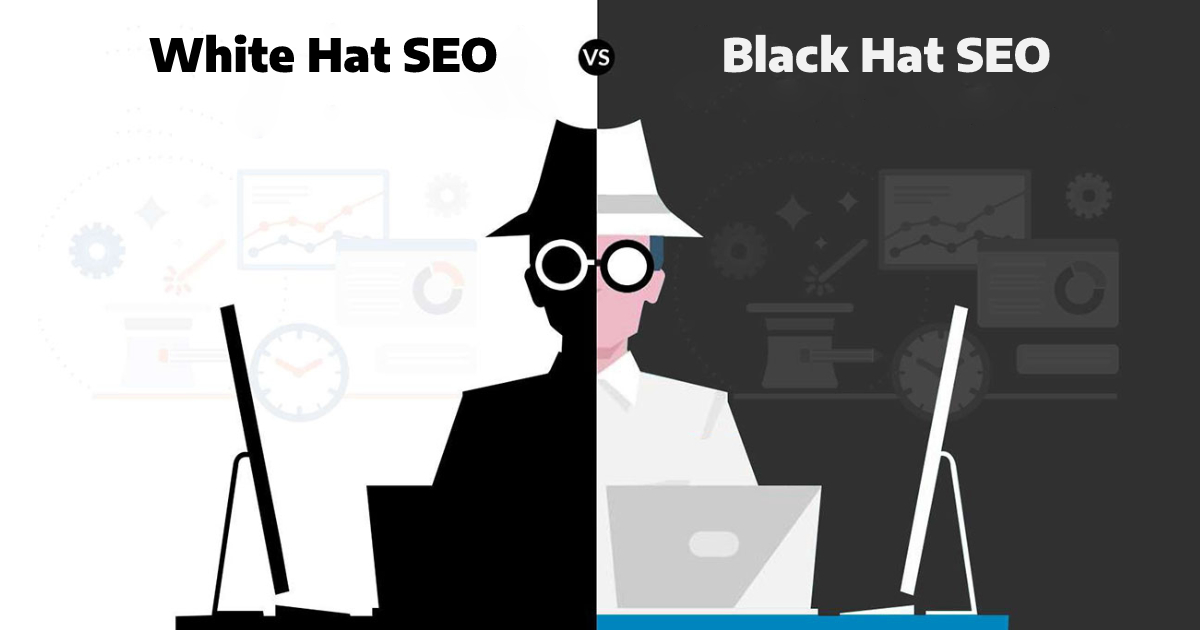
Like everything in life, there are two ways to get things done: the wholesome, honest way, and the wrong way, frowned upon by the majority. Concerning Search Engine Optimization (SEO), the same thing applies. That is exactly why the terms ‘White hat SEO‘ and ‘Black hat SEO‘ exist. SEO is the process by which websites obtain a better ranking in Search Engine Result Pages (SERP) and therefore, get more visitors. The real difference between Black Hat SEO and White Hat SEO is the ways to reach that goal. Now, which one gives you more benefits? Is there one best SEO technique for your business? What hat should you want to wear?
To see the bigger picture and decide what the best SEO practices are, we have to see how both methods work. Here’s a quick summary to help you understand them:
Black Hat SEO
These methods refer to any attempt to improve your website rankings in ways that are not approved by Search Engines; they all have their algorithms with which they evaluate the relevancy of a site, and it changes regularly. Although it is true that Black hat SEO techniques give you fast visible results, anything that goes against Search Engine regulations may be penalized, leaving you with negative results that are also hard and expensive to get rid of. Black hat SEO targets robots; they use their toolboxes to manipulate the system and make it believe the site in question is more relevant than it is. This strategy is the preferred one by people seeking quick results rather than lasting ones. These are some of the most popular Black Hat SEO practices:
Keyword Stuffing:
Meta keywords are the way users tell robots what content they want to look for online. Robots essentially collect information about the sites that make use of keywords related to user searches and make the top list of sites. The point is that these keywords help readers (and search engine robots) know what you intend to convey. Ideally, it would be a short list of words that appear a certain amount of times on a web page. However, Black Hat SEO practitioners bloat their websites with keywords so as to make Google believe the website has the information you´re looking for.
Although some used to get great results fast, Google Panda is not easily fooled by this black hat SEO technique. It is not only tedious for users that find themselves scrolling through a lot of nonsense or extremely superficial content with repetitive keyword use, but it can also get your site heavily penalized.
Link Farms:
We all know that a way to measure the level of trustworthiness of a site is to see how many people link to it. Link farms are a group of websites usually created by automated programs with the sole purpose of linking back to each other’s websites. This is a form of spamming the index of a search engine, also called spamdexing, that makes robots believe a site is trustworthy because it has the ‘approval’ of other web pages. Although it does have some influence on your web page’s ranking, it does not last for long and can incur harsh punishments.
Hidden Text:
It is also called invisible text or fake text, and it involves textual content visible to search engine robots but invisible to users. Made with white text on a white background and plagued with keywords, it fools search engines into believing the content is richer in keywords than it is. It used to be very popular among black hat SEO artists, but nowadays search engines have become smarter. They now can read this type of text and identify it as ‘search spam’. Very bad for your website.
Paid Links:
Just as it sounds, these are links you paid for to improve your link popularity and rankings. Although there are ways to exchange or trade links that are both viable and ethical, link buying is not only very costly but is also a time bomb. There are lots of people who offer to build thousands of backlinks to your website but end up spamming blogs and other pages. If a search engine catches you doing this, just as you imagine, you get penalized as well. Some have experimented with backlink buying and have reported on the disastrous results this can bring to your website. Do you want to risk the future of your business for short-term results?
White Hat SEO
White hat SEO strategies are much more ethical and Search Engine safer ways to reach the common goal of improving your website rankings. They abide by the updated Google guidelines to improve website SERP rankings in an ‘organic’ way. A distinctive mark that separates White hat SEO from Black Hat SEO is their target. White hat SEO focuses on the users that will be looking for products or services such as the ones your company offers, giving them friendlier ways to find your business’ site without tricking them. These web pages may not always appear in the first place on a search result page since the outcome usually takes longer than it would with Black hat SEO. However, the results obtained with White hat SEO practices are long-lasting and ethical.
Link Baiting:
This is a pretty important and challenging part of an SEO job. It is all about quality work and interesting topics, making other people WANT to link back to your website. People say ‘content is king and that is totally accurate. Engaging, quality content is more likely to attract visitors, and when one visitor tells a friend about how great your website is, it´s like getting free advertising. After all, you catch more flies with honey than with vinegar.
Guest Blogging:
By getting guest bloggers and posting on other people’s blogs, a sort of trade occurs that can get you more backlinks that significantly improve your website’s overall relevance (to search engine robots). This will certainly give you extra points for your SERP rankings. Different from link purchasing, there usually isn’t any money involved. Plus, it is an excellent way to spice things up on your site and have a new, fresh perspective.
Site Optimization:
To make your business stand out from the rest, you need to enhance your online presence, and this means that every little space of your site must be optimized. Your website must look good on desktops, tablets, and mobile devices so users can access it and really enjoy surfing through your content. It must also make good use of pictures and video content. A video is more likely to rank higher on a search engine. There are also other aspects, such as metadata, link architecture, and URL creation. The point is to make your site accessible to both users and crawlers by performing a few tweaks on your content or maybe even rearranging your entire web page. Any measure used to optimize your website makes it easier to find, and the easier it is to find, the more people will visit. Simple math, isn’t it?
Effective Keyword Research and Use:
It implies searching for relevant words that might come to mind when a user thinks of your business. Sounds a bit esoteric, but this is actually where SEO becomes a kind of art. When people perform a Google search, they normally would not use your brand name or your website´s URL. They use words that are related to whatever service or product they are looking for. SEO experts have a knack for finding what those words are and seamlessly integrating them into website content in order to increase the chances that a search engine finds it relevant and puts it on top of a search result.
As we have said before, after having a list with a certain quantity of keywords they must be perfectly placed, so they do not make the reader´s eyes bleed. Search robots now can tell when a site is using keywords indiscriminately, so it must be done in a way that feels natural. It is a tricky thing to do, but it is one of the best SEO practices ever.
Conclusion
It may be hard to tell one from the other for the uninitiated, but Black hat and White hat SEO are divergent practices altogether. Choosing one over the other will make a huge difference in the future of your business. It all comes down to what you intend to do in the long run. If your company is a one-time hit, you might want to consider Black hat SEO. But if you intend to keep your business up and running for a long time, White hat SEO practices are the right choice for you.
The best SEO practices are the ones you feel more comfortable with and the ones that go along best with your business needs. Choose wisely always consult your SEO company to see what the best SEO technique is right for your company. In the end, it must be your decision. So, what hat are you going to wear?
-
 By Marcel Casella
- Nov 26, 2015
 By Marcel Casella