Most e-commerce firms prioritize attracting new consumers, as they should, but failing to take care of your current clientele is a typical and expensive mistake. Marketing to your present customers allows you to reach potential customers who may have moved on while also drastically reducing your marketing expenses.
You may increase your sales and increase your revenue in e-commerce marketing by learning more about retention. This strategy is low-cost and highly rewarding. The best part is that these clients have already been located, are aware of your brand, and are much more likely to convert than newcomers. For a deeper dive, explore our guide on Boost Sales.
What is Customer Retention?
Customer loyalty, or an organization’s capacity to retain customers over time, is measured by a metric called customer retention. Consumer retention can represent or forecast customer satisfaction, repurchase behavior, customer involvement, and emotional links to a brand in addition to counting the number of devoted customers.
Customer retention numbers are tied to the first transaction made by a customer and include all future contacts, whereas customer relationships often start with an initial engagement.
Organizations can use this feedback after customer retention has been assessed to do data analysis on aspects of customer success and customer experience. As an illustration, if a decline in client retention is noted, a company can use this information to determine the fundamental cause and modify its product offers.
Because it costs significantly more to acquire new clients than it does to keep existing ones, customer retention is crucial. Additionally, returning consumers are more likely to participate in word-of-mouth advertising or serve as brand ambassadors.
Why is it crucial for firms to retain customers?
An organization risks losing out on recurring business if it does not prioritize customer retention and instead just concentrates on growing its client base. Although the procedure for acquiring new clients, also known as customer acquisition, is crucial, it is also far more expensive. Gaining new clients is crucial, but so is keeping existing ones and turning them into loyal patrons
3 Reasons to Focus on Retention Marketing
- Outstanding ROI:
Your ROI will be impacted favorably by the cheap cost and high success combo. Your company will still experience significant profits even if retention is only a small component of the entire e-commerce marketing strategy. Harvard Business Review claims that increasing your retention rate by just 5% can increase your profitability by at least 75%. This percentage can reach 95% for certain brands, yielding a large return on investment for your retention-focused initiatives and programs.
- Affordability:
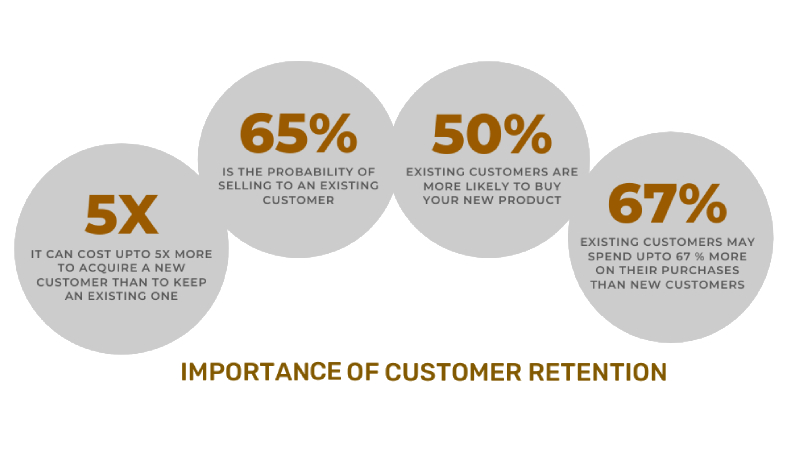
Your marketing expenses automatically decrease, sometimes significantly, when you sell to and satisfy an existing customer. According to OTT, selling to a repeat client can save you up to five times as much money as finding a new consumer who isn’t familiar with your e-commerce brand.
Programs to keep customers can also help you make more money overall by giving you more opportunities to sell without raising your prices.
- High success rates:
You can increase your overall conversion rates by focusing a portion of your e-commerce marketing strategy on returning consumers since they are more likely to make another purchase. Your current customers are five times more likely to make another purchase from you and seven times more inclined to try your newest product, according to OTT.
The market for new holiday launches, new product releases, and more is already created when you develop strong relationships with your previous consumers. It is much simpler to connect with and resell to prior consumers because they are already familiar with your brand and products.
Three Strategies for Customer Retention
How can you build a segment for your e-commerce marketing activities and benefit from client retention? maintaining contact with your clients. With exclusive benefits and activities reserved especially for them, you can show your customers how much you care about them. By rewarding your clients, you will increase their loyalty, which will be extremely beneficial to your brand.
- Let clients know you value them
Follow up with intention. Reconnecting with a customer to express gratitude for their patronage and check on their happiness will also help them feel valued. Several approaches to this include:
- A brief thank-you note on your social media accounts.
- Free shipping on their subsequent order to demonstrate your appreciation for their business.
- The handwritten message of gratitude is delivered with each order.
A customer’s decision to patronize a small business has an impact on the owners and employees of that company. Customers will return frequently when you remind them of how important they are to you because it is a far more personal engagement. The majority of customers will choose the brand that acknowledges and values their purchases over an anonymous large box store if that is their other choice. For a deeper dive, explore our guide on Bigcommerce Optimize Online Store.
- Engaging and Staying in Touch
You have two options: either simply execute the order and hope for the best, or make a concerted effort to interact with your clients after the sale. There are many tools available to you, and most of them are cheap and simple to use, like DataQ. Use social media or targeted email marketing to engage with customers and help them remember and connect with you. A quick follow-up email or message after an order has been filled might show your customer that you are interested in them. Additionally, focusing on their experience by asking for feedback without the salesy talk will build good sentiment. Without incurring significant expenses, regular touchpoints can strengthen your relationships.
- Offer Special Perks
If you’ve ever gotten an email advertising exclusive VIP discounts or a deal for current customers, you understand how alluring this kind of campaign is. Making repeat customers feel unique by providing an exclusive bonus for “insiders only” enhances the likelihood that they will make another purchase. Sales can be increased immediately and over time by targeting a group of returning customers and making them an exclusive offer.
Even while you should always look to expand your clientele, investing time in your current clientele has numerous benefits. You can benefit from the higher ROI and profitability that only repeat clients can offer for a comparatively small investment.
For a deeper dive, explore our guide on Basic eCommerce Metrics Every.
Understanding the Digital Marketing Landscape in 2024 and Beyond
The digital marketing ecosystem continues to evolve at an unprecedented pace, presenting both challenges and opportunities for businesses seeking to establish and expand their online presence. As consumer behaviors shift and new technologies emerge, understanding the current landscape becomes crucial for marketing success. This comprehensive exploration examines the key trends, strategies, and best practices that define effective digital marketing in today’s competitive environment.
Modern consumers expect seamless, personalized experiences across all digital touchpoints. They interact with brands through multiple channels—from search engines and social media platforms to email marketing and mobile applications. This multichannel reality demands integrated marketing approaches that deliver consistent messaging and user experiences regardless of where customers engage with your brand.
The convergence of artificial intelligence, machine learning, and automation has transformed how marketers approach audience targeting, content creation, and campaign optimization. These technologies enable unprecedented levels of personalization, allowing businesses to deliver highly relevant content to specific audience segments at optimal times throughout the customer journey.
The Critical Role of Search Engine Optimization in Business Growth
Search engine optimization remains one of the most powerful and cost-effective digital marketing strategies available to businesses of all sizes. Unlike paid advertising, which stops generating traffic once you stop paying, SEO builds lasting organic visibility that continues delivering results over time. A well-executed SEO strategy can generate consistent, high-quality traffic that converts at higher rates than many other channels.
Modern SEO extends far beyond keyword optimization and link building. Technical SEO ensures that search engines can efficiently crawl and index your website, while on-page optimization focuses on creating valuable, user-centric content that satisfies search intent. Off-page factors, including backlinks, social signals, and brand mentions, contribute to your site’s overall authority and credibility in the eyes of search engines.
The emergence of AI-powered search experiences has fundamentally changed how users find and consume information. Optimizing for these new search paradigms requires understanding entity relationships, topical authority, and the semantic connections between content. Businesses that adapt their SEO strategies to these changes position themselves for sustained visibility in evolving search environments.
Content Marketing: Building Brand Authority Through Valuable Resources
Content marketing has emerged as the cornerstone of effective digital marketing, providing the foundation upon which all other strategies depend. High-quality content attracts organic traffic, earns backlinks, engages audiences, and establishes your brand as an authority in your industry. The key to content marketing success lies in creating genuinely valuable resources that address your audience’s pain points, answer their questions, and help them achieve their goals.
Successful content strategies require deep understanding of your target audience’s needs, preferences, and search behaviors. This understanding enables creation of content that not only ranks well in search engines but also resonates with readers and encourages engagement. The best content combines SEO optimization with compelling storytelling, data-driven insights, and actionable takeaways.
Content distribution and promotion are equally important as content creation. Even the most valuable content fails to deliver results if your target audience cannot find it. Effective distribution strategies leverage social media, email marketing, influencer partnerships, and paid promotion to amplify content reach and maximize return on content investment.
Data-Driven Decision Making: Leveraging Analytics for Marketing Success
The abundance of digital marketing data provides unprecedented opportunities for optimization and improvement. However, transforming raw data into actionable insights requires sophisticated analytics capabilities and a data-driven decision-making culture. Understanding which metrics matter most and how they connect to business outcomes enables continuous optimization of marketing efforts.
Key performance indicators vary by business model and marketing objectives but typically include measures of reach, engagement, conversion, and return on investment. Advanced analytics approaches segment data by channel, audience, device, and other dimensions to identify patterns and opportunities that aggregate data might obscure.
Attribution modeling helps marketers understand how different touchpoints contribute to conversions and revenue. Multi-touch attribution models provide more accurate pictures of customer journeys than last-click attribution, enabling better allocation of marketing budgets across channels and campaigns. For a deeper dive, explore our guide on Pricing Psychology Improved Ecommerce.
Building Sustainable Competitive Advantage Through Digital Marketing
Long-term success in digital marketing requires building sustainable competitive advantages that are difficult for competitors to replicate. This involves developing proprietary content libraries, building engaged community followings, establishing thought leadership, and creating efficient marketing processes that compound over time.
Brand building in the digital age requires authentic storytelling, consistent quality delivery, and genuine connection with your audience. Companies that invest in building strong brands develop customer loyalty that transcends price competition and creates barriers to entry for competitors.
The most successful digital marketing strategies view marketing as a long-term investment rather than a short-term expense. Building authority, nurturing relationships, and creating valuable assets provide returns that continue growing over time, making marketing one of the most valuable investments a business can make.
Frequently Asked Questions
What makes digital marketing essential for modern business success?
Digital marketing provides unparalleled reach, targeting capabilities, and measurability compared to traditional marketing channels. It allows businesses of all sizes to compete for attention, generate leads, and build customer relationships at scale. With consumers spending increasingly more time online, establishing a strong digital presence is critical for reaching and engaging your target audience where they spend their time.
How long does it typically take to see results from digital marketing efforts?
Results timelines vary significantly by tactic and industry. Paid advertising can generate immediate traffic and leads, while search engine optimization and content marketing typically require 3-6 months before significant results materialize. Building sustainable organic visibility often takes 6-12 months of consistent effort. The key is maintaining patience while continuously optimizing based on performance data.
What is the difference between SEO and paid advertising, and which should I prioritize?
SEO focuses on earning organic visibility through content optimization, technical improvements, and authority building. It provides sustainable, long-term traffic but requires time to build momentum. Paid advertising delivers immediate visibility and qualified traffic but requires ongoing budget allocation. Most successful strategies integrate both approaches—using paid for immediate results while building organic presence for long-term sustainability.
How do you measure return on investment for digital marketing campaigns?
ROI measurement involves tracking conversions, calculating customer acquisition costs, and measuring lifetime customer value. Key metrics include cost per lead, conversion rates, revenue attributed to marketing activities, and return on ad spend. Regular analysis of these metrics helps optimize spending and improve overall marketing efficiency.
Why should I work with a professional digital marketing agency rather than handling marketing in-house?
Professional agencies bring specialized expertise, proven processes, and dedicated resources that are difficult to develop internally. They stay current with industry changes, have access to premium tools and technologies, and can scale efforts efficiently based on your business needs. The cost is often offset by faster results and better performance compared to the learning curves in-house teams typically face.
What role does content marketing play in digital marketing success?
Content marketing serves as the foundation for effective digital marketing, enabling organic traffic generation, brand authority building, and audience engagement. Quality content attracts backlinks, satisfies search intent, and provides value that keeps audiences returning. Without compelling content, other marketing tactics have limited effectiveness.
How important is mobile marketing in today’s digital landscape?
Mobile marketing is absolutely critical, with mobile devices accounting for the majority of digital interactions. Mobile-first design, fast loading times, and responsive experiences are no longer optional—they are requirements. Businesses that neglect mobile risk alienating the majority of their potential audience.
What are the most important metrics to track for digital marketing success?
Essential metrics include website traffic and sources, conversion rates, customer acquisition costs, lifetime value, engagement rates, and return on investment. The specific metrics that matter most depend on your business goals and model. Comprehensive tracking and analysis enable data-driven optimization that continuously improves marketing performance.
Conclusion: Investing in Digital Marketing for Long-Term Success
The digital marketing landscape offers unprecedented opportunities for businesses willing to invest in building their online presence. Success requires strategic approach, consistent effort, and willingness to adapt to changing technologies and consumer behaviors. By focusing on delivering genuine value to your audience and continuously optimizing based on data, your business can build sustainable competitive advantage through digital marketing.
Remember that digital marketing is not a one-time effort but an ongoing commitment to engaging your audience, building brand authority, and driving measurable business results. The businesses that succeed are those that treat marketing as a strategic investment rather than an expense, continuously optimizing and improving their efforts based on performance data and market feedback.
Whether you handle digital marketing internally or partner with a professional agency, the key is to start with clear objectives, measure results consistently, and maintain the patience required to build lasting success. The digital marketing landscape will continue evolving—businesses that stay adaptive and focused on delivering value will thrive in this dynamic environment.
The Evolution of Digital Marketing: From Traditional to Modern Approaches
Digital marketing has undergone a remarkable transformation over the past two decades, evolving from simple banner advertisements and email campaigns to sophisticated, data-driven strategies that leverage artificial intelligence and machine learning. Understanding this evolution provides valuable context for developing effective modern marketing strategies that resonate with today’s consumers.
The early days of digital marketing were characterized by interruptive advertising tactics that prioritized visibility over relevance. Companies spent significant budgets on display ads that reached broad audiences but delivered limited engagement. As consumer behavior shifted and technology advanced, marketers began recognizing the value of permission-based marketing and targeted approaches that delivered personalized messages to specific audience segments.
Today’s digital marketing landscape demands integrated approaches that combine multiple channels and tactics into cohesive customer experiences. The most successful businesses recognize that modern consumers interact with brands through complex, non-linear journeys that span multiple devices and platforms. Meeting customers where they are requires sophisticated targeting capabilities, real-time personalization, and seamless cross-channel experiences.
The integration of marketing technology has enabled unprecedented levels of automation and optimization, allowing marketers to deliver the right message to the right person at the right time. These capabilities have transformed marketing from an art to a science, enabling continuous improvement based on real-time performance data and predictive analytics.
Strategic Content Development for Search Engine Success
Content remains the foundation of successful digital marketing, serving as the primary mechanism for attracting organic traffic, building brand authority, and engaging target audiences. Developing a comprehensive content strategy requires understanding search intent, creating valuable resources, and optimizing for both search engines and human readers.
Effective content addresses specific search queries while providing genuine value to readers. This requires deep understanding of your audience’s needs, questions, and pain points. The best content answers questions comprehensively, provides actionable insights, and offers unique perspectives that readers cannot find elsewhere.
Content optimization extends beyond keyword placement to include structural elements, readability, and multimedia integration. Well-structured content with clear headings, bullet points, and visual elements performs better in search results while delivering superior user experiences. Mobile optimization is particularly critical as mobile traffic continues growing.
Content promotion and distribution are equally important as creation. Even excellent content delivers limited results if target audiences cannot discover it. Strategic distribution leverages social media, email marketing, influencer partnerships, and paid promotion to maximize content reach and impact.
Data Analytics and Performance Measurement Fundamentals
Modern marketing success depends heavily on sophisticated analytics capabilities that enable data-driven decision making. Understanding which metrics matter most and how they connect to business outcomes allows continuous optimization of marketing efforts and improved return on investment.
Essential marketing metrics include traffic volume and sources, engagement rates, conversion rates, customer acquisition costs, and lifetime value. Each metric provides insights into different aspects of marketing performance, and comprehensive analysis reveals the full picture of marketing effectiveness.
Attribution modeling helps marketers understand how different touchpoints contribute to conversions. Multi-touch attribution provides more accurate pictures of customer journeys than last-click attribution, enabling better allocation of marketing budgets across channels and campaigns.
Advanced analytics approaches segment data by multiple dimensions to identify patterns and opportunities that aggregate data might miss. Understanding audience segments, channel performance, and campaign effectiveness enables continuous optimization and improved results over time.
Building Brand Authority Through Thought Leadership
Establishing thought leadership in your industry provides significant competitive advantages, including increased brand awareness, customer trust, and organic visibility. Thought leadership requires consistent creation of valuable content that demonstrates expertise and unique insights.
Effective thought leadership content addresses emerging trends, challenges conventional wisdom, and provides actionable guidance that readers can apply to their own situations. This type of content positions your brand as an authority that audiences can trust for reliable information and guidance.
Building thought leadership requires sustained effort over time, with consistent publication of high-quality content that addresses relevant industry topics. The most successful thought leadership strategies identify unique perspectives and expertise areas that differentiate your brand from competitors.
Distribution amplifies thought leadership impact. Strategic promotion through social media, email marketing, industry publications, and speaking opportunities extends reach and builds recognition among target audiences.
Maximizing Return on Marketing Investment
Proving and maximizing marketing return on investment requires clear objectives, sophisticated tracking, and continuous optimization. The most successful marketing organizations treat marketing as an investment that must deliver measurable returns rather than an expense that cannot be quantified.
ROI calculation requires understanding customer lifetime value, acquisition costs, and the contribution of marketing activities to revenue generation. These calculations enable informed budget allocation decisions and help identify the most effective marketing tactics for your specific business.
Continuous testing and optimization improve marketing performance over time. A/B testing, multivariate testing, and iterative improvement processes enable identification of optimal approaches and continuous enhancement of marketing effectiveness.
Marketing automation improves efficiency while enabling personalization at scale. Automating routine tasks frees marketing teams to focus on strategic initiatives while maintaining consistent customer experiences across touchpoints.
Future-Proofing Your Digital Marketing Strategy
The digital marketing landscape continues evolving rapidly, with emerging technologies, changing consumer behaviors, and new platforms creating both challenges and opportunities. Future-proofing your strategy requires staying current with trends while maintaining focus on fundamental marketing principles.
Artificial intelligence and machine learning continue transforming marketing capabilities, enabling more sophisticated targeting, personalization, and optimization. Businesses that embrace these technologies gain competitive advantages through improved efficiency and effectiveness.
Privacy regulations and changes to third-party cookies require adaptation of tracking and targeting approaches. First-party data strategies and consent-based marketing become increasingly important as the industry transitions to a privacy-focused environment.
Voice search, visual search, and AI-powered search experiences create new optimization requirements. Adapting content and technical strategies for these emerging search modalities positions businesses for success in evolving search environments.
Frequently Asked Questions
How do I increase eCommerce conversion rates?
Conversion rate optimization priorities for eCommerce: (1) Page speed — every 1-second improvement increases conversions 2–5%; target LCP under 2.5 seconds on mobile; (2) Product photography — high-quality multi-angle photos with lifestyle imagery and zoom functionality reduce purchase hesitation; (3) Social proof — star ratings and review counts on product pages increase conversion by 20–30%; (4) Checkout optimization — offer guest checkout, reduce form fields to 5 maximum, display trust badges (SSL, payment methods, money-back guarantee); (5) Mobile UX — if your mobile conversion rate is below 50% of desktop, your mobile experience needs urgent improvement; (6) Abandoned cart sequences — 3-email series recovers 5–15% of abandoned carts at minimal cost.
What is customer lifetime value and why does it matter?
Customer Lifetime Value (CLV or LTV) is the total revenue a business can expect from a single customer account throughout their relationship. CLV formula: Average Order Value × Purchase Frequency per Year × Customer Relationship Length in Years. CLV drives every major business decision: how much you can spend to acquire a customer (CAC should be no more than CLV÷3 for healthy unit economics), which customer segments to prioritize (CLV varies dramatically by acquisition channel, product category, and customer demographics), and when a customer is ‘at risk’ of churning (monitoring CLV trajectory per cohort). A business with $800 average CLV can profitably spend $200–$250 to acquire each customer — one with $150 CLV cannot.
How do I create a loyal customer base?
Customer loyalty-building tactics: (1) First purchase experience — the onboarding/unboxing experience creates the emotional foundation for repeat purchase; invest in packaging, delivery experience, and post-purchase communication; (2) Loyalty program — points, tiers, and exclusive benefits reduce price sensitivity and increase purchase frequency (Starbucks Rewards members visit 2.5x more frequently than non-members); (3) Proactive communication — value-add emails (usage tips, new features, exclusive content) between purchase cycles maintain brand presence without being purely promotional; (4) Community building — Facebook groups, Discord communities, or user forums create social investment beyond the product relationship; (5) Exceptional service recovery — customers who experience a problem handled well are 17% more loyal than those who never had a problem.
What is the average customer acquisition cost by marketing channel?
Customer acquisition cost (CAC) benchmarks by channel: Content marketing/SEO ($10–50 at scale after 12+ months of investment), Email marketing to owned list ($1–10 per conversion), Referral program ($20–80 including incentives), Google Search Ads ($50–200 for most B2B, $20–100 for e-commerce), Meta/Instagram Ads ($30–150 for e-commerce, $50–300 for B2B), LinkedIn Ads ($100–400 for enterprise B2B), Trade shows ($500–2,000+ per qualified lead including all event costs), Cold outbound ($200–500+ including SDR time and tools). Evaluate CAC against CLV — not in isolation. A $300 CAC is excellent if CLV is $3,000; it’s catastrophic if CLV is $200.
How does personalization increase marketing performance?
Personalization impact across marketing channels: Email: personalized subject lines increase open rates 26%; personalized email content increases CTR 14% and conversion 10%. Website: personalized homepages for returning visitors increase engagement 40% and conversion 20%. Recommendations: 35% of Amazon’s revenue comes from its recommendation algorithm — product suggestions based on purchase and browse history. Ad creative: dynamically personalized ad creative (different visuals and copy per audience segment) improves ROAS 30–50% vs. single static creative. The personalization ROI case is clear; the barrier is data and technology infrastructure. Start with email personalization (name, past purchase-based recommendations) using Klaviyo or ActiveCampaign before investing in website personalization technology.
Sources & Research
- According to Harvard Business Review, increasing customer retention rates by just 5% increases profits by 25% to 95%.
- Bain & Company research confirms that acquiring a new customer costs 5 to 25 times more than retaining an existing one.
- The Adobe Digital Economy Index (2025) reports that repeat customers account for 41% of eCommerce revenue despite representing only 8% of total visitors.
- Salesforce State of the Connected Customer Report (2025) found that 88% of customers say the experience a company provides is as important as its products.
- McKinsey & Company research shows that data-driven personalization can reduce customer acquisition costs by up to 50% and increase revenue by 5-15%.

Bigcommerce Strategies to Optimize Your Online Store in 2023
BigCommerce is a cloud-based platform that allows businesses to create and operate online stores. It…
Read More →
Boost Your Sales: Essential SEO Tips for Bonanza Marketplace
As an e-commerce seller on Bonanza, your success depends on your relationship with search engines.…
Read More →
Etsy SEO Tips: How to Rank Higher in Search Results
Your Etsy shop is part of a marketplace with over 89.1 million buyers in the…
Read More →
Best Payment Gateway Providers for Online Business in 2023
Payment gateways serve as the critical infrastructure enabling online transactions between merchants and customers. Understanding…
Read More →
Basic eCommerce Metrics That Every Business Owner Should Monitor
It can be difficult to launch an Internet store. There are a lot of things…
Read More →-
 By Guy Sheetrit
- Dec 13, 2022
 By Guy Sheetrit