Without a social listening plan, you’re passing up some of the most important information to help you grow your company.
In fact, almost two-thirds of marketers concur that the value of social listening has grown over the past year.
By examining what people are saying on social media, social media listening technologies enable you to develop a thorough picture of exactly how current and future customers feel about you. Also, you may find out what they think about the contest. If you know how to obtain it, this amazing market research is readily available in real-time.
Explore more in our digital marketing guide and social media marketing resources.
What is Social Listening?
Monitoring social media channels for mentions of your brand, those of your competitors, and relevant keywords is known as social listening.
You may monitor each and every mention of your business on social media in real time by using social listening. This will provide important information on how customers feel about your goods or services, their problems, and what they want to see from you in the future. For a deeper dive, explore our guide on Social Commerce.
Yet, social listening is more than just monitoring brand remarks. Additionally, you may use it to monitor rival brands, popular articles, and sentiment research on themes pertaining to your industry.
You can utilize this insight to inform anything from marketing and product planning to customer service and support, enabling you to make more informed decisions that will improve the bottom line of your company.
What Distinguishes Social Monitoring From Social Listening?
Social media monitoring is more reactionary than social media listening, which is a proactive technique to follow, evaluate, and participate in online conversations.
Every time your brand is discussed online, social media monitoring looks for specific brand references and notifies you. A different name for it is brand monitoring. That can be helpful for swiftly addressing any unfavorable opinions or complaints, but it doesn’t give you a comprehensive picture of what people are saying about your company or your sector.
On the other hand, social listening provides you with a thorough overview of all online discussions pertaining to your company, its goods, your sector of business, and its rivals. This all-encompassing method offers insightful information that can guide your strategic choice-making regarding your social media and marketing plans.
In other words, you need a social listening strategy if you want to keep up with the newest trends and monitor what consumers are saying over time about your company.
What Benefits Might A Social Listening Strategy Offer Your Company?
You’re developing your business plan while wearing blinders if you’re not using social media listening. Online, actual people actively discuss your brand and your sector. It is best for you to learn what they have to say.
Simply said, you care about social listening insights if you care about your customers. Here are a few advantages of social listening for your company.
Understand Your Audience
You may better grasp what your audience wants from your brand by using social media listening.
An existing client might tweet about how much they enjoy your product, for instance. Maybe you might hear someone talking about a problem that your product or service could solve.
In either scenario, you can use this insightful criticism to enhance your product and please your customers.
Spotify has developed an entire Twitter account around this premise. Users who have questions or concerns are actively heard by @SpotifyCares, which also provides its followers with daily tips, tricks, and feature updates.
By doing so, businesses may simultaneously improve their product, foster loyalty, and offer top-notch customer service.
Business and Product Intelligence
Monitoring talks in the sector also reveal a wealth of information about what appeals to both current and potential clients.
Your customer service, product development, and marketing teams will find this information to be a gold mine.
For instance, the Zappos social team learned some crucial information to share with the UX team here: why not modify an existing product or add a feature to address issues people are bringing up? Maybe what you discover will inspire a fresh product concept.
You can learn about customer complaints about your present items and those of your rivals by engaging in social listening. Can you alter your goods, shipments, or marketing strategies to help with consumer complaints? If you do, use a focused marketing strategy to let people know.
Crisis Management
You can monitor sentiment in real-time with social listening, so you can immediately detect any substantial changes in the volume of people talking about you or the tone of their remarks.
It serves as a kind of early warning system, letting you know when internet perceptions of your brand alter for the better or worse.
Look for the causes if you’re receiving more engagement than normal. Plenty of useful information about what they enjoy and don’t like is shared by your audience. These insights can aid in channel-specific strategy development.
Review the social input if there is a decline in sentiment and make an effort to pinpoint the cause. While you’re at it, search for lessons that can help you avoid making the same mistake again. By doing this, you can deal with PR catastrophes before they become out of control.
Acquisition of Clients and Client Connections
In general, people like it when you offer to help them with their difficulties. Online strangers, however, most definitely detest it when businesses interject a sales pitch into their social chats.
Social listening can help you find queries and discussions about your sector on social media platforms, but you shouldn’t use it as a pretext to start pitching straight away.
Instead, see the conversation you enter through social listening as a chance to build connections with potential clients in your industry that you can then nurture into connections for social selling.
Make an effort to interact with others and spread useful knowledge. When it comes time for a customer to make a purchasing decision, this will help position your business as the best source.
Possibilities for Collaboration
You may identify the key creators and opinion leaders in your field by keeping an eye on social media debates about it. Connecting with these people is crucial. These can have a significant impact on how others perceive you.
Keep in mind that this is a two-way street. Helping people in your field increases the likelihood that they will do the same for you. Connect through partnerships with people who already have a significant voice in the debates you wish to join rather than attempting to impose yourself into an already established group.
You may identify the key creators and opinion leaders in your field by keeping an eye on social media debates about it. Connecting with these people is crucial. These can have a significant impact on how others perceive you.
Keep in mind that this is a two-way street. Helping people in your field increases the likelihood that they will do the same for you. Connect through partnerships with people who already have a significant voice in the debates you wish to join rather than attempting to impose yourself into an already established group.
Through social listening, you can discover natural ways to integrate yourself into relevant online communities in a way that comes across as helpful rather than pushy.
Also, you’ll come across folks who already adore your company and are raving about you on social media. These people are logical brand supporters. Reach out to them and look for chances to work together in productive ways.
Competitor and Industry Trends
Understanding what others are saying about you is only one aspect of social listening. You should also find out what they have to say about your rivals and the industry as a whole. This provides you with crucial information about your location in the industry.
You may see what your rivals are doing in real-time by using social listening. Are new items being introduced? are new social media marketing initiatives being developed?
Uncover Market Trends
Everyone is aware of how quickly the social media world evolves. What is popular today may be outmoded tomorrow. To keep your content strategy current and avoid losing out on important dialogues, it’s imperative to stay on top of these trends.
You can stay on top of the most recent trends in your business by keeping an eye on the pertinent keywords and hashtags that are associated with them.
By examining not just what people are talking about right now but also how those discussions have evolved over time, you can utilize social listening to forecast future trends. You’ll be able to tell which subjects are gaining and losing traction by doing this.
Your content strategy, product development, and marketing efforts can be shaped by these insightful observations.
Improve Campaign Targeting
Any social media advertising effort must incorporate personalization. Instead of merely pumping out generic material, your audience wants to feel like you’re speaking to them specifically.
You can develop a thorough grasp of your target audience by using social listening. You can determine what topics matter to them, how they speak, and what information speaks to them. Imagine it as a background survey that is constantly running.
This knowledge will help you develop content that speaks directly to your audience and will inform every element of your campaign, including the copy and the graphics.
- Are clients discussing social burnout? Create a work-life balance guide to demonstrate your concern.
- grumbling about the weather in your target area? Launch a brief sale for seasonally relevant merchandise.
- Seeing an increase in small business demands for social media? Why not create a comprehensive effort to assist them?
The Best Social Listening Tools to Help You Conduct Research
It’s time to start using some social listening tools once you’ve decided what you want to listen for. The greatest social listening tools are listed below for your use.
1. Hootsuite

You may use Hootsuite to create social media streams that keep an eye on discussions, keywords, mentions, and hashtags even if you have a free or Pro Plan.
Instead of signing in and out of numerous social platforms, you may monitor conversations and mentions directly from your social media dashboard.
By keeping an eye on the competition, networking with influencers on social media, and identifying prospective brand champions, Hootsuite also enables you to stay on top of developments in your sector.
One of the aspects of Hootsuite that clients appreciate the most is social listening.
2. Adview
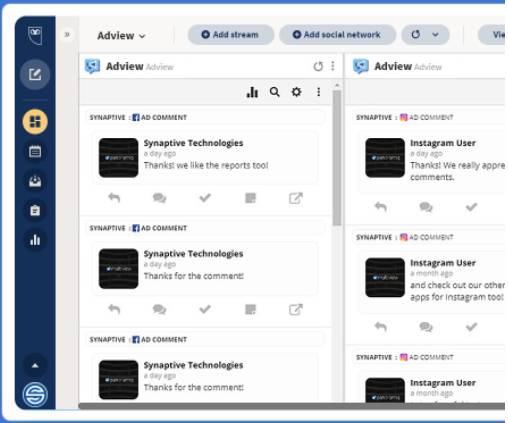
Unlike the bulk of social listening tools, Adview is only used for social listening on Facebook and Instagram advertisements. You may monitor an unlimited number of sites and up to three Facebook Ad Accounts using it.
After you’ve integrated Adview into your Hootsuite dashboard, you can respond to comments on all your Facebook and Instagram advertising from any location. Also, you get comprehensive information on which adverts are getting the most feedback so you may change your campaign plan.
3. Talkwalker
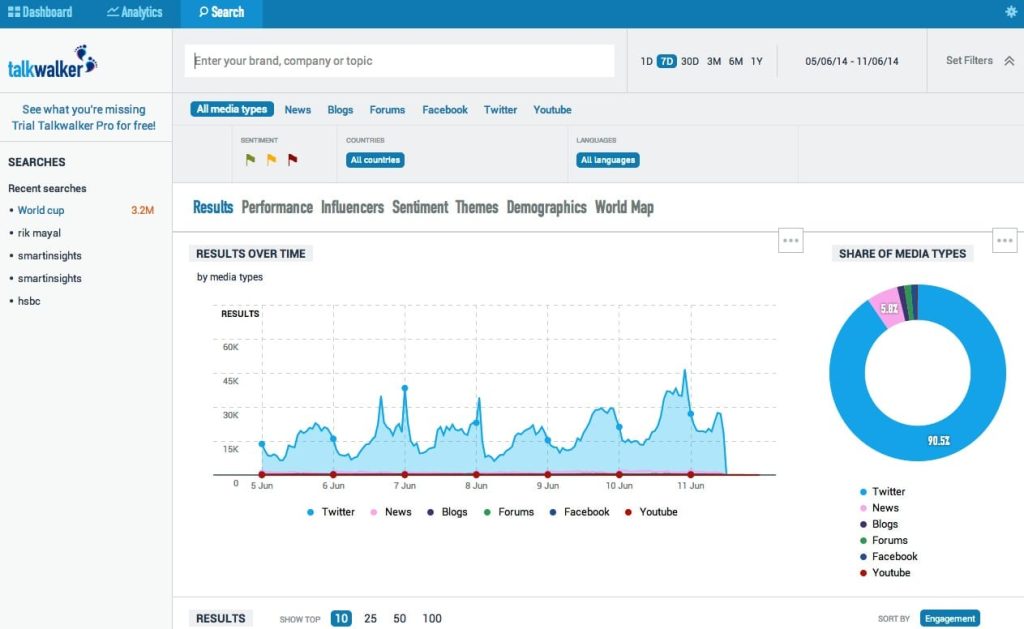
With one dashboard, Talkwalker’s powerful social listening software capabilities may monitor blogs, forums, videos, news websites, review websites, and social networks. Talkwalker collects information from over 150 million sources.
You can separate your data using advanced filters so that you can concentrate on the messages and audience that are most important to you. To be informed of any increases in mentions or term usage, you can also set up notifications.
Talkwalker makes it simple to keep an eye on conversations involving your business and analyze their emotion, engagement, and reach.
4. Synthesio

Synthesio is a social media listening tool that monitors talks among carefully selected communities about incredibly niche issues. Your social listening data can be divided up by factors like language, geography, demographics, sentiment, gender, influence, and more.
The reports also provide a useful social reputation score so you can see how you compare to rivals.
5. Mentionlytics

Use this social media listening tool to track mentions, keywords, and sentiment across several languages. The Mentionlytics social media monitoring tool searches blogs, news websites, and social media platforms for mentions. It’s linked with Hootsuite, so you can view them right on your dashboard.
Additionally, Mentionlytics makes it simple to locate influencers across social media platforms and other internet sources. You can quickly monitor terms in several languages, keep track of your top influencers, and even identify the sentiment behind each mention.
Frequently Asked Questions
Q: What is this guide about?
This comprehensive guide provides strategies and best practices for achieving success in your marketing efforts. Following these approaches can help improve your results and competitive advantage.
Q: How long does it take to see results?
Results vary depending on consistency and implementation quality. Most strategies require 3-6 months of dedicated effort before significant improvements become visible. Ongoing optimization is essential.
Q: Do I need professional help?
While basic implementation can be done independently, professional guidance often accelerates results and helps avoid common mistakes. Consider experts if you lack internal resources.
Q: What are the most important factors for success?
Key success factors include thorough research, consistent execution, quality over quantity, regular performance monitoring, and adapting to industry changes.
Q: How do I measure success?
Success depends on your goals but typically involves tracking KPIs like traffic, conversions, revenue, and engagement rates. Regular analysis helps identify improvements.
Q: What digital marketing channels should I focus on?
The best channels depend on your audience. Most businesses benefit from SEO, content marketing, social media, and paid advertising. Start where your audience is most active.
The Evolution of Digital Marketing: From Traditional to Modern Approaches
Digital marketing has undergone a remarkable transformation over the past two decades, evolving from simple banner advertisements and email campaigns to sophisticated, data-driven strategies that leverage artificial intelligence and machine learning. Understanding this evolution provides valuable context for developing effective modern marketing strategies that resonate with today’s consumers.
The early days of digital marketing were characterized by interruptive advertising tactics that prioritized visibility over relevance. Companies spent significant budgets on display ads that reached broad audiences but delivered limited engagement. As consumer behavior shifted and technology advanced, marketers began recognizing the value of permission-based marketing and targeted approaches that delivered personalized messages to specific audience segments.
Today’s digital marketing landscape demands integrated approaches that combine multiple channels and tactics into cohesive customer experiences. The most successful businesses recognize that modern consumers interact with brands through complex, non-linear journeys that span multiple devices and platforms. Meeting customers where they are requires sophisticated targeting capabilities, real-time personalization, and seamless cross-channel experiences.
The integration of marketing technology has enabled unprecedented levels of automation and optimization, allowing marketers to deliver the right message to the right person at the right time. These capabilities have transformed marketing from an art to a science, enabling continuous improvement based on real-time performance data and predictive analytics.
Strategic Content Development for Search Engine Success
Content remains the foundation of successful digital marketing, serving as the primary mechanism for attracting organic traffic, building brand authority, and engaging target audiences. Developing a comprehensive content strategy requires understanding search intent, creating valuable resources, and optimizing for both search engines and human readers.
Effective content addresses specific search queries while providing genuine value to readers. This requires deep understanding of your audience’s needs, questions, and pain points. The best content answers questions comprehensively, provides actionable insights, and offers unique perspectives that readers cannot find elsewhere.
Content optimization extends beyond keyword placement to include structural elements, readability, and multimedia integration. Well-structured content with clear headings, bullet points, and visual elements performs better in search results while delivering superior user experiences. Mobile optimization is particularly critical as mobile traffic continues growing.
Content promotion and distribution are equally important as creation. Even excellent content delivers limited results if target audiences cannot discover it. Strategic distribution leverages social media, email marketing, influencer partnerships, and paid promotion to maximize content reach and impact.
Data Analytics and Performance Measurement Fundamentals
Modern marketing success depends heavily on sophisticated analytics capabilities that enable data-driven decision making. Understanding which metrics matter most and how they connect to business outcomes allows continuous optimization of marketing efforts and improved return on investment.
Essential marketing metrics include traffic volume and sources, engagement rates, conversion rates, customer acquisition costs, and lifetime value. Each metric provides insights into different aspects of marketing performance, and comprehensive analysis reveals the full picture of marketing effectiveness.
Attribution modeling helps marketers understand how different touchpoints contribute to conversions. Multi-touch attribution provides more accurate pictures of customer journeys than last-click attribution, enabling better allocation of marketing budgets across channels and campaigns.
Advanced analytics approaches segment data by multiple dimensions to identify patterns and opportunities that aggregate data might miss. Understanding audience segments, channel performance, and campaign effectiveness enables continuous optimization and improved results over time.
Building Brand Authority Through Thought Leadership
Establishing thought leadership in your industry provides significant competitive advantages, including increased brand awareness, customer trust, and organic visibility. Thought leadership requires consistent creation of valuable content that demonstrates expertise and unique insights.
Effective thought leadership content addresses emerging trends, challenges conventional wisdom, and provides actionable guidance that readers can apply to their own situations. This type of content positions your brand as an authority that audiences can trust for reliable information and guidance.
Building thought leadership requires sustained effort over time, with consistent publication of high-quality content that addresses relevant industry topics. The most successful thought leadership strategies identify unique perspectives and expertise areas that differentiate your brand from competitors.
Distribution amplifies thought leadership impact. Strategic promotion through social media, email marketing, industry publications, and speaking opportunities extends reach and builds recognition among target audiences.
Maximizing Return on Marketing Investment
Proving and maximizing marketing return on investment requires clear objectives, sophisticated tracking, and continuous optimization. The most successful marketing organizations treat marketing as an investment that must deliver measurable returns rather than an expense that cannot be quantified.
ROI calculation requires understanding customer lifetime value, acquisition costs, and the contribution of marketing activities to revenue generation. These calculations enable informed budget allocation decisions and help identify the most effective marketing tactics for your specific business.
Continuous testing and optimization improve marketing performance over time. A/B testing, multivariate testing, and iterative improvement processes enable identification of optimal approaches and continuous enhancement of marketing effectiveness.
Marketing automation improves efficiency while enabling personalization at scale. Automating routine tasks frees marketing teams to focus on strategic initiatives while maintaining consistent customer experiences across touchpoints.
Future-Proofing Your Digital Marketing Strategy
The digital marketing landscape continues evolving rapidly, with emerging technologies, changing consumer behaviors, and new platforms creating both challenges and opportunities. Future-proofing your strategy requires staying current with trends while maintaining focus on fundamental marketing principles.
Artificial intelligence and machine learning continue transforming marketing capabilities, enabling more sophisticated targeting, personalization, and optimization. Businesses that embrace these technologies gain competitive advantages through improved efficiency and effectiveness.
Privacy regulations and changes to third-party cookies require adaptation of tracking and targeting approaches. First-party data strategies and consent-based marketing become increasingly important as the industry transitions to a privacy-focused environment.
Voice search, visual search, and AI-powered search experiences create new optimization requirements. Adapting content and technical strategies for these emerging search modalities positions businesses for success in evolving search environments.
Frequently Asked Questions
Which social media platforms should my business focus on?
Platform selection depends on your target audience and business type. B2B companies: LinkedIn (decision-maker targeting, thought leadership content), YouTube (tutorial and demo content that ranks in Google), and Twitter/X (industry conversation and real-time engagement). B2C e-commerce: Instagram (product discovery, visual content), TikTok (viral reach, Gen Z and Millennial audiences), and Pinterest (high-AOV audiences for home, fashion, food). Local businesses: Facebook (established local community presence, events, reviews) and Google Business Profile (technically not social but drives local search conversions). Choose 2 platforms and execute excellently rather than maintaining a mediocre presence on 5.
How often should I post on social media for business?
Platform-specific posting frequency for optimal algorithm performance: Instagram — 4–7 Reels per week for reach, 3–5 feed posts per week for engagement, daily Stories for retention. TikTok — 1–3 times daily for algorithm momentum (quantity drives discovery on TikTok). LinkedIn — 3–5 times per week for thought leadership, engagement-focused rather than promotional. Facebook — 3–5 times per week, prioritize video and community-building content. YouTube — weekly consistency matters more than daily volume; one high-quality video per week outperforms daily low-quality uploads. Always prioritize consistency and quality over raw frequency.
How do social media algorithms work?
Social media algorithms prioritize content based on: predicted engagement (how likely this content is to generate likes, comments, shares based on past performance and audience behavior), watch time and completion rate (especially for video — finishing a video signals quality to algorithms), early engagement velocity (content that gets strong engagement in the first 30–60 minutes gets boosted to broader audiences), user relationship signals (content from accounts users regularly interact with gets prioritized), and platform-specific signals (LinkedIn prioritizes native documents and polls; TikTok prioritizes completion rate and rewatches; Instagram prioritizes Reels watch time and Shares).
How do I grow my social media following organically?
Organic social growth strategies: (1) Niche down — accounts with a clear, specific focus grow faster than generalist accounts because algorithms categorize and recommend them more effectively; (2) Collaborate with complementary creators — cross-promotion exposes your content to qualified new audiences; (3) Optimize posting times using your analytics platform’s audience activity data; (4) Use trending audio on Reels and TikTok — platform-boosted sounds give your content algorithmic lift; (5) Engage authentically — comment substantively on larger accounts in your niche (visible to their audiences); (6) Repurpose your best content across platforms; (7) Analyze your top-performing posts and double down on similar content formats and topics.
What social media metrics actually matter for business?
Business-relevant social media metrics: Awareness — reach (unique accounts seeing content), impressions (total views including repeat), and follower growth rate. Engagement — engagement rate (interactions/reach, not followers), saves (indicate content value), and shares (indicate virality potential). Traffic — click-through rate to website, sessions from social in GA4, and landing page conversion rate from social traffic. Revenue — revenue attributed to social channels, ROAS from paid social, and customer acquisition cost from social. Vanity metrics to deprioritize: follower count without engagement, raw like counts, and impression totals without conversion data. Report monthly against business KPIs, not just platform metrics.
Sources & Research
- Sprout Social’s 2025 Index reports that 76% of consumers expect brands to respond to social media comments within 24 hours.
- According to Brandwatch, social listening helps brands identify emerging trends 4-6 weeks before they peak in search volume.
- Gartner (2025) predicts that by 2026, 60% of B2B organizations will transition from experience-based to data-driven decision making using social intelligence.
- Research from Nielsen shows that 92% of consumers trust earned media (word-of-mouth, social mentions) over all other forms of advertising.
- A Hootsuite Social Trends Report (2026) found that brands using social listening tools see a 23% improvement in campaign ROI on average.

Marketing Attribution in a Cookieless World: What Works After Third-Party Cookies
The cookie apocalypse arrived. Third-party cookies are deprecated across major browsers. This guide covers the…
Read More →-
 By Guy Sheetrit
- Feb 27, 2023
 By Guy Sheetrit