
Marketing professionals who want to develop a white paper for their company may find it confusing given the wide variations in definitions of whitepapers between industries.
A legislative document outlining and endorsing a specific political solution is the term used in politics in the past.
Even a business whitepaper can be utilized for a range of purposes and target markets, some of which are more product-focused than others. Although it is organized similarly to an ebook, the two are written very differently. For a deeper dive, explore our guide on Revolutionizing SEO.
We are here to provide you with the greatest explanation of a whitepaper in the business environment as well as advice on how to make one. This article covers: What is a white paper?, How should a whitepaper be written? as well as some White Paper samples.
What Is a White Paper?
A whitepaper is an authoritative, in-depth report that presents a problem and offers a solution on a particular subject.
Marketers create white papers to educate their audience on a certain subject or explain and advocate a particular methodology. These are sophisticated problem-solving manuals. Whitepapers are excellent for generating leads because they typically require more information than just an email address in order to download them.
What Isn’t a White Paper?
A product pitch.
A white paper, according to Investopedia, is “an informational document released by a company to promote or highlight the characteristics of a solution, product, or service,” but you should be aware that openly pitching your own products to readers may alienate them.
The purpose of a whitepaper is to enlighten and persuade based on facts and data, not tell the world why people need to buy your product right now.
Blog Posts and Ebooks
A whitepaper is not your only option if you’re seeking for a quick and engaging way to communicate your value to the industry. There are also ebooks and blog entries, both of which differ from whitepapers in a number of ways.
The differences in each product’s size, look, and time commitment is what actually set them distinct. A solid whitepaper can take between a few weeks and a few months to write and polish, but publishing blog articles and ebooks might take anything from a few hours to a few weeks. Compared to blog articles and ebooks, they are less showy, far more serious in tone, and include deeper research. For a deeper dive, explore our guide on Link Building Actually Work.
Whitepapers and e-books can both begin with the same template. Whitepapers, however, are essentially research papers on marketing content. Readers anticipate a high level of knowledge supported by reliable research that is fully referenced.
Ebooks, on the other hand, are frequently a continuation of a subject you frequently blog about. When breaking down a business topic, they can result from careful research but they can appeal to a wider audience.
While most people don’t really want to read whitepapers, they do it nevertheless to increase their understanding of an operation they need more insight on before making their next move, thus you can guess this makes them sort of boring in comparison.
For this reason, they tend to be very extensive and instructive, authoritative, and produced by industry specialists. And some decision-makers may feel more positive about a future purchase as a result of these traits.
What Makes a Good White Paper?
Theoretically, whitepapers don’t need to meet any minimum standards. Anything can be referred to as a “whitepaper,” but that doesn’t mean you should. Without clear guidelines on what constitutes and does not constitute a whitepaper, we run the danger of losing credibility and misleading our readers. This is an example of an A+ whitepaper:
- Length: Six pages in all, with references, charts, and images. can reach 50 if the subject calls for that much depth.
- Structure: The typical structure includes a title page, table of contents, a brief executive summary (optional but helpful), an introduction, several pages that inform the reader about the issue, several pages that propose a solution, several pages that provide an example of a business that used the proposed solution to produce results, and several pages that offer a conclusion.
- Density: Denser than an ebook. White Papers are typically difficult to skim; in fact, readers often need to read them more than once to extract all of the information from them.
- Format: PDF in portrait orientation (8.5″ by 11″).
- Style: serious, expert, well-written, and well-edited. To design the page layout, graphics, fonts, and colors as well, I’d suggest employing a graphic designer.
How to Write a Whitepaper?

1. Find the Problems your audience is facing.
Despite the fact that you are a subject matter expert in a unique position to create content, you must take your audience and what is happening in their life into account. You’ll be better able to develop demand for your whitepaper if you create one that answers (and solves) their demands.
Consider developing a buyer persona to do this. You can put yourself in their situation by engaging in this activity. Then, you should think about the knowledge that would appeal to them, how they would use it, and how it would alleviate their suffering or difficulty.
2. Do proper research.
White Papers are informational by nature, so you should think about how to give your audience knowledge they can’t find anywhere else. This is possible by:
- Doing proper study or survey
- Assembling distinctive case studies
- Describing a special procedure or project
If you are unable to conduct your own research, consider obtaining statistics from survey companies and/or government agencies and conducting an original analysis of them (and make sure you cite your sources).
3. Create an outline
Given the length of a whitepaper, an outline can assist you to keep your ideas organized. Think about outlining your subject using the following structure:
i. Introduction and Synopsis
The topic of the whitepaper is introduced, along with the audience’s perspective on why it is essential and what the whitepaper aims to accomplish, communicate, or solve.
ii. Overview
Defining a few of the major terms you plan to use, outlining the relevant variables or parameters, and summarize your main points.
iii. Body
laying out every important detail and highlight you’ll cover.
iv. Conclusion
Highlighting the main points of the body and any recommendations for the reader’s actions.
4. Write down your outline and give it more detail.
Use the outline as a guide as you start to elaborate on your thoughts in an informative and fact-based manner. Each paragraph should also advance the article’s main objective.
5. To help you describe your points, use visuals.
Visuals like charts, graphs, and tables can help you present information in a visually attractive way and make the paper easier to read because whitepapers go deeply into research and analysis.
6. Get feedback.
It’s crucial to give your readers the finest article you can. Your credibility with your audience will increase as it becomes better. Get input from a reliable source to identify any typos or other readability difficulties.
7. Work on formatting and design.
Although it’s not necessary to go overboard, appealing whitepapers often feature color, layout, and graphics.
A Few Good Examples of Whitepaper
Here are some more recent examples of whitepapers that are exemplary of excellent white paper execution (and why) to serve as further inspiration:
1. It’s Not You, It’s My Data, Custora
This whitepaper was produced by Custora to discuss customer churn, its importance, and how to avoid it. This booklet is fantastic since it promises the reader tangible value (revenue savings from minimizing attrition), supported by a plethora of information and helpful guidance. Even more, the whitepaper is stylish and appealing, making reading enjoyable. This makes it easier for the reader to consume long-form content.

2. Google Cloud’s AI Adoption Framework, Google
This whitepaper uses Google’s influence to influence the reader to use AI. Google hopes to give the reader the tools to consider the power of AI as it can be used in their business by outlining a methodology at the outset. The whitepaper then delves deeper into more technical details for knowledgeable readers.

3. Employees and Cybersecurity, Excedeo
Excedo attempts to raise awareness about the security threats that poorly trained staff may unwittingly present to firms. The whitepaper promotes the kinds of internal IT regulations and education that are necessary for modern society.

4. Not Another State of Marketing Report, HubSpot
Every year, HubSpot does a fantastic job of assembling information from professionals and partners to express current trends in the marketing industry. Marketers can produce marketing and sales content using the facts, and they can also learn from the macro shifts taking place in the sector. This information is presented in the whitepaper using eye-catching visuals, succinct editorial summaries, and links to in-depth articles on each subject.

Whitepapers have a lengthy history, and their applications have evolved over time. Be sure to assess whether or not a whitepaper will genuinely assist your audience before investing in the months-long process to develop it. An ebook will suffice on occasion. On the other hand, your content strategy should include long-form educational content.
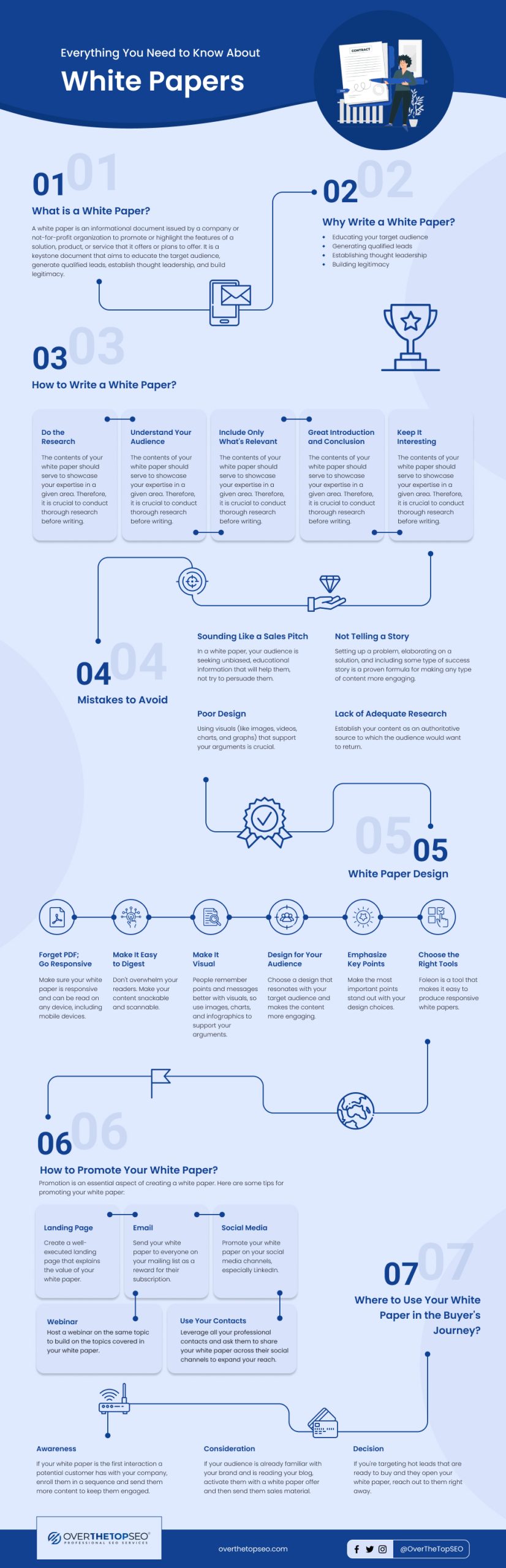
INFOGRAPHIC:
Frequently Asked Questions
Q: What is this guide about?
This comprehensive guide provides strategies and best practices for achieving success in your marketing efforts. Following these approaches can help improve your results and competitive advantage.
Q: How long does it take to see results?
Results vary depending on consistency and implementation quality. Most strategies require 3-6 months of dedicated effort before significant improvements become visible. Ongoing optimization is essential.
Q: Do I need professional help?
While basic implementation can be done independently, professional guidance often accelerates results and helps avoid common mistakes. Consider experts if you lack internal resources.
Q: What are the most important factors for success?
Key success factors include thorough research, consistent execution, quality over quantity, regular performance monitoring, and adapting to industry changes.
Q: How do I measure success?
Success depends on your goals but typically involves tracking KPIs like traffic, conversions, revenue, and engagement rates. Regular analysis helps identify improvements.
Q: What digital marketing channels should I focus on?
The best channels depend on your audience. Most businesses benefit from SEO, content marketing, social media, and paid advertising. Start where your audience is most active.
The Evolution of Digital Marketing: From Traditional to Modern Approaches
Digital marketing has undergone a remarkable transformation over the past two decades, evolving from simple banner advertisements and email campaigns to sophisticated, data-driven strategies that leverage artificial intelligence and machine learning. Understanding this evolution provides valuable context for developing effective modern marketing strategies that resonate with today’s consumers.
The early days of digital marketing were characterized by interruptive advertising tactics that prioritized visibility over relevance. Companies spent significant budgets on display ads that reached broad audiences but delivered limited engagement. As consumer behavior shifted and technology advanced, marketers began recognizing the value of permission-based marketing and targeted approaches that delivered personalized messages to specific audience segments.
Today’s digital marketing landscape demands integrated approaches that combine multiple channels and tactics into cohesive customer experiences. The most successful businesses recognize that modern consumers interact with brands through complex, non-linear journeys that span multiple devices and platforms. Meeting customers where they are requires sophisticated targeting capabilities, real-time personalization, and seamless cross-channel experiences.
The integration of marketing technology has enabled unprecedented levels of automation and optimization, allowing marketers to deliver the right message to the right person at the right time. These capabilities have transformed marketing from an art to a science, enabling continuous improvement based on real-time performance data and predictive analytics.
Strategic Content Development for Search Engine Success
Content remains the foundation of successful digital marketing, serving as the primary mechanism for attracting organic traffic, building brand authority, and engaging target audiences. Developing a comprehensive content strategy requires understanding search intent, creating valuable resources, and optimizing for both search engines and human readers. For a deeper dive, explore our guide on Search Optimization Traditional SEO.
Effective content addresses specific search queries while providing genuine value to readers. This requires deep understanding of your audience’s needs, questions, and pain points. The best content answers questions comprehensively, provides actionable insights, and offers unique perspectives that readers cannot find elsewhere.
Content optimization extends beyond keyword placement to include structural elements, readability, and multimedia integration. Well-structured content with clear headings, bullet points, and visual elements performs better in search results while delivering superior user experiences. Mobile optimization is particularly critical as mobile traffic continues growing.
Content promotion and distribution are equally important as creation. Even excellent content delivers limited results if target audiences cannot discover it. Strategic distribution leverages social media, email marketing, influencer partnerships, and paid promotion to maximize content reach and impact.
Data Analytics and Performance Measurement Fundamentals
Modern marketing success depends heavily on sophisticated analytics capabilities that enable data-driven decision making. Understanding which metrics matter most and how they connect to business outcomes allows continuous optimization of marketing efforts and improved return on investment.
Essential marketing metrics include traffic volume and sources, engagement rates, conversion rates, customer acquisition costs, and lifetime value. Each metric provides insights into different aspects of marketing performance, and comprehensive analysis reveals the full picture of marketing effectiveness.
Attribution modeling helps marketers understand how different touchpoints contribute to conversions. Multi-touch attribution provides more accurate pictures of customer journeys than last-click attribution, enabling better allocation of marketing budgets across channels and campaigns.
Advanced analytics approaches segment data by multiple dimensions to identify patterns and opportunities that aggregate data might miss. Understanding audience segments, channel performance, and campaign effectiveness enables continuous optimization and improved results over time.
Building Brand Authority Through Thought Leadership
Establishing thought leadership in your industry provides significant competitive advantages, including increased brand awareness, customer trust, and organic visibility. Thought leadership requires consistent creation of valuable content that demonstrates expertise and unique insights. For a deeper dive, explore our guide on ChatGPT Visibility Citation Optimization.
Effective thought leadership content addresses emerging trends, challenges conventional wisdom, and provides actionable guidance that readers can apply to their own situations. This type of content positions your brand as an authority that audiences can trust for reliable information and guidance.
Building thought leadership requires sustained effort over time, with consistent publication of high-quality content that addresses relevant industry topics. The most successful thought leadership strategies identify unique perspectives and expertise areas that differentiate your brand from competitors.
Distribution amplifies thought leadership impact. Strategic promotion through social media, email marketing, industry publications, and speaking opportunities extends reach and builds recognition among target audiences.
Maximizing Return on Marketing Investment
Proving and maximizing marketing return on investment requires clear objectives, sophisticated tracking, and continuous optimization. The most successful marketing organizations treat marketing as an investment that must deliver measurable returns rather than an expense that cannot be quantified.
ROI calculation requires understanding customer lifetime value, acquisition costs, and the contribution of marketing activities to revenue generation. These calculations enable informed budget allocation decisions and help identify the most effective marketing tactics for your specific business.
Continuous testing and optimization improve marketing performance over time. A/B testing, multivariate testing, and iterative improvement processes enable identification of optimal approaches and continuous enhancement of marketing effectiveness.
Marketing automation improves efficiency while enabling personalization at scale. Automating routine tasks frees marketing teams to focus on strategic initiatives while maintaining consistent customer experiences across touchpoints.
Future-Proofing Your Digital Marketing Strategy
The digital marketing landscape continues evolving rapidly, with emerging technologies, changing consumer behaviors, and new platforms creating both challenges and opportunities. Future-proofing your strategy requires staying current with trends while maintaining focus on fundamental marketing principles.
Artificial intelligence and machine learning continue transforming marketing capabilities, enabling more sophisticated targeting, personalization, and optimization. Businesses that embrace these technologies gain competitive advantages through improved efficiency and effectiveness.
Privacy regulations and changes to third-party cookies require adaptation of tracking and targeting approaches. First-party data strategies and consent-based marketing become increasingly important as the industry transitions to a privacy-focused environment.
Voice search, visual search, and AI-powered search experiences create new optimization requirements. Adapting content and technical strategies for these emerging search modalities positions businesses for success in evolving search environments.
Conclusion: Embracing Digital Marketing for Sustainable Business Growth
The digital marketing landscape presents unprecedented opportunities for businesses willing to invest in building their online presence. Success requires strategic approach, consistent effort, and willingness to adapt to changing technologies and consumer behaviors. By focusing on delivering genuine value to your audience and continuously optimizing based on data, your business can achieve sustainable growth through digital marketing.
Remember that digital marketing is an ongoing commitment rather than a one-time effort. The businesses that succeed view marketing as a strategic investment that delivers compounding returns over time. Stay focused on your objectives, measure results consistently, and maintain patience required for building lasting success in the dynamic digital environment.
The Evolution of Digital Marketing Strategy
Digital marketing has transformed dramatically over the past decade, evolving from simple banner advertisements to sophisticated, data-driven strategies that leverage artificial intelligence and machine learning.
Modern digital marketing requires integrated approaches combining multiple channels into cohesive customer experiences.
Content Marketing Best Practices
Content remains the foundation of successful digital marketing, serving as the primary mechanism for attracting organic traffic, building brand authority, and engaging target audiences.
Data-Driven Marketing Decisions
Modern marketing success depends on sophisticated analytics enabling data-driven decisions.
Building Brand Authority
Establishing thought leadership provides significant competitive advantages including increased brand awareness and customer trust.
Maximizing Marketing ROI
Proving marketing ROI requires clear objectives, sophisticated tracking, and continuous optimization.
Learn More: Home
Frequently Asked Questions
How do I create content that ranks in Google?
Content that earns top Google rankings shares five characteristics: (1) Comprehensively answers the search intent — not just the keyword, but the full range of related questions a searcher would have; (2) Demonstrates first-hand experience or expertise (E-E-A-T) — original insights, data, or case studies that syndicated content can’t replicate; (3) Matches search intent precisely — informational intent requires educational content, not sales pages; (4) Well-structured for scannability — H1, H2, H3 hierarchy, short paragraphs, bullet points, tables; (5) Better than what’s currently ranking — analyze the top 3 results and ask ‘what does this content do that theirs doesn’t?’ Outranking requires being demonstrably better, not just similar.
How long should a blog post be for SEO?
Optimal blog post length depends on the topic and competitive landscape. General benchmarks: informational how-to content (1,500–2,500 words), comprehensive guides and ultimate resources (2,500–4,500 words), news and opinion pieces (500–1,000 words), product comparisons (1,500–3,000 words). The right length is ‘as long as needed to be the best result for this query’ — not arbitrarily padded to hit a word count target. Run a content audit of the top 5 ranking pages for your target keyword — if they average 2,200 words, aim for 2,500–3,000 words of higher-quality content. Longer content earns more backlinks naturally (more citable), keeping other factors equal.
What is the difference between a pillar page and a blog post?
A pillar page is a comprehensive, authoritative resource covering a broad topic in depth — typically 3,000–8,000+ words covering all major subtopics of a subject. It serves as the hub of a topic cluster, linking to and receiving links from multiple supporting cluster articles. Blog posts (supporting cluster content) cover specific subtopics in depth (1,500–3,000 words), targeting more specific long-tail keywords within the pillar’s broader topic. Example: ‘Content Marketing’ pillar page → cluster articles on ‘Blog Writing Guide’, ‘Content Calendar Templates’, ‘Content Distribution Strategy’, etc. This architecture builds topical authority signals that help the entire cluster rank higher than isolated articles.
How do I measure the ROI of content marketing?
Content marketing ROI measurement framework: (1) Organic traffic from content (GA4 Source/Medium = organic/google to content URLs); (2) Lead generation from content (form submissions, content downloads attributed to organic content); (3) Conversion rate from organic content visitors vs. other channels; (4) Content-assisted pipeline (CRM attribution showing content touchpoints in closed deals); (5) Content cost per lead (total content investment / leads generated); (6) Lifetime value of content-acquired customers vs. paid-acquired. Benchmark: content marketing generates 3x as many leads as outbound marketing at 62% lower cost (DemandMetric). Track at minimum: traffic, leads, and customer attribution to content channels with monthly reporting.
What content types generate the most leads for B2B?
B2B lead generation content performance ranking: (1) Original research and data reports (highest backlink earning, high-value lead magnet, establishes authority); (2) Free tools and calculators (interactive, high engagement, captures emails naturally); (3) Webinars (live and on-demand, builds relationship depth, high conversion to demo); (4) Detailed case studies (bottom-funnel, high conversion, reduces purchase risk); (5) Comprehensive guides and ebooks (foundational lead magnet, broad middle-funnel reach); (6) Template and swipe file collections (high perceived value, practical utility drives downloads). Combine multiple content types in a content hub — visitors who consume 3+ content pieces convert at 5x the rate of single-piece visitors.

AI Search Optimization vs Traditional SEO: Why the Smartest Brands Do Both (2026)
AI search optimization and traditional SEO are not competing strategies -- they are complementary systems.…
Read More →
Generative Engine Optimization (GEO) Services: The Complete Enterprise Guide (2026)
Enterprise GEO services that get your brand cited in ChatGPT, Gemini, and Perplexity. OTT builds…
Read More →
ChatGPT Visibility & AI Citation Optimization: How to Get Your Brand Cited by AI in 2026
AI citation optimization gets your brand inside the answers ChatGPT, Gemini, and Perplexity generate. OTT…
Read More →
Voice Search SEO in 2026: Optimizing for Alexa, Siri, and Google Assistant
Voice search was supposed to have already taken over the internet. In 2016, analysts predicted…
Read More →
E-E-A-T 2.0: How Google’s Quality Signals Evolved for AI-Generated Content
Table of Contents Toggle What Is E-E-A-T? The Foundation You Need to Understand From E-A-T…
Read More →-
 By Guy Sheetrit
- Mar 23, 2023
 By Guy Sheetrit