
Have you heard marketing experts discuss adopting less formal methods to promote goods and services?
Maybe one that uses imaginative storylines rather than scripts that are line by line?
You probably have, and it’s known as brand storytelling.
Although brand storytelling has been around for a while, it is becoming more and more popular as digital marketing overtakes its print-based forerunner. For a deeper dive, explore our guide on Behavioral Marketing.
Digital marketing that uses storytelling responds to the needs of a fast-paced society where people sift through the clutter and seek out information quickly.
What Effect Does Storytelling Have on Online Marketing?
The only difference between digital and traditional storytelling is how the stories are presented. Currently, a lot of people create and distribute their messages to others via online platforms.
These many marketing techniques and types of communication are combined through storytelling in digital marketing to create persuading selling points.
Three ways that storytelling affects digital marketing are listed below:
1. Storytelling Helps You In Reaching Your Target Market

People are constantly exposed to commercial messages today. It’s rare to click on a website link these days without a slew of pop-up adverts or advertisements spilling down the sides of each item you read.
The brain has become trained to skim information and ignore everything basic and uninteresting as a result. To capture the interest of a reader, a story needs to be imaginative and original.
2. It Builds Trust
Using generic marketing materials will not help you connect with customers. Rather, it is dull, informative content that frequently resembles assembly instructions.
The power of storytelling is much greater. It solves the problems that customers have and avoids coming across as a pushy pitch.
People want to believe that you are thinking about them exclusively.
3. It Feels Less Pushy
Normally, consumers tend to avoid aggressive, in-your-face hard sales.
People can simply escape unpleasant confrontations and awkward interactions in today’. S world of internet purchasing by clicking the “x” on their browser.
Asking them questions and developing a more personal connection with them are effective ways to pique a customer’s interest.
What Role Does Storytelling in Marketing Play?
After gaining an understanding of how storytelling affects your digital marketing strategy, you should consider how storytelling in digital marketing might help you reach your target audience.
The following are three of those methods:
1. Customer-Generated Storytelling
Customer endorsements are the best way to sell anything.
Customers have more platforms to share their reviews of goods and services as communications technology develops. People frequently place more trust in their peers than they do in corporate marketers, which makes sense.
As a result, it is crucial to give your clients access to a similar platform and give them a chance to share their stories.
2. Data-Driven Storytelling
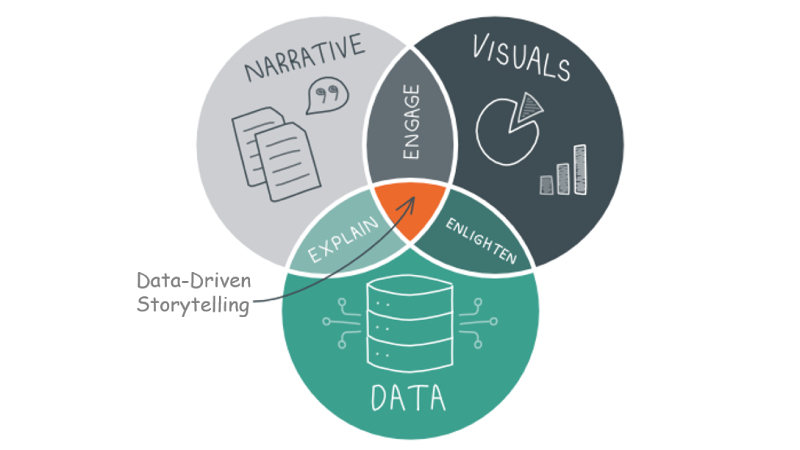
There is digital data everywhere, and it keeps expanding in waves. In the fiercely competitive world of digital marketing, it’s imperative to use all data at your disposal to create compelling tales.
Humans process visuals considerably more quickly than they do text,. Your commercials will be more effective if you use digital data to produce visually compelling storytelling.
It’s critical to keep in mind that a tale or advertisement need not always be verbose.
3. Mini Ads
The shortening attention span of the ordinary human is a side effect of developing technologies.
“Mini commercials,” which are brief tidbits of teaser content, are replacing more conventional, drawn-out types of advertising.
Although they don’t say much, they are just long enough to pique a consumer’s curiosity without being tedious.
5 Ways To Use Storytelling In Digital Marketing
A number of tried-and-true tactics that facilitate client connection are the foundation of efficient digital advertising.
These are the first five:
1. Knowing Your Brand’s Story
Conventional marketing is quite regimented and formal. It describes what a business is selling, offers details on that good or service, and explains how customers may get their hands on it.
An emotional and informative narrative that appeals to consumers’ emotions is known as a brand story. Instead of overwhelming a customer with information, it responds to the most important query of all: Why is your brand on my screen?
2. Don’t Tell, Show
This idea is a tried-and-true strategy utilized by creative writers to captivate readers. The author employs particular allusions that allow the reader to interpret. Experience the thoughts and emotions for themselves rather than directly stating what a character is thinking or experiencing.
Similar principles apply to digital marketing. By using a descriptive story rather than a pushy sales pitch, you may help your audience understand the value of your product or service.
3. Keep your narrative coherent.
Never change the story when trying to persuade a customer to buy a good or service. Throughout the advertisement, your message should be constant.
Otherwise, a customer might detect a bait-and-switch or some other form of deceptive advertising. It’s simple to lose a customer’s faith in this way.
4. Build An Emotional Connection
Humans have a tendency to be emotional, and this frequently affects their buying habits.
Emotional marketing, as its name implies, uses subtle, yet potent, and convincing messaging to appeal to a consumer’s emotions. These messages elicit a consumer’s subliminal buying inclinations, according to numerous marketing specialists.
As a result, a close bond is formed between the brand and the customer.
5. A/B Testing
A/B testing is a randomized test in. Various variables are simultaneously shown to various website visitors (such as a web page and particular page parts).
Finding out which version of that page or page element generates the most “click-throughs” is the goal. A click-through indicates that the advertisement piqued the viewer’. S interest enough for them to click the link and proceed to the next page.
Digital marketing storytelling is crucial for establishing a connection with potential customers in a world of avalanche data, quick-moving information, and short attention spans.
The era of tedious scripting and information overload has ended. They prefer commercials that stand out from the digital cacophony and connect with them personally.
Frequently Asked Questions
Q: What is this guide about?
This comprehensive guide provides strategies and best practices for achieving success in your marketing efforts. Following these approaches can help improve your results and competitive advantage.
Q: How long does it take to see results?
Results vary depending on consistency and implementation quality. Most strategies require 3-6 months of dedicated effort before significant improvements become visible. Ongoing optimization is essential.
Q: Do I need professional help?
While basic implementation can be done independently, professional guidance often accelerates results and helps avoid common mistakes. Consider experts if you lack internal resources.
Q: What are the most important factors for success?
Key success factors include thorough research, consistent execution, quality over quantity, regular performance monitoring, and adapting to industry changes.
Q: How do I measure success?
Success depends on your goals but typically involves tracking KPIs like traffic, conversions, revenue, and engagement rates. Regular analysis helps identify improvements.
Q: What digital marketing channels should I focus on?
The best channels depend on your audience. Most businesses benefit from SEO, content marketing, social media, and paid advertising. Start where your audience is most active.
The Science of Storytelling: Why Stories Outperform Data in Marketing
The preference for narrative over raw information is deeply embedded in human cognition — and modern neuroscience has given us a detailed understanding of why. When we hear or read a compelling story, our brains don’. T just process it intellectually; they actively simulate the experience, activating the same neural circuits that fire when we have the experience ourselves.
This phenomenon — called “neural coupling” — means that a well-told story creates a shared experience between the storyteller and the audience. It explains why stories are more persuasive, more memorable, and more emotionally engaging than equivalent information presented as facts or statistics.
For marketing, the implications are profound. A customer testimonial that tells the story of a problem solved, uncertainty overcome, and transformation achieved engages the audience’. S neurology in ways a feature list or statistic cannot. The reader who identifies with the protagonist of the story experiences the emotional journey vicariously — and that emotional experience is what drives decision-making.
According to research by Stanford University professor Chip Heath, co-author of “. Made to stick,” stories are remembered 22 times more frequently than facts alone. For brands building content strategies, this memorability gap has direct commercial implications: the content that tells compelling stories builds the brand memory structures that drive purchase decisions weeks or months after first exposure.
Storytelling Frameworks for Marketing Content
Effective marketing storytelling follows recognizable structures that guide audiences through an emotional journey. Several proven frameworks:
The Hero’s Journey (Customer-as-Hero). The most powerful marketing storytelling positions the customer, not the brand, as the hero. The customer has a problem (the call to adventure), encounters obstacles (the trials), finds guidance (meets the brand’. S product or service as the mentor), and achieves transformation (the triumph). The brand’s role is the wise guide — Yoda to the customer’s Luke Skywalker.
The Problem-Agitate-Solve (PAS) Framework. Introduce the problem the customer faces, amplify the emotional weight of that problem (what it costs them, how it makes them feel, what they’re missing), then present the solution. PAS is widely used in direct response marketing because it meets customers where they are emotionally before offering the resolution.
The Before-After-Bridge (BAB) Framework. Paint a vivid picture of “. Before” (the customer’s current situation, complete with its frustrations and costs), then paint an equally vivid picture of “after” (life with the problem solved), then bridge the two with your product or service. BAB is particularly effective for visually demonstrable transformations — fitness products, home improvement, cosmetic dentistry before/afters.
The Data Story. Complex data becomes meaningful through narrative framing. Rather than presenting statistics as isolated facts, the data story contextualizes each number within a narrative arc: here’. S the situation, here’s what the data reveals, here’s what it means, here’s what changes as a result. This framework transforms analytical content into engaging, actionable storytelling.
Implementing Storytelling Across Marketing Channels
Each marketing channel offers distinct storytelling opportunities that reward format-appropriate narrative approaches:
Email marketing storytelling leverages the personal, conversational nature of email. Subject lines that open a narrative loop (“. The mistake that cost me 3 clients…”) generate above-average open rates because they trigger the human compulsion to complete unfinished stories. Email sequences that tell a multi-part story across several messages build engagement and click-through rates significantly above single-message campaigns.
Social media storytelling operates in compressed formats that require opening with maximum impact. Instagram and Facebook Stories — literally named for the format — deliver episodic narrative content that rewards consistent viewing with character development and narrative arc. LinkedIn storytelling builds professional authority through case studies, lessons learned, and transparent founder narratives that demonstrate experience and judgment.
Video storytelling is the highest-impact format when executed with craft. A 2-minute brand story video that follows a real customer’. S journey from problem to transformation communicates more brand equity than hours of feature-focused advertising. Customer testimonial videos are particularly powerful because they combine authentic narrative with visual credibility.
OTT SEO’s content marketing ROI guide and SEO content writing services incorporate storytelling principles into every piece of content we produce. Our team understands that the best SEO content is content humans actually want to read — and stories are what humans have always wanted most. For external research on narrative and brand impact, Nielsen Norman Group’. S ux storytelling research provides evidence-based guidance on narrative effectiveness in digital contexts.
Frequently Asked Questions About Marketing Storytelling
What is brand storytelling?
Brand storytelling is the use of narrative to communicate a brand’. S values, purpose, and impact in a way that creates emotional connection with audiences. Unlike traditional brand messaging that focuses on features and benefits, brand storytelling focuses on the human experiences and transformations enabled by the brand. It answers the questions: Why do we exist? What problems do we solve? Who are we trying to help, and how does their life change when we do?
Why is storytelling important in digital marketing?
Storytelling is important in digital marketing because it dramatically improves content memorability (stories are remembered 22x more than facts), builds emotional connection that drives purchase decisions, differentiates brands in commoditized markets,. Generates significantly higher engagement across all digital platforms. In a content-saturated digital environment, the brands that tell compelling stories capture and hold attention in ways that information-only content cannot.
What makes a good brand story?
A good brand story has: a clearly identifiable protagonist (your customer, not your brand). A genuine problem or tension that creates emotional stakes; authentic details that make the story credible and specific; a transformation or resolution that demonstrates real value; and a human truth that resonates beyond the immediate narrative. The best brand stories feel like they could be told by anyone involved — they’re true, specific, and emotionally honest.
How do you use storytelling in content marketing?
Use storytelling in content marketing by: opening every blog post with a scene or situation rather than a definition. Using customer case studies with narrative structure (problem → struggle → solution → outcome); framing data and statistics within narrative context (what does this number mean for a real person?); structuring email sequences as ongoing narratives; using video testimonials that follow a story arc; and positioning the customer as the hero of every story your brand tells.
Storytelling is not a soft skill in digital marketing — it is the hardest skill to execute well. The highest-leverage when done right. The brands consistently outperforming in content marketing, social media, and email are the ones that have invested in genuine narrative craft alongside their technical SEO and distribution mechanics. In an AI-saturated content landscape where generic information is commoditized, authentic human stories — specific, emotionally honest, grounded in real experience — are more differentiated. More valuable than at any previous point in marketing history. The opportunity for brands willing to invest in storytelling craft has never been larger.
Content That Tells Your Brand Story
Over The Top SEO creates content that combines SEO optimization with genuine storytelling craft — content that ranks and resonates. Featured in Forbes, Inc., NYT, Entrepreneur.
Written by Guy Sheetrit, CEO of Over The Top SEO. Content marketing and brand storytelling specialist. Last updated: March 2026.
The Evolution of Digital Marketing Strategy
Digital marketing has transformed dramatically over the past decade, evolving from simple banner advertisements to sophisticated, data-driven strategies that leverage artificial intelligence and machine learning. Understanding this evolution provides context for developing effective modern marketing strategies that resonate with today’s consumers.
Modern digital marketing requires integrated approaches combining multiple channels into cohesive customer experiences. The most successful businesses recognize that consumers interact with brands through complex journeys spanning multiple devices and platforms.
Content Marketing Best Practices
Content remains the foundation of successful digital marketing, serving as the primary mechanism for attracting organic traffic, building brand authority, and engaging target audiences. Effective content addresses specific search queries while providing genuine value to readers through comprehensive answers and actionable insights.
Data-Driven Marketing Decisions
Modern marketing success depends on sophisticated analytics enabling data-driven decisions. Understanding which metrics connect to business outcomes allows continuous optimization and improved return on investment through testing and iterative improvement.
Building Brand Authority
Establishing thought leadership provides significant competitive advantages including increased brand awareness and customer trust. Effective thought leadership addresses emerging trends, challenges conventional wisdom, and provides actionable guidance.
Maximizing Marketing ROI
Proving marketing ROI requires clear objectives, sophisticated tracking, and continuous optimization. The most successful marketing organizations treat marketing as an investment delivering measurable returns through continuous testing.
Learn More: Home
-
 By Guy Sheetrit
- Mar 15, 2023
 By Guy Sheetrit


