A drip campaign is a sequence of automatic emails you send to website visitors after they perform a particular activity. You have the option to decide how many emails and at what rate to send them for any particular activity. Using information like the contact’s name and precise references to the activity they took, these emails can be customized. Someone who registers for your online course, for instance, might receive an email drip campaign from you. Alternatively, you might send abandoned cart emails to customers who add an item to their online basket but do not complete the transaction.
What is Drip Marketing?
Drip marketing is the practice of automatically sending a predetermined number of emails to your audience at predetermined intervals in response to their activities or status changes. Following significant events or acts, businesses utilize drip marketing to stay in touch with their audience in a tailored and focused manner.
For more technical SEO insights, explore our Core Web Vitals checklist and SEO fundamentals guide.
A drip marketing campaign, for instance, might be based on:
- Making a purchase
- Taking part in a gathering at your shop
- Registering for a webcast
- Registering for a white paper or report
- Leaving a shopping basket empty
- Becoming involved in customer service
- Haven’t ordered anything in a long.
Drip marketing is effective and distinctive due to a few factors. The usual material is
- Automated and prewritten
- Delivered according to a predetermined timetable in response to audience activity or another type of strategic automation plan
- “Mapped” to key engagement points
The “drip” in drip marketing refers to sending a series of emails gradually and steadily. It might be 2, 5, or whatever you determine is the ideal amount of emails to exchange on a specific subject without going overboard. You compose the emails once for each campaign—like an abandoned cart drip campaign—and then use automation to personalize and send them. Your drip marketing campaigns run automatically after they are set up.
Why Use Drip Campaigns?
By converting visitors into customers, creating recurring business, and re-engaging a dormant audience, drip marketing can help you increase sales. You can establish a connection with your audience and show that you’re an excellent resource for their needs by explaining the value your firm offers.
Half of us are involved in “a never-ending quest for products, services, and content that encourage behaviour altering,” according to a study of 2,000 people. This behaviour can be encouraged through a drip campaign. For a deeper dive, explore our guide on Generative Engine Optimization Services.
Drip campaigns can also be successful because they are targeted, which means they can be based on a certain action and customized.
How Drip Campaigns Are Used?
Drip campaigns are made to reach out to a specific person at the ideal moment with a customized message. These emails, which include welcome letters, birthday wishes, and order alerts, are automatically sent out, so they work for your company while you concentrate on other tasks.
Connecting with the appropriate person at the right time is simple with automated drip campaigns—without having to put in any extra effort. There are numerous instances of drip campaigns that could be effective for your company, whether they are triggered by dates or actions.
Each prospective customer can follow a drip email through your sales pipeline. Including welcome drips, onboarding procedures, lead nurturing efforts, abandoned shopping cart reminders, and new product recommendations.
Reach out on dates that are important to your audience
By using date-based automation, you may reach out to your audience on the days that are important to them. This automation can be used in a variety of situations, including:
Asks for subscription renewal or reordering. A drip campaign is a great way to let your audience know when their subscription is up for renewal if your company offers any products on a subscription or membership basis, such as a gym or yoga studio, a paid newsletter, a farm delivery service, regular deliveries of essentials like toothpaste or shaving cream, etc. Remind them of the benefits you offer and the ways in which they have profited from your services. If you can, lure them in with upcoming new goods.
Events like birthdays and anniversaries. Even though you might not decide to turn this into a series, sending an email on a customer’s birthday, the anniversary of their first purchase or any significant occasion can be a terrific way to emphasize your brand’s worth and even inspire a purchase.
Communicate in accordance with a user’s actions
A lot of drip campaigns can be started when a member of your audience takes (or doesn’t take) a certain action. These are a few illustrations of drip campaigns:
Welcome Emails:
Making a favourable impression when a new audience member enters the room is crucial. You may tell new customer everything they need to know about your company with welcome drips. You can also use welcome emails to get in touch with people you met in person, such as during a trunk exhibition, wine tasting, or sale that you organized. A drip campaign can be an efficient approach to inform new audience members about forthcoming activities, discounts, or other events while also creating a sense of shared values.
Initial Automation in Purchases:
When a customer makes their first purchase from you, it’s a great chance to thank them for their patronage, remind them of the product’s qualities and features, offer them advice on how to maximize their purchase, recommend complementary items that other customers have bought, and reassure them that they made the right choice. At this early stage of your company partnership, expressing gratitude might help them feel like members of a unique group.
Product Suggestions:
Offering related products after a customer make a purchase is a fantastic strategy to increase sales. This can be mentioned in an email that confirms your order or notifies you of shipping. If someone purchases a dress on your website, for instance, you might offer a belt or scarf—whether they are frequently purchased along by other customers or are suggested by your in-house specialists. As an alternative, you might get in touch a few weeks or even months following a purchase to recommend replacement components or refills. For instance, you might send an email three months after someone purchases an air purifier from your website proposing replacement filters.
Send follow-up emails to your audience to inform and welcome them:
A drip campaign might encourage someone to take further action if they contact your customer care or sales staff, for example, to ask about the status of an order, the delivery window, or another issue. A drip campaign might suggest people sign up for online or automatic payment if they phone about a forgotten invoice or payment, for instance. A drip campaign can help them finish a product registration or tutorial video on how to use your product if they started but didn’t finish, which will strengthen their connection to your company. For a deeper dive, explore our guide on Veo Review.
Abandoned Shopping Carts:
Online customers frequently add an item to their cart, delete it before checking out, or decide not to make the transaction at all. An effective abandoned cart email may persuade them to reconsider the purchase. But be careful not to come off as too “big brother”—you don’t want to seem overbearing. For instance, if a customer returned a certain skirt, you might send them an email promoting your entire spring collection or one from that particular designer without mentioning the precise item they bought.
Lead Nurturing:
Prospects’ active interest makes drip campaigns highly effective. It’s your cue to get in touch with someone with pertinent content if they sign up for a webinar or a content component like a white paper or an interactive tool. For instance, if you offer lawn care and a potential customer signs up for your guide on winterizing their yard, you may send them emails with more advice and specials for your lawn care goods and services. Lead nurturing can take many different forms, such as providing them with more information about the features of your product, what they will learn from your online course, or providing them with information about your service. In any case, a lead nurturing campaign can boost both your sales and the purchase value.
Email Unsubscribe:
You may send a follow-up email to the person who unsubscribed from your e-newsletter to get their opinion. You may give a special “we want you back” offer or incentive in addition to asking for feedback if they cancel your subscription service (like a gym). In order to win them back, you can also follow up with them three or six months later, when their circumstances may have altered.
How Should a Drip Campaign be Set Up?
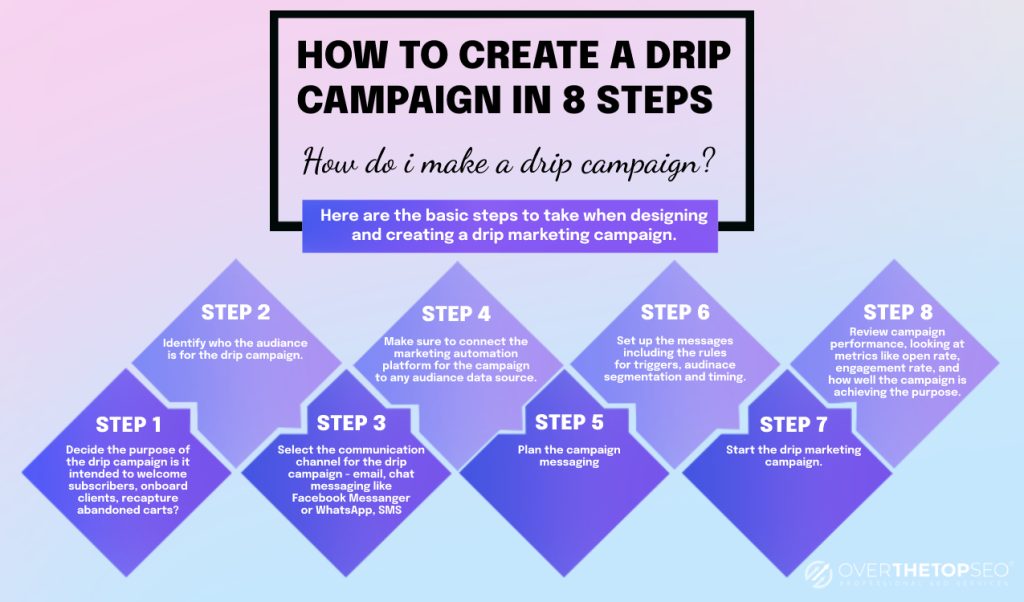
A constant marketing workhorse, drip marketing keeps up the marketing, nurturing, and selling activities vital to your success. To set up and manage your drip campaign, follow these 5 steps:
- Decide on a trigger. What precise event or date is the foundation of your drip campaign?
- Choose your audience (s). Will your “first purchase” drip campaign, for instance, be sent to all new audience members or just those who make purchases that are, say, $100 or more?
- Prepare a unique message for every email. Your drip campaign emails don’t have to be extensive, but they must adhere to your brand guidelines.
- Based on results: Evaluate and make adjustments. The type of email you send, its recipient list, and other elements will determine the appropriate measurement for your campaign. Keep track of how each of your emails is performing, including their click-through and conversion rates, and be ready to make adjustments as you learn more.
- Keep sending drip emails: The copy you use can become outdated when your offerings change; occasionally examine all of your drip campaigns to make sure they aren’t getting stale.
Launch Drip Campaigns For Your Business.
Despite everything you have to accomplish, employ drip marketing to support your efforts to promote your business. You may concentrate on other business concerns while the right message is being sent at the right moment to the ideal target. To create a successful drip campaign, hire a reputed company like OTT SEO. Our team will help you to achieve your target, and engage better.
Frequently Asked Questions
Q: What is this guide about?
This comprehensive guide provides strategies and best practices for achieving success in your marketing efforts. Following these approaches can help improve your results and competitive advantage.
Q: How long does it take to see results?
Results vary depending on consistency and implementation quality. Most strategies require 3-6 months of dedicated effort before significant improvements become visible. Ongoing optimization is essential.
Q: Do I need professional help?
While basic implementation can be done independently, professional guidance often accelerates results and helps avoid common mistakes. Consider experts if you lack internal resources.
Q: What are the most important factors for success?
Key success factors include thorough research, consistent execution, quality over quantity, regular performance monitoring, and adapting to industry changes.
Q: How do I measure success?
Success depends on your goals but typically involves tracking KPIs like traffic, conversions, revenue, and engagement rates. Regular analysis helps identify improvements.
Q: What digital marketing channels should I focus on?
The best channels depend on your audience. Most businesses benefit from SEO, content marketing, social media, and paid advertising. Start where your audience is most active. For a deeper dive, explore our guide on Paid Search Advertising.
For a deeper dive, explore our guide on Paid Media Advertising Effective.
The Evolution of Digital Marketing: From Traditional to Modern Approaches
Digital marketing has undergone a remarkable transformation over the past two decades, evolving from simple banner advertisements and email campaigns to sophisticated, data-driven strategies that leverage artificial intelligence and machine learning. Understanding this evolution provides valuable context for developing effective modern marketing strategies that resonate with today’s consumers.
The early days of digital marketing were characterized by interruptive advertising tactics that prioritized visibility over relevance. Companies spent significant budgets on display ads that reached broad audiences but delivered limited engagement. As consumer behavior shifted and technology advanced, marketers began recognizing the value of permission-based marketing and targeted approaches that delivered personalized messages to specific audience segments.
Today’s digital marketing landscape demands integrated approaches that combine multiple channels and tactics into cohesive customer experiences. The most successful businesses recognize that modern consumers interact with brands through complex, non-linear journeys that span multiple devices and platforms. Meeting customers where they are requires sophisticated targeting capabilities, real-time personalization, and seamless cross-channel experiences.
The integration of marketing technology has enabled unprecedented levels of automation and optimization, allowing marketers to deliver the right message to the right person at the right time. These capabilities have transformed marketing from an art to a science, enabling continuous improvement based on real-time performance data and predictive analytics.
Strategic Content Development for Search Engine Success
Content remains the foundation of successful digital marketing, serving as the primary mechanism for attracting organic traffic, building brand authority, and engaging target audiences. Developing a comprehensive content strategy requires understanding search intent, creating valuable resources, and optimizing for both search engines and human readers.
Effective content addresses specific search queries while providing genuine value to readers. This requires deep understanding of your audience’s needs, questions, and pain points. The best content answers questions comprehensively, provides actionable insights, and offers unique perspectives that readers cannot find elsewhere.
Content optimization extends beyond keyword placement to include structural elements, readability, and multimedia integration. Well-structured content with clear headings, bullet points, and visual elements performs better in search results while delivering superior user experiences. Mobile optimization is particularly critical as mobile traffic continues growing.
Content promotion and distribution are equally important as creation. Even excellent content delivers limited results if target audiences cannot discover it. Strategic distribution leverages social media, email marketing, influencer partnerships, and paid promotion to maximize content reach and impact.
Data Analytics and Performance Measurement Fundamentals
Modern marketing success depends heavily on sophisticated analytics capabilities that enable data-driven decision making. Understanding which metrics matter most and how they connect to business outcomes allows continuous optimization of marketing efforts and improved return on investment.
Essential marketing metrics include traffic volume and sources, engagement rates, conversion rates, customer acquisition costs, and lifetime value. Each metric provides insights into different aspects of marketing performance, and comprehensive analysis reveals the full picture of marketing effectiveness.
Attribution modeling helps marketers understand how different touchpoints contribute to conversions. Multi-touch attribution provides more accurate pictures of customer journeys than last-click attribution, enabling better allocation of marketing budgets across channels and campaigns.
Advanced analytics approaches segment data by multiple dimensions to identify patterns and opportunities that aggregate data might miss. Understanding audience segments, channel performance, and campaign effectiveness enables continuous optimization and improved results over time.
Building Brand Authority Through Thought Leadership
Establishing thought leadership in your industry provides significant competitive advantages, including increased brand awareness, customer trust, and organic visibility. Thought leadership requires consistent creation of valuable content that demonstrates expertise and unique insights.
Effective thought leadership content addresses emerging trends, challenges conventional wisdom, and provides actionable guidance that readers can apply to their own situations. This type of content positions your brand as an authority that audiences can trust for reliable information and guidance.
Building thought leadership requires sustained effort over time, with consistent publication of high-quality content that addresses relevant industry topics. The most successful thought leadership strategies identify unique perspectives and expertise areas that differentiate your brand from competitors.
Distribution amplifies thought leadership impact. Strategic promotion through social media, email marketing, industry publications, and speaking opportunities extends reach and builds recognition among target audiences.
Maximizing Return on Marketing Investment
Proving and maximizing marketing return on investment requires clear objectives, sophisticated tracking, and continuous optimization. The most successful marketing organizations treat marketing as an investment that must deliver measurable returns rather than an expense that cannot be quantified.
ROI calculation requires understanding customer lifetime value, acquisition costs, and the contribution of marketing activities to revenue generation. These calculations enable informed budget allocation decisions and help identify the most effective marketing tactics for your specific business.
Continuous testing and optimization improve marketing performance over time. A/B testing, multivariate testing, and iterative improvement processes enable identification of optimal approaches and continuous enhancement of marketing effectiveness.
Marketing automation improves efficiency while enabling personalization at scale. Automating routine tasks frees marketing teams to focus on strategic initiatives while maintaining consistent customer experiences across touchpoints. For a deeper dive, explore our guide on Sora Video.
Future-Proofing Your Digital Marketing Strategy
The digital marketing landscape continues evolving rapidly, with emerging technologies, changing consumer behaviors, and new platforms creating both challenges and opportunities. Future-proofing your strategy requires staying current with trends while maintaining focus on fundamental marketing principles.
Artificial intelligence and machine learning continue transforming marketing capabilities, enabling more sophisticated targeting, personalization, and optimization. Businesses that embrace these technologies gain competitive advantages through improved efficiency and effectiveness.
Privacy regulations and changes to third-party cookies require adaptation of tracking and targeting approaches. First-party data strategies and consent-based marketing become increasingly important as the industry transitions to a privacy-focused environment.
Voice search, visual search, and AI-powered search experiences create new optimization requirements. Adapting content and technical strategies for these emerging search modalities positions businesses for success in evolving search environments.
Conclusion: Embracing Digital Marketing for Sustainable Business Growth
The digital marketing landscape presents unprecedented opportunities for businesses willing to invest in building their online presence. Success requires strategic approach, consistent effort, and willingness to adapt to changing technologies and consumer behaviors. By focusing on delivering genuine value to your audience and continuously optimizing based on data, your business can achieve sustainable growth through digital marketing.
Remember that digital marketing is an ongoing commitment rather than a one-time effort. The businesses that succeed view marketing as a strategic investment that delivers compounding returns over time. Stay focused on your objectives, measure results consistently, and maintain patience required for building lasting success in the dynamic digital environment.

Mobile Advertising: A Complete Guide for Marketers and Businesses
The world of advertising, like technology, has evolved. The term of the day is mobile…
Read More →
How to Use Microsoft Ads (Bing Ads) to Boost Your Online Visibility and Sales
Do you remember Bing Ads ? They are now known as Microsoft Ads and should…
Read More →
Google Ads Manager: A Ultimate Guide For Publishers
You require a Google Ads Manager in case you are handling numerous Google Ads accounts.…
Read More →
Pay Per Call Advertising – A Comprehensive Guide for Beginners
Are you the one who wants to build sales immediately? Ready to begin searching for…
Read More →
Crypto Ad Networks For Beginners: A Look at the Most Popular Options
For your crypto-related ventures to reach the relevant audience, crypto advertising is crucial. While most…
Read More →-
 By Guy Sheetrit
- Feb 28, 2023
 By Guy Sheetrit