Globally, there are more than 2 billion WhatsApp users. Every single day, WhatsApp users exchange around 100 billion messages. It indicates that the majority of your current and potential clients are using the application. Therefore, in order to increase sales, it is imperative that businesses create a compelling presence on WhatsApp.
WhatsApp is the ideal platform for you if you want to market and raise brand awareness or if you are wanting to expand your consumer base.
A few cutting-edge features of WhatsApp for Business include quick replies, auto-replies, list messages, broadcast lists, etc. The WhatsApp Business Management process is made easier by these capabilities. For a deeper dive, explore our guide on Facebook Business Manager.
Explore more in our digital marketing guide and social media marketing resources.
WhatsApp marketing is a powerful approach to reaching a broad audience in a cost-effective manner. It can help businesses to engage with customers and prospects more quickly and easily than ever before.
WhatsApp has become one of the most popular messaging applications and is used by millions of people around the world. It has become an essential part of everyday communication for many people. With its increasing popularity, businesses have started to take advantage of WhatsApp marketing strategies to reach a wide audience.
Major WhatsApp Marketing strategies
Here are five important strategies which marketers use in the WhatsApp Marketing campaign.
1. Content Marketing
Content marketing is the practice of creating and sharing content that attracts and engages an audience, with the aim of increasing brand awareness and generating leads. Content marketing can be used to promote products and services, as well as to provide useful information and entertaining content. Content can be in the form of blog posts, videos, infographics, podcasts, and more.
2. Viral Campaigns
Viral campaigns are campaigns that encourage users to share content with their friends and followers in order to spread the message of a brand. They often use creative and engaging content such as videos, GIFs, and images to encourage sharing. These campaigns can be used to increase brand awareness and generate leads.
3. Automated Messaging
Automated messaging is the practice of sending automated messages to users on WhatsApp. These messages can be sent on a schedule, in response to certain triggers, or as part of a campaign. Automated messages can be used to send promotions, updates, reminders, and more.
4. Group Messaging
Group messaging is the practice of creating groups on WhatsApp and inviting users to join them. These groups can be used to share content, hold conversations, and promote products or services. Group messaging can be used to increase brand awareness and build relationships with customers.
5. Broadcast Messaging
Broadcast messaging is the practice of sending messages to a large number of users at once. These messages can be sent to promote products or services, announce updates, or provide useful information. Broadcast messaging can be used to increase brand awareness and generate leads.
Advantages Of WhatsApp For Sales
There are numerous benefits to using WhatsApp for business purposes. Let’s check them out one by one.
Change In Consumers’ Online Behavior
The arrival of the pandemic has brought about a significant shift in how consumers interact with businesses online. The populace turned to online shopping and selling in excess. Customers now expect firms to respond quickly to their online inquiries.
As a result, as a firm, you must satisfy your clients. You need to be where your customers are already. According to statistics, WhatsApp is by far the most popular medium for sales because it is used by the majority of people worldwide. In order to increase sales, it is essential to establish a compelling brand presence on WhatsApp that draws in the most users.
Quick and Convenient
WhatsApp has risen to third place among the most popular social networking sites as of 2022, behind Facebook and YouTube. The use of WhatsApp is rapid, convenient, and simple, which explains this. In just a few clicks, it makes formal and casual contacts possible. Building strong, personal client relationships, the messages can be broadcast to a number of customers at once on WhatsApp.
Local and Global Reach
WhatsApp enables businesses to reach more customers than they would anticipate. To promote deals, discounts, the release of new products, etc., all you need are the WhatsApp contact numbers of your customers.
How Can WhatsApp Be Used To Increase Sales?
Let’s look at several tactics firms can use to increase sales by utilizing WhatsApp.
Create a business profile on WhatsApp.

You must first download the app and set up a business profile if you’ve never had a WhatsApp Business Account. Choose WhatsApp Business Application if you run a startup and need to handle fewer consumers and clients.
Choose WhatsApp Business API if you are a medium-sized or established business owner. Use a smart solution, such as OTT SEO, the leading SMM product in the market, to administer WhatsApp Business API effectively.
You can link Google My Business, Facebook, Instagram, YouTube, and WhatsApp, among other social media platforms. Managing all of your company’s social media accounts may be done from a single dashboard, saving you the trouble of having to sign into many different programmes at once.
Utilize a unique business number
Although it might seem obvious, this is a crucial action. Using a personal WhatsApp number will have an effect on the company as well, and customers can lose faith in it. Additionally, it will ruin your personal life. Therefore, have a telephone number specifically for your business to avoid any mistake.
Add your company’s logo as a display image.
Make your WhatsApp Business Account more professional. In the display image, use your logo. It is advised against including your photo. Customers should be able to recognise you by your brand and the services and goods it offers. In addition to the logo, your slogan or punchline can help you promote yourself successfully to your current and potential customers. For a deeper dive, explore our guide on Snapchat Business.
Display Your Goods, Prices, and Description
In the hands of your clients, WhatsApp for Business is very similar to a store. Your company will develop as your clients do. Therefore, be careful to highlight your products in WhatsApp for Business’ Catalog feature. Around 500 items can be uploaded to your catalog.
Your internet store is prepared to be used after you provide a brief description of the products and add prices for each one. Businesses will greatly benefit from the Catalog function because it relieves them of the burden of repeatedly sending links to each product and discussing it separately.
The important feature is that you can combine related goods into one catalog. Just be mindful of the restrictions and the things that WhatsApp’s Commerce Policy forbids.
Continue to update your catalog
You shouldn’t let down either your current clients or the ones you’re intending to pursue. The new stock or promotions that you are already promoting on other social media platforms should be included in your catalog. Customers expect prompt resolutions to their difficulties, keep in mind.
You might lose a conversion if they had to wait for you to demonstrate what was new in the store. Maintain your WhatsApp Catalog’s updates. You can add goods and services to your catalog in the following manner.
Another option outside the Catalog is “WhatsApp Status.” Create a sense of scarcity, be genuine in your approach, add your products to your status, and boost sales.
Notify customers as soon as possible
You must continue to nudge your clients if you want to boost sales. Update them on new deals, specials, releases, etc. Use WhatsApp for Business’ clever tools and capabilities to accomplish this. Learn how to utilize WhatsApp for Business by reading this article.
Promote Services Using Captivating Deals
Another function that will be very beneficial to your company is broadcast messages. You may quickly send messages to all of your customers with this function. You can reach the greatest number of individuals easily. You can use the time and energy you save thanks to this functionality to focus on other crucial business duties.
Importance of WhatsApp Marketing
WhatsApp marketing is a powerful digital marketing tool that can help businesses reach a wide range of audiences. It’s an effective and cost-efficient way to communicate with customers, build relationships, and promote products and services.
The beauty of WhatsApp marketing is that it allows businesses to communicate with customers in real time, which can be a great way to build relationships. A business can use WhatsApp to send out timely messages and updates to customers, as well as answer any questions they might have.
WhatsApp also has a wide reach. Since it’s a popular platform, businesses can easily reach customers all over the world. This allows businesses to target a global audience and expand their reach.
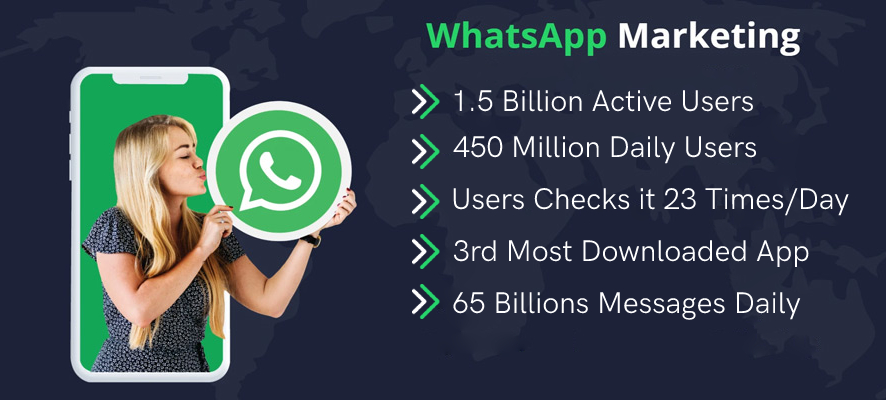
WhatsApp marketing is also very cost-effective. Unlike other digital marketing platforms, WhatsApp does not charge businesses to send messages or use its platform. This makes it a great choice for businesses on a budget.
In addition, WhatsApp marketing is very versatile. Businesses can use it to send out promotional messages, offer discounts and special deals, announce upcoming events, and much more. This allows businesses to create a variety of different campaigns that can be tailored to fit their needs.
Overall, WhatsApp marketing is an effective and cost-efficient way for businesses to reach a wide range of customers. It’s a great way to build relationships, promote products and services, and reach a global audience.
Hire Professionals For Creating WhatsApp Marketing Strategies
Creating a successful WhatsApp marketing strategy requires professional expertise due to a variety of factors.
First and foremost, professional marketers understand the importance of segmenting audiences, setting goals, and tracking performance. Professional marketers can help identify target audiences and create campaigns that are tailored to their needs. This helps ensure that the messages being sent through WhatsApp are relevant and engaging, which can help increase response rates. Professional marketers can also help track the performance of campaigns and optimize them for maximum return on investment.
Second, professional marketers understand the importance of compliance with WhatsApp terms of service. They can help businesses ensure that their campaigns adhere to all applicable laws and regulations, as well as WhatsApp’s own terms of service. This is critical for avoiding any legal trouble that could arise from running a campaign on WhatsApp.
Finally, professional marketers are well-versed in the best practices for running a WhatsApp campaign. They understand the importance of personalization, the benefits of using multimedia content, the value of leveraging automation, and other strategies for getting the most out of a WhatsApp marketing campaign. This knowledge can be invaluable in ensuring that the campaign is as successful as possible.
In summary, professional marketers are essential for creating successful WhatsApp marketing strategies due to their expertise in segmentation, compliance, and best practices. This expertise can help businesses ensure that their campaigns are as effective as possible and deliver the desired results.
WhatsApp marketing can be an effective way to reach a broad audience and engage with customers and prospects. By using the strategies mentioned above, you can create a strong connection with customers and increase the success of your business.
Why Hire OTTSEO To Create WhatsApp Marketing Strategies?
OTTSEO is one of the leading marketing firms for creating WhatsApp marketing strategies for businesses due to its extensive experience and expertise in digital marketing. They have a team of experienced digital marketers who understand the nuances of WhatsApp and how to leverage it for business growth.
Firstly, OTTSEO has a comprehensive understanding of the WhatsApp platform and the marketing tactics that work best for it. They understand how to create content that is engaging and relevant to your target audience and how to optimize the content for maximum reach. They also have the necessary tools and technology to track the effectiveness of the campaigns and make adjustments as needed.
Secondly, OTTSEO understands the importance of personalization when it comes to WhatsApp marketing. They know how to create personalized messages and campaigns that speak to the needs and interests of the target audience. By focusing on personalization, they can ensure that the messages they send out are tailored and effective.
Thirdly, OTTSEO has a wealth of experience in creating effective campaigns and strategies for businesses. They have helped numerous businesses to reach their goals through their campaigns, and they are well-versed in the various ways of maximizing the reach and impact of WhatsApp campaigns. They also know how to use analytics to track the success of the campaigns and make changes as needed.
Finally, OTTSEO is committed to providing excellent customer service to its clients. They are always available to answer any questions or concerns business owners may have and provide guidance on how to create an effective WhatsApp marketing strategy. They are also willing to customize their services to meet the specific needs of each business.
Overall, OTTSEO is the best marketing firm for creating WhatsApp marketing strategies for businesses because of their extensive experience and expertise in digital marketing, their comprehensive understanding of the WhatsApp platform, their focus on personalization, and their commitment to excellent customer service.
Frequently Asked Questions
Q: What is this guide about?
This comprehensive guide provides strategies and best practices for achieving success in your marketing efforts. Following these approaches can help improve your results and competitive advantage.
Q: How long does it take to see results?
Results vary depending on consistency and implementation quality. Most strategies require 3-6 months of dedicated effort before significant improvements become visible. Ongoing optimization is essential.
Q: Do I need professional help?
While basic implementation can be done independently, professional guidance often accelerates results and helps avoid common mistakes. Consider experts if you lack internal resources.
Q: What are the most important factors for success?
Key success factors include thorough research, consistent execution, quality over quantity, regular performance monitoring, and adapting to industry changes.
Q: How do I measure success?
Success depends on your goals but typically involves tracking KPIs like traffic, conversions, revenue, and engagement rates. Regular analysis helps identify improvements.
Q: What digital marketing channels should I focus on?
The best channels depend on your audience. Most businesses benefit from SEO, content marketing, social media, and paid advertising. Start where your audience is most active.
The Evolution of Digital Marketing: From Traditional to Modern Approaches
Digital marketing has undergone a remarkable transformation over the past two decades, evolving from simple banner advertisements and email campaigns to sophisticated, data-driven strategies that leverage artificial intelligence and machine learning. Understanding this evolution provides valuable context for developing effective modern marketing strategies that resonate with today’s consumers.
The early days of digital marketing were characterized by interruptive advertising tactics that prioritized visibility over relevance. Companies spent significant budgets on display ads that reached broad audiences but delivered limited engagement. As consumer behavior shifted and technology advanced, marketers began recognizing the value of permission-based marketing and targeted approaches that delivered personalized messages to specific audience segments.
Today’s digital marketing landscape demands integrated approaches that combine multiple channels and tactics into cohesive customer experiences. The most successful businesses recognize that modern consumers interact with brands through complex, non-linear journeys that span multiple devices and platforms. Meeting customers where they are requires sophisticated targeting capabilities, real-time personalization, and seamless cross-channel experiences.
The integration of marketing technology has enabled unprecedented levels of automation and optimization, allowing marketers to deliver the right message to the right person at the right time. These capabilities have transformed marketing from an art to a science, enabling continuous improvement based on real-time performance data and predictive analytics.
Strategic Content Development for Search Engine Success
Content remains the foundation of successful digital marketing, serving as the primary mechanism for attracting organic traffic, building brand authority, and engaging target audiences. Developing a comprehensive content strategy requires understanding search intent, creating valuable resources, and optimizing for both search engines and human readers. For a deeper dive, explore our guide on Discord Marketing 101.
Effective content addresses specific search queries while providing genuine value to readers. This requires deep understanding of your audience’s needs, questions, and pain points. The best content answers questions comprehensively, provides actionable insights, and offers unique perspectives that readers cannot find elsewhere.
Content optimization extends beyond keyword placement to include structural elements, readability, and multimedia integration. Well-structured content with clear headings, bullet points, and visual elements performs better in search results while delivering superior user experiences. Mobile optimization is particularly critical as mobile traffic continues growing.
Content promotion and distribution are equally important as creation. Even excellent content delivers limited results if target audiences cannot discover it. Strategic distribution leverages social media, email marketing, influencer partnerships, and paid promotion to maximize content reach and impact.
Data Analytics and Performance Measurement Fundamentals
Modern marketing success depends heavily on sophisticated analytics capabilities that enable data-driven decision making. Understanding which metrics matter most and how they connect to business outcomes allows continuous optimization of marketing efforts and improved return on investment.
Essential marketing metrics include traffic volume and sources, engagement rates, conversion rates, customer acquisition costs, and lifetime value. Each metric provides insights into different aspects of marketing performance, and comprehensive analysis reveals the full picture of marketing effectiveness.
Attribution modeling helps marketers understand how different touchpoints contribute to conversions. Multi-touch attribution provides more accurate pictures of customer journeys than last-click attribution, enabling better allocation of marketing budgets across channels and campaigns.
Advanced analytics approaches segment data by multiple dimensions to identify patterns and opportunities that aggregate data might miss. Understanding audience segments, channel performance, and campaign effectiveness enables continuous optimization and improved results over time.
Building Brand Authority Through Thought Leadership
Establishing thought leadership in your industry provides significant competitive advantages, including increased brand awareness, customer trust, and organic visibility. Thought leadership requires consistent creation of valuable content that demonstrates expertise and unique insights.
Effective thought leadership content addresses emerging trends, challenges conventional wisdom, and provides actionable guidance that readers can apply to their own situations. This type of content positions your brand as an authority that audiences can trust for reliable information and guidance.
Building thought leadership requires sustained effort over time, with consistent publication of high-quality content that addresses relevant industry topics. The most successful thought leadership strategies identify unique perspectives and expertise areas that differentiate your brand from competitors.
Distribution amplifies thought leadership impact. Strategic promotion through social media, email marketing, industry publications, and speaking opportunities extends reach and builds recognition among target audiences.
Maximizing Return on Marketing Investment
Proving and maximizing marketing return on investment requires clear objectives, sophisticated tracking, and continuous optimization. The most successful marketing organizations treat marketing as an investment that must deliver measurable returns rather than an expense that cannot be quantified.
ROI calculation requires understanding customer lifetime value, acquisition costs, and the contribution of marketing activities to revenue generation. These calculations enable informed budget allocation decisions and help identify the most effective marketing tactics for your specific business.
Continuous testing and optimization improve marketing performance over time. A/B testing, multivariate testing, and iterative improvement processes enable identification of optimal approaches and continuous enhancement of marketing effectiveness.
Marketing automation improves efficiency while enabling personalization at scale. Automating routine tasks frees marketing teams to focus on strategic initiatives while maintaining consistent customer experiences across touchpoints.
Future-Proofing Your Digital Marketing Strategy
The digital marketing landscape continues evolving rapidly, with emerging technologies, changing consumer behaviors, and new platforms creating both challenges and opportunities. Future-proofing your strategy requires staying current with trends while maintaining focus on fundamental marketing principles.
Artificial intelligence and machine learning continue transforming marketing capabilities, enabling more sophisticated targeting, personalization, and optimization. Businesses that embrace these technologies gain competitive advantages through improved efficiency and effectiveness.
Privacy regulations and changes to third-party cookies require adaptation of tracking and targeting approaches. First-party data strategies and consent-based marketing become increasingly important as the industry transitions to a privacy-focused environment.
Voice search, visual search, and AI-powered search experiences create new optimization requirements. Adapting content and technical strategies for these emerging search modalities positions businesses for success in evolving search environments.
Frequently Asked Questions
What is the difference between marketing strategy and marketing tactics?
Marketing strategy is the overarching plan that defines who you’re targeting, how you’ll position your brand, what you’re trying to achieve, and which broad channels and approaches will get you there. Tactics are the specific, executable actions that implement the strategy. Strategy: ‘We will become the go-to resource for e-commerce SEO, targeting Shopify merchants with $1M+ revenue, through content marketing and organic search.’ Tactics: ‘Publish 4 blog posts per week targeting Shopify SEO keywords, create an SEO audit tool for Shopify stores, run LinkedIn content targeting Shopify Plus merchants.’ Strategy should be stable for 12–24 months; tactics should be tested, measured, and adjusted monthly.
How do I create a marketing strategy from scratch?
Marketing strategy development process: (1) Market research — understand your target customers’ problems, alternatives they consider, and decision criteria; (2) ICP definition — create a detailed ideal customer profile based on your best existing customers; (3) Competitive analysis — map competitive positioning and identify gaps you can own; (4) Value proposition — articulate specifically why your ICP should choose you over alternatives (not generic ‘better, faster, cheaper’ but specific differentiation); (5) Channel strategy — select 2–3 primary channels where your ICP is reachable and purchase decisions are made; (6) Goals and KPIs — set specific, measurable 90-day and 12-month targets; (7) Budget allocation — distribute resources across channels based on expected ROI. Review quarterly, adjust monthly.
How do I measure marketing campaign success?
Marketing measurement framework by funnel stage: Awareness — reach, impressions, share of voice, branded search volume growth. Consideration — website sessions from target audiences, content engagement (time on page, scroll depth), email open/click rates, webinar attendance. Conversion — conversion rate, cost per lead (CPL), lead quality score (MQL rate), cost per acquisition (CAC). Revenue — customer lifetime value (CLV), CLV:CAC ratio, revenue by channel, payback period. Set campaign-specific KPIs before launch — never judge a campaign by metrics that weren’t predetermined goals. Report against these KPIs monthly and make data-driven optimization decisions rather than intuition-driven pivots.
What is the marketing funnel and how does it work?
The marketing funnel maps the stages customers move through from first awareness to loyal advocacy: TOFU (Top of Funnel) — Awareness: customer discovers a problem or your brand; content needs: educational blog posts, videos, social content, PR coverage. MOFU (Middle of Funnel) — Consideration: evaluating solutions; content needs: comparison guides, case studies, demos, webinars, detailed FAQs. BOFU (Bottom of Funnel) — Decision: ready to purchase; content needs: pricing pages, testimonials, free trials, sales calls, ROI calculators. Post-purchase — Retention and Advocacy: ongoing value delivery; content needs: onboarding content, customer education, loyalty programs, referral incentives. Each stage requires different messaging, content types, and conversion actions. A common mistake: investing only in TOFU awareness while neglecting the conversion stages where revenue is made.
How do I calculate marketing ROI?
Marketing ROI formula: (Revenue Attributed to Marketing − Marketing Cost) / Marketing Cost × 100 = ROI%. Example: $500,000 revenue attributed to marketing campaigns that cost $100,000 = 400% ROI. Attribution complexity: which touchpoints in a multi-touchpoint journey get credit? Models: first-touch (100% credit to first touchpoint — overweights awareness channels), last-touch (100% credit to last touchpoint — overweights direct/search), linear (equal credit to all touchpoints), time-decay (more credit to recent touchpoints), and data-driven (algorithmic based on actual path analysis — most accurate but requires significant data volume). Use data-driven attribution in GA4 for the most accurate picture of multi-channel marketing contribution to revenue.

Best Twitter Alternatives for Business and Marketing Success
Many Twitter alternatives have gained popularity ever since massive changes happened in the most popular…
Read More →
Mastering LinkedIn Lead Generation: A Comprehensive Guide
LinkedIn has emerged as the premier platform for B2B lead generation, offering unparalleled access to…
Read More →
Why Content Curation is a Must-Have in Your Digital Strategy
Content curation is more than just sharing. Finding the best material that appeals to your…
Read More →
Social Media Automation Tools To Boost Engagement in 2023
Just posting is insufficient today. According to social media statistics, the vast majority of businesses…
Read More →
Snapchat for Business: An Ultimate Guide to Promote Your Brand
Launched in 2011, Snapchat. Snapchat is still in the top 15 most popular social media…
Read More →-
 By Guy Sheetrit
- Feb 13, 2023
 By Guy Sheetrit