Social commerce is a form of e-commerce that is conducted through social media platforms. It is a relatively new phenomenon that has become increasingly popular in recent years, as more. More people are turning to social media to shop.
Social commerce works by enabling users to shop directly from a company’s social media page. This eliminates the need for shoppers to visit a company’s website and allows them to purchase items quickly and conveniently. Social commerce also allows companies to interact directly with their customers, as they can respond to comments and questions directly on their social media pages.
The growth of social commerce has been exponential. In 2020, it was estimated that global social commerce sales had reached $559.7 billion,. It is projected to grow to $2900 billion by 2026. This growth can be attributed to the increasing number of people using social media, as well as the convenience. Ease of use that social commerce offers.
Explore more in our digital marketing guide and social media marketing resources.

Social commerce is beneficial for both businesses and consumers. It is an effective way for businesses to reach a wider audience and increase their sales. It also allows them to interact directly with their customers and build relationships. For consumers, social commerce is convenient and easy to use, as they can shop from the comfort of their own homes. Additionally, it allows them to access exclusive deals and discounts that are not available on traditional websites.
What is Social Commerce?
Social commerce is a form of e-commerce that involves the use of social media networks to aiding in the online buying. Selling of products and services.
It combines the use of social networks, such as Facebook, Twitter. Instagram, with shopping marketplaces, such as Amazon and eBay, to create an interactive shopping experience.
It allows customers to connect with the brand and other customers, share reviews and recommendations, and make purchases directly on the social media platform.
Social commerce also enables businesses to target customers with personalized product recommendations and offers, as well as to track customer behavior and preferences. Social commerce has become an increasingly popular way of doing business, as it allows companies to reach a wider audience, reduce costs, and increase sales.
Social Commerce vs. eCommerce: What’s The Difference
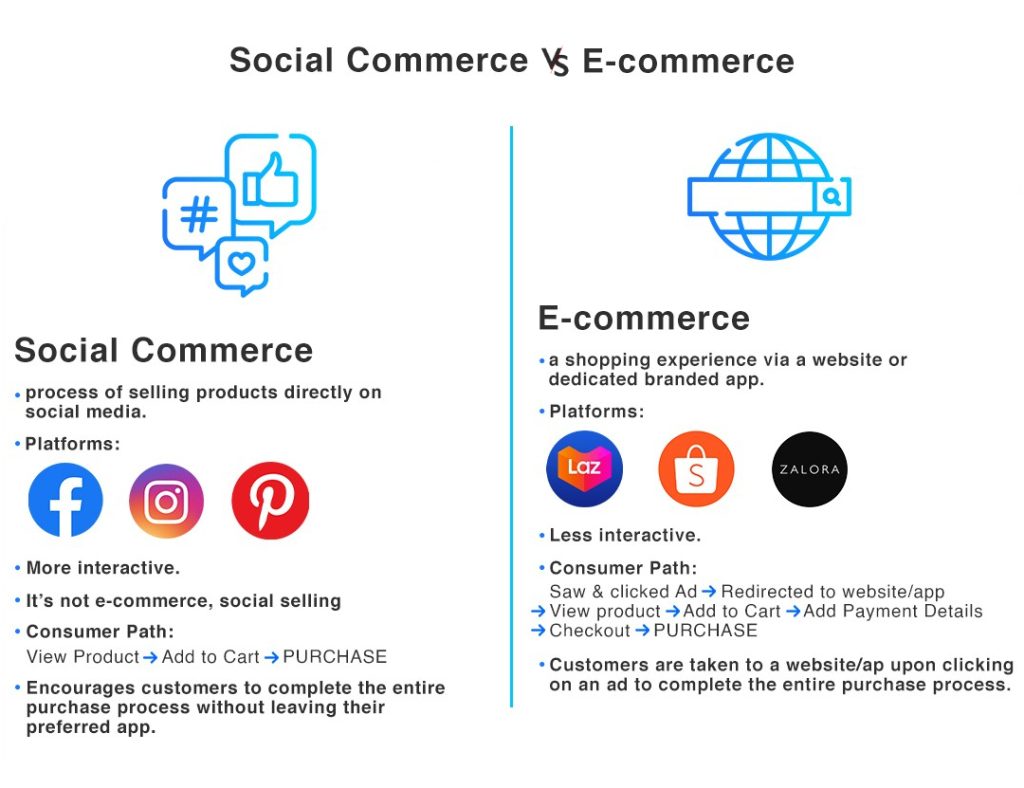
Social commerce is a subset of e-commerce that focuses on social media platforms. It is the use of social media platforms to facilitate the buying and selling of products and services. It is a way for businesses to reach out to their target audience, engage them, and ultimately drive sales.
E-commerce, on the other hand, is the buying and selling of goods and services online. It is the process of buying and selling goods and services over the internet. It has been around for decades and is one of the most popular and efficient ways to transact business.
The major difference between social commerce and e-commerce is that social commerce is focused on leveraging social media platforms to promote products. Services while e-commerce is focused on providing an online platform for customers to purchase goods and services.
Social commerce takes advantage of the interactivity and engagement of social media to create relationships and build brand awareness. It also uses data and analytics to identify target audiences and then market to them.
E-commerce, on the other hand, is focused on providing an online platform for customers to purchase goods and services. It relies heavily on search engine optimization to attract customers and increase sales. E-commerce sites are often more complex and require more advanced coding and design than social commerce sites.
In conclusion, social commerce and e-commerce are both forms of online commerce,. They differ in the way they are used to promote products and services.
Social commerce leverages the interactivity of social media platforms to engage customers, build relationships, and drive sales. E-commerce, on the other hand, is focused on providing an online platform for customers to purchase goods and services.
5 Reasons Why You Should Try Social Commerce
Here are 5 major reasons why you should try social commerce:
1. Increased Engagement
Social commerce is an effective way to engage with customers and build relationships. Through social media platforms like Facebook, Twitter, and Instagram, businesses can interact with customers in real-time, respond to questions. Inquiries quickly, and build connections with their target audience.
2. Reach New Audiences
Social commerce allows businesses to reach new audiences and expand their reach. By leveraging popular social media networks, businesses can reach potential customers that may not have been aware of their products and services before.
3. Cost-Effective
Social commerce is a cost-effective way to reach customers. Unlike traditional advertising, social media platforms are free to use, and businesses can reach a large audience for a fraction of the cost.
4. Higher Conversion Rates
Social commerce increases conversion rates by providing customers with an easy way to purchase products and services. With the addition of social media “buy now” buttons, customers can purchase items directly from the platform, eliminating the need to leave the site or app.
5. Improved Customer Service
Social commerce also provides businesses with an opportunity to provide better customer service. By responding to customer queries and complaints in real-time, businesses can build trust and loyalty with their customers.
5 Tips For Effective Social Commerce
There are a few steps you should do after setting up your social media store to make sure you maximize your revenue from this channel. Here are a few examples:
1. Pay attention to your audience.
You have all the data you require about your audience thanks to social media. Pay attention to your audience to get the most out of it.
Keep a close eye on the shares and comments you receive on your shop. When necessary, respond to them or provide customer service.
You can track your audience across all social media channels with the use of tools like Hootsuite. You’ll stay informed about client feedback and business news in this way. For a deeper dive, explore our guide on Social Listening.
2. Get your audience involved
Don’t forget the “social” in “social commerce.” There is more to social commerce than just posting your catalog. Hoping for sales to come flooding in.
In order to keep your audience entertained, you must provide value, respond to inquiries, and produce engaging material. They need to recognize your humanity and authenticity. A chatbot can be set up to assist customers while they make purchases from you.
3. Review requests
If you want to create a successful internet business, gathering social proof is crucial. Approximately 99.99% of buyers claim to read reviews when shopping online, according to Power Reviews research.
So ask for reviews if you sell a product that people like. After your product is delivered, you may send them an automated email asking what they think of it. Alternatively, you could provide incentives like a giveaway to entice current customers to leave reviews for your products.
Post your favorable evaluations on social media and mention them in emails as you receive them. Possibilities include posting user-generated content, a carousel of favorable reviews, and even hosting a live video with pleased clients.
4. Utilize Hootsuite to broadcast items
Users of Hootsuite who use e-commerce platforms like Shopify, Bigcommerce, Woocommerce,. Magento can post items from their online stores on social media using the Shopview app, even though this isn’t technically social commerce. This is a simple method for using social media to enhance the online buying experience for your clients.
From a single social media management dashboard, Hootsuite users may sell goods directly to social media using the Shopview app.
However, you shouldn’t end there. Build a solid advertising and social commerce plan that will help your posts reach the appropriate people at the right time if you want to maximize your success with social commerce.
5. Streamline sales and customer support by using an AI chatbot.
A prompt, competent response can occasionally be the difference between a confirmed sale and a cart that has been abandoned. However, as was already said, manually responding to every comment can be time-consuming.
You can automate customer service answers and make sure that clients are taken care of even when your team is not available with the correct tools.
The Best Social Media Platforms For Social Commerce
The best social media platforms for social commerce are:
Facebook is one of the most popular social media platforms and is a great platform for social commerce. It allows businesses to set up a page and create ads that are targeted toward a specific audience. Businesses can also use Facebook to post updates about their products and services and interact with customers.
Instagram is a great platform for businesses to engage with their customers. It allows businesses to create visually appealing posts that showcase their products and services. Additionally, customers can comment and share posts, making it easier for businesses to build a relationship with their customers.
Advertising your eCommerce business on Instagram can be a highly effective way to reach your target audience and drive sales. With over 1 billion active monthly users, Instagram offers a large. Engaged audience that can be targeted through various ad formats, such as photo, video, carousel, and story ads. By creating visually appealing content that showcases your products. Using strategic targeting, you can effectively reach your desired audience, increase brand awareness, and drive traffic to your website.
To maximize your advertising efforts, consider utilizing Instagram shopping features, such as product tags. The shopping tab, to make it easy for users to shop for your products directly from the platform. Overall, advertising on Instagram can be a cost-effective and scalable way to grow your eCommerce business.
TikTok
TikTok Shop is still available in the UK and Asia despite the social media platform’. S recent decision to abandon ambitions to sell it outside of north america. On TikTok Shop, there are three ways to sell your goods: Videos in the feed, a product showcase tab, and LIVEs. Additionally, are you familiar with the hashtag #TikTokMadeMeBuyIt? This hashtag has been used 7 billion times by users to show what they’ve bought as a result of recommendations on TikTok. So if you have seen it, you are aware that if you want to remain relevant with your audience, selling your items on TikTok is a no-brainer.
Twitter is another popular social media platform that is great for businesses. It allows businesses to post updates, respond to customer inquiries, and engage with their customers in real-time. Additionally, businesses can use Twitter to create ads that are targeted toward a specific audience.
One of the first social media sites to enable members to buy and sell goods was Pinterest back in 2015. They accomplished this using standard pins with fields for availability and cost details. However, because they drive users to a landing page with a focus on the product to complete the transaction, these pins aren’t direct social commerce features.
You can make Product Pins, which are shown in your Pinterest Shop, if you have a Pinterest business account. The “Buy” button is located beneath each pin,. If your consumer is located in the United States, they can click it to finish their purchase without leaving the app.
Overall, the above-mentioned platforms are the best social media platforms for social commerce. They allow businesses to post updates, create ads, interact with customers, and build relationships with their customers.
Frequently Asked Questions
Q: What is this guide about?
This comprehensive guide provides strategies and best practices for achieving success in your marketing efforts. Following these approaches can help improve your results and competitive advantage.
Q: How long does it take to see results?
Results vary depending on consistency and implementation quality. Most strategies require 3-6 months of dedicated effort before significant improvements become visible. Ongoing optimization is essential.
Q: Do I need professional help?
While basic implementation can be done independently, professional guidance often accelerates results and helps avoid common mistakes. Consider experts if you lack internal resources.
Q: What are the most important factors for success?
Key success factors include thorough research, consistent execution, quality over quantity, regular performance monitoring, and adapting to industry changes.
Q: How do I measure success?
Success depends on your goals but typically involves tracking KPIs like traffic, conversions, revenue, and engagement rates. Regular analysis helps identify improvements.
Q: What digital marketing channels should I focus on?
The best channels depend on your audience. Most businesses benefit from SEO, content marketing, social media, and paid advertising. Start where your audience is most active.
The Evolution of Digital Marketing: From Traditional to Modern Approaches
Digital marketing has undergone a remarkable transformation over the past two decades, evolving from simple banner advertisements. Email campaigns to sophisticated, data-driven strategies that leverage artificial intelligence and machine learning. Understanding this evolution provides valuable context for developing effective modern marketing strategies that resonate with today’s consumers.
The early days of digital marketing were characterized by interruptive advertising tactics that prioritized visibility over relevance. Companies spent significant budgets on display ads that reached broad audiences but delivered limited engagement. As consumer behavior shifted and technology advanced, marketers began recognizing the value of permission-based marketing. Targeted approaches that delivered personalized messages to specific audience segments.
Today’s digital marketing landscape demands integrated approaches that combine multiple channels and tactics into cohesive customer experiences. The most successful businesses recognize that modern consumers interact with brands through complex, non-linear journeys that span multiple devices and platforms. Meeting customers where they are requires sophisticated targeting capabilities, real-time personalization, and seamless cross-channel experiences.
The integration of marketing technology has enabled unprecedented levels of automation. Optimization, allowing marketers to deliver the right message to the right person at the right time. These capabilities have transformed marketing from an art to a science, enabling continuous improvement based on real-time performance data and predictive analytics.
Strategic Content Development for Search Engine Success
Content remains the foundation of successful digital marketing, serving as the primary mechanism for attracting organic traffic, building brand authority, and engaging target audiences. Developing a comprehensive content strategy requires understanding search intent, creating valuable resources, and optimizing for both search engines and human readers.
Effective content addresses specific search queries while providing genuine value to readers. This requires deep understanding of your audience’s needs, questions, and pain points. The best content answers questions comprehensively, provides actionable insights, and offers unique perspectives that readers cannot find elsewhere.
Content optimization extends beyond keyword placement to include structural elements, readability, and multimedia integration. Well-structured content with clear headings, bullet points, and visual elements performs better in search results while delivering superior user experiences. Mobile optimization is particularly critical as mobile traffic continues growing.
Content promotion and distribution are equally important as creation. Even excellent content delivers limited results if target audiences cannot discover it. Strategic distribution leverages social media, email marketing, influencer partnerships, and paid promotion to maximize content reach and impact.
Data Analytics and Performance Measurement Fundamentals
Modern marketing success depends heavily on sophisticated analytics capabilities that enable data-driven decision making. Understanding which metrics matter most and how they connect to business outcomes allows continuous optimization of marketing efforts and improved return on investment.
Essential marketing metrics include traffic volume and sources, engagement rates, conversion rates, customer acquisition costs, and lifetime value. Each metric provides insights into different aspects of marketing performance, and comprehensive analysis reveals the full picture of marketing effectiveness.
Attribution modeling helps marketers understand how different touchpoints contribute to conversions. Multi-touch attribution provides more accurate pictures of customer journeys than last-click attribution, enabling better allocation of marketing budgets across channels and campaigns.
Advanced analytics approaches segment data by multiple dimensions to identify patterns and opportunities that aggregate data might miss. Understanding audience segments, channel performance, and campaign effectiveness enables continuous optimization and improved results over time.
Building Brand Authority Through Thought Leadership
Establishing thought leadership in your industry provides significant competitive advantages, including increased brand awareness, customer trust, and organic visibility. Thought leadership requires consistent creation of valuable content that demonstrates expertise and unique insights.
Effective thought leadership content addresses emerging trends, challenges conventional wisdom, and provides actionable guidance that readers can apply to their own situations. This type of content positions your brand as an authority that audiences can trust for reliable information and guidance.
Building thought leadership requires sustained effort over time, with consistent publication of high-quality content that addresses relevant industry topics. The most successful thought leadership strategies identify unique perspectives and expertise areas that differentiate your brand from competitors.
Distribution amplifies thought leadership impact. Strategic promotion through social media, email marketing, industry publications, and speaking opportunities extends reach and builds recognition among target audiences.
Maximizing Return on Marketing Investment
Proving and maximizing marketing return on investment requires clear objectives, sophisticated tracking, and continuous optimization. The most successful marketing organizations treat marketing as an investment that must deliver measurable returns rather than an expense that cannot be quantified.
ROI calculation requires understanding customer lifetime value, acquisition costs, and the contribution of marketing activities to revenue generation. These calculations enable informed budget allocation decisions and help identify the most effective marketing tactics for your specific business.
Continuous testing and optimization improve marketing performance over time. A/B testing, multivariate testing, and iterative improvement processes enable identification of optimal approaches and continuous enhancement of marketing effectiveness.
Marketing automation improves efficiency while enabling personalization at scale. Automating routine tasks frees marketing teams to focus on strategic initiatives while maintaining consistent customer experiences across touchpoints.
Future-Proofing Your Digital Marketing Strategy
The digital marketing landscape continues evolving rapidly, with emerging technologies, changing consumer behaviors, and new platforms creating both challenges and opportunities. Future-proofing your strategy requires staying current with trends while maintaining focus on fundamental marketing principles.
Artificial intelligence and machine learning continue transforming marketing capabilities, enabling more sophisticated targeting, personalization, and optimization. Businesses that embrace these technologies gain competitive advantages through improved efficiency and effectiveness.
Privacy regulations and changes to third-party cookies require adaptation of tracking and targeting approaches. First-party data strategies and consent-based marketing become increasingly important as the industry transitions to a privacy-focused environment.
Voice search, visual search, and AI-powered search experiences create new optimization requirements. Adapting content and technical strategies for these emerging search modalities positions businesses for success in evolving search environments.
Frequently Asked Questions
Which social media platforms should my business focus on?
Platform selection depends on your target audience and business type. B2B companies: LinkedIn (decision-maker targeting, thought leadership content), YouTube (tutorial. Demo content that ranks in Google), and Twitter/X (industry conversation and real-time engagement). B2C e-commerce: Instagram (product discovery, visual content), TikTok (viral reach, Gen Z and Millennial audiences), and Pinterest (high-AOV audiences for home, fashion, food). Local businesses: Facebook (established local community presence, events, reviews) and Google Business Profile (technically not social but drives local search conversions). Choose 2 platforms and execute excellently rather than maintaining a mediocre presence on 5.
How often should I post on social media for business?
Platform-specific posting frequency for optimal algorithm performance: Instagram — 4–7 Reels per week for reach, 3–5 feed posts per week for engagement, daily Stories for retention. TikTok — 1–3 times daily for algorithm momentum (quantity drives discovery on TikTok). LinkedIn — 3–5 times per week for thought leadership, engagement-focused rather than promotional. Facebook — 3–5 times per week, prioritize video and community-building content. YouTube — weekly consistency matters more than daily volume; one high-quality video per week outperforms daily low-quality uploads. Always prioritize consistency and quality over raw frequency.
How do social media algorithms work?
Social media algorithms prioritize content based on: predicted engagement (how likely this content is to generate likes, comments, shares based on past performance and audience behavior), watch time and completion rate (especially for video — finishing a video signals quality to algorithms), early engagement velocity (content that gets strong engagement in the first 30–60 minutes gets boosted to broader audiences), user relationship signals (content from accounts users regularly interact with gets prioritized), and platform-specific signals (LinkedIn prioritizes native documents and polls. Tiktok prioritizes completion rate and rewatches; instagram prioritizes reels watch time and shares).
How do I grow my social media following organically?
Organic social growth strategies: (1) Niche down — accounts with a clear, specific focus grow faster than generalist accounts because algorithms categorize and recommend them more effectively. (2) collaborate with complementary creators — cross-promotion exposes your content to qualified new audiences; (3) optimize posting times using your analytics platform’s audience activity data; (4) use trending audio on reels and tiktok — platform-boosted sounds give your content algorithmic lift; (5) engage authentically — comment substantively on larger accounts in your niche (visible to their audiences); (6) repurpose your best content across platforms; (7) analyze your top-performing posts and double down on similar content formats and topics.
What social media metrics actually matter for business?
Business-relevant social media metrics: Awareness — reach (unique accounts seeing content), impressions (total views including repeat), and follower growth rate. Engagement — engagement rate (interactions/reach, not followers), saves (indicate content value), and shares (indicate virality potential). Traffic — click-through rate to website, sessions from social in GA4, and landing page conversion rate from social traffic. Revenue — revenue attributed to social channels, ROAS from paid social, and customer acquisition cost from social. Vanity metrics to deprioritize: follower count without engagement, raw like counts, and impression totals without conversion data. Report monthly against business KPIs, not just platform metrics.

Best Twitter Alternatives for Business and Marketing Success
Many Twitter alternatives have gained popularity ever since massive changes happened in the most popular…
Read More →
Mastering LinkedIn Lead Generation: A Comprehensive Guide
LinkedIn has emerged as the premier platform for B2B lead generation, offering unparalleled access to…
Read More →
Why Content Curation is a Must-Have in Your Digital Strategy
Content curation is more than just sharing. Finding the best material that appeals to your…
Read More →
Social Media Automation Tools To Boost Engagement in 2023
Just posting is insufficient today. According to social media statistics, the vast majority of businesses…
Read More →
Snapchat for Business: An Ultimate Guide to Promote Your Brand
Launched in 2011, Snapchat. Snapchat is still in the top 15 most popular social media…
Read More →-
 By Guy Sheetrit
- Feb 2, 2023
 By Guy Sheetrit


