In digital marketing, artificial intelligence and machine learning have shown their value. Will they, however, take content writers’ jobs? Although it seems improbable, marketers can use AI to raise the caliber of content creation.
According to Statista, the total amount of data generated worldwide will reach more than 180 zettabytes by 2025. And there is no doubt that ML and AI will contribute to the generation of this content.
Contrary to what some experts believe, artificial intelligence (AI) can be a highly effective assistant in increasing the productivity of content authors.
In fact, I think that leveraging AI to create content can help businesses provide excellent customer service. The ability of AI to process and evaluate data can be used to produce content tailored to individual customers.
Do you have any doubts about what I’m saying? Do you require some persuasion?
Let me explain how AI is already used in the process of creating content and how it will affect content marketing in the future.
Let’s begin straight away.
The Future of Content Creation is AI: 7 Reasons
Comparatively speaking to other areas of digital marketing, content creation is more of a human-centered profession.
But, in order to increase the quantity and quality of their work, content writers might benefit from any form of help. That’s where AI entered the picture and changed the way we produce content.
Check out these 7 ways that AI-powered content creation is transforming content marketing.
1. Personalization is Increased in Content Production Using AI
Are you aware that in this day and age, personalization is essential for enhancing consumer engagement?
Marketers also need a better understanding of their client’s needs and expectations in order to produce customized content. AI-powered content creation can be very beneficial in this situation.
With the help of artificial intelligence and machine learning, it is possible to collect important consumer data and evaluate it to develop targeted customer profiles and segments. You can be sure that you will be able to collect client data while observing rules in the future when cookies won’t be used.
To better interact with your customers, you can use this information to create highly personalized recommendations and communications.
Marketers nowadays have left behind generalized email marketing campaigns and with the help of AI-powered solutions, they can produce tailored email marketing content.
You can create a powerful combination if you combine these with solutions for mass email verification. As a result, if you work in the communications industry, AI might be a huge benefit to you.
What is the outcome? better lead generation and engagement. Artificial content creation is essential because of this.
2. It Can Provide Natural Language Generation
That machines can “learn” has been demonstrated.
The automated software process is known as “Natural Language Generation (NLG)” enables artificial intelligence (AI) to create text based on what it learns from the available data.
You might be shocked to learn that a number of well-known media outlets, like The New York Times, The Washington Post, Reuters, and others, currently use NLG technologies to produce content.
Some of the more effective NLG solutions in use today include QuillBot, Amazon Polly, Google’s Text-to-Speech, and Wordsmith.
Such AI tools can be used to write anything, including product descriptions, tweets, business data reports, news stories, and even poetry.
The good news for content creators is what? Companies may establish a structure and rules for their content requirements, and NLG technologies can quickly and effectively finish the tales.
Further, for the generation of high-quality content, humans and machines will collaborate even more closely.
3. Minor requirements for content can be automated.
Let’s face it, humans, no matter how fast they are, can only write at a certain pace.
What if you had a capable assistant that could handle your content needs on a minor level?
The aforementioned AI techniques can create customized content with little assistance from people.
For social media posts, quick reports, news updates, and notifications for personal messaging apps, data-specific content can be generated using artificial intelligence (AI).
Also, the entire process of creating content with AI may be automated with little involvement from humans. One of the best B2B content marketing strategies is to use this to boost your content creation and increase traffic and leads.
You can anticipate that as AI technology develops, it will handle such content-generation activities much more effectively.
4. It Can Create New Keywords and Topics
AI has the unique ability to analyze data and derive insights in ways that humans will never be able to.
The analysis of client data by AI can yield useful insights for content production.
It can provide you with a precise picture of the interests and preferences of your target audience. This is how you may think of original themes that will appeal to your target audience.
Can AI be used to create material that is more SEO-friendly? Most definitely.
Semrush and Ahrefs, two sophisticated keyword research tools, are capable of calculating keyword search volume, organic competition, and a number of other variables to assist marketers in selecting the precise phrases necessary to meet SEO objectives.
For keyword research, using AI technologies can make the process go more quickly.
It can provide more precise results to aid content creators in successfully engaging their target audience.
In order to maximize their content marketing ROI, AI assists writers in writing material in accordance with the most recent blogging trends.
5. It can raise the effectiveness of content on social media.
AI can help you create better social media content. Let’s examine the potential for that.
Building a brand’s presence on social media and driving more visitors to targeted landing sites are the key objectives of social media content.
Also, marketers extensively rely on consumer demographics when developing social media content. In this regard, AI has proven to be a game-changer.
Artificial intelligence-powered tools can assess consumer behavior, sentiment, and preferences in addition to demographic data.
With the use of this useful information, marketers can optimize their SMM activities and boost user engagement. It can also be used to locate and follow up on sales leads, strengthening your sales funnel.
6. It Can Curate User-Generated Content
Today’s social media users excel at both producing and consuming content.
User-generated content (UGC) is more likely to serve as the foundation for millennials’ purchasing decisions than branded material.
This generation is significantly more open to discussing their shopping experiences and thoughts about businesses with their connections on social media.
You would undoubtedly want to use UGC as a brand to analyze and improve your reputation.
AI systems may comb through different social media channels to find brand mentions and gather comments and consumer reviews about your company and its goods.
AI can recognize photographs and videos utilizing visual recognition technologies in addition to user-generated text about your products.
In order to increase brand awareness and trust on social media, AI algorithms can filter high-quality UGC.
7. It Delivers Quality Customer Service
We all know how chatbots are already proving to be beneficial in lessening the obligations of customer support workers. An AI-powered live chat platform minimizes your customer care efforts while responding to customers around-the-clock.
Because of deep learning and the addition of AI, sophisticated chatbots can now comprehend client inquiries and respond to them similarly to humans.
AI-assisted chatbots can deliver the most pertinent information to clients based on their unique needs:
- Recognize a product’s USP
- They finish their purchases.
- Learn about the various sorts of referral programs
- Create a connection with your brand.
AI chatbots can improve customer experience and customers’ purchasing experiences by removing response delays and providing the precise information that customers are seeking.
6 Best AI Content Writing Tools
By assisting you in transforming your content (such as blog pieces) into top search result performers, the best AI marketing solutions enable you to carry out your marketing strategy.
1. Copy AI
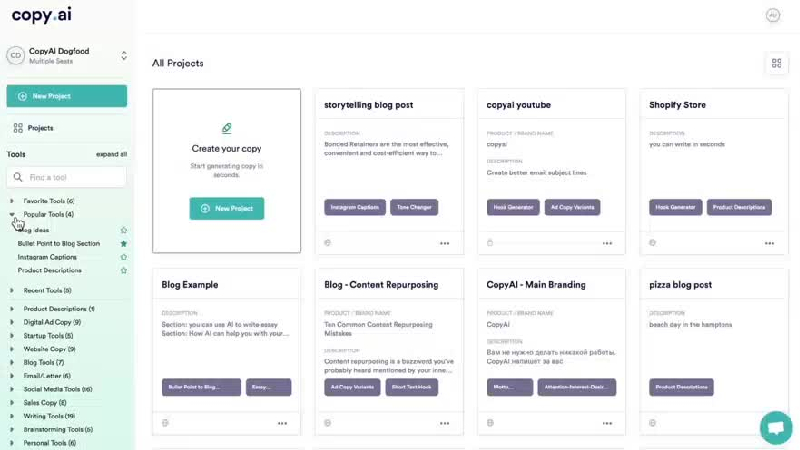
With the help of CopyAI’s numerous automated copy-generating tools, you may overcome writer’s block. CopyAI has you covered whether you’re at a loss for what to write for Instagram captions, those nurturing email subject lines, or if you’re trying to launch a new business but aren’t sure what to call it.
Instead of only producing social media captions and short-form material, CopyAI can now have long-form texts.
2. Surfer
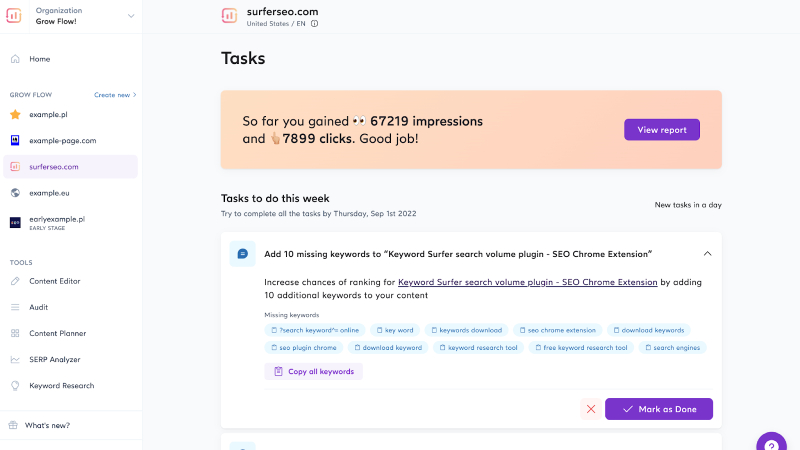
In order to make sure you’re always generating pertinent content, Surfer is an AI-powered content production tool that combines keyword research, content editing, domain analysis, and SERP analysis with the content planning. This application contains a tonne of functionality for everything related to article writing.
3. GrowthBar

One more item is taken care of for you because Surfer’s document editor allows you to copy and paste directly into the platform of your choice and is already prepared for HTML. It has evolved into a complete solution with Surfer’s AI writing tool, Surfy.
GrowthBar is an AI-powered marketing platform that lets you generate your content, research keywords, and optimize it all in one place. This means that conducting research and then creating content doesn’t require using two different apps. GrowthBar has everything on a single platform.
Everything from writing basic paragraphs or complete articles to creating sales letters is possible.
4. Article Forge

As opposed to the previous marketing solutions, which only allowed you to optimize the material you had already produced, Article Forge uses AI to create the content for you. It creates full articles for you, making it one of the best content-generation tools.
Article Forge will create a high-quality first draught for you to use. Yet, given its Intelligence, it’s already a good idea to have a set of human eyes go over it for grammar and spelling. It might even be good enough to publish right away.
The keywords you want to use are sent to Article Forge, and it takes care of the rest.
5. Scale Nut
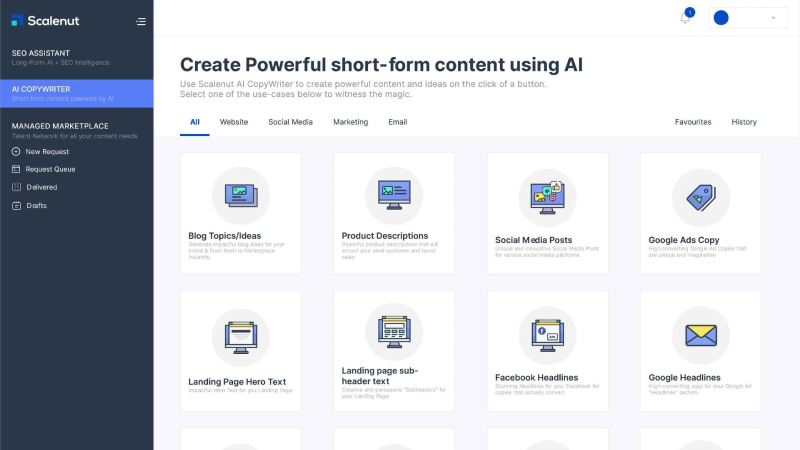
To assist you in creating content, Scalenut is a content marketing platform that combines keyword research and optimization tools. With tools and features that automate every step of the process, Scalenut’s SEO Assistant enables you to create content that is optimized for search engines. Jasper has integration with Surfer SEO, but Scale Not offers the best of both worlds without requiring you to buy two different programs. You enter your keyword, and you are presented with a document editor built around it. It has a panel on the left that I like that shows your rivals.
The Scalenut commands are a little trickier to use and traverse than other tools. There are precise commands you give to generate content rather than just a simple button.
6. WriteSonic

You can produce original content using WriteSonic based on your requirements. You can use templates in WriteSonic to make an outline for your writing.
Your target audience will be easier to reach, and it will help you get through writer’s block so you can come up with original content. The best option for authors who are having trouble coming up with new content ideas is WriteSonic.
You may produce content that is extremely engaging, distinctive, fascinating, and shareable on a variety of channels. It has a free trial and is accessible to PC and Mac users.
Are You Prepared to Try Content Creation Using AI?
Using AI to create content is the future, I’m sure you can see that now.
It’s crucial for marketers to produce high-quality content to establish a consistent brand image online, and adopting AI tools to accomplish this work is a wise and cutting-edge decision.
Investigate the top AI-assisted technologies available and see how they may elevate your content creation process to a whole new level.
You might be pleasantly surprised by what this technology can achieve for your organization.
-
 By SEO
- Mar 14, 2023
 By SEO