Just posting is insufficient today. According to social media statistics, the vast majority of businesses market through social media platforms.
Also, you must continually be active on all the platforms where your audience is present if you want to leave an impression on them. Nonetheless, managing all the facets of social media is a massive undertaking.
But why stress when you have so many tools at your disposal to help you out on the social media front?
Explore more in our digital marketing guide and social media marketing resources.
These social media automation tools provide a tonne of features that will help you protect your online presence and monitor its effectiveness.
Hence, you can concentrate on what matters the most—your business—instead of worrying about what to post and when. Choose the appropriate social media tools to streamline your marketing efforts.
In this piece, we’ll walk you through some of these social media automation tools. You can improve your marketing and elevate your branding.
13 Best Social Media Automation Tools
1. SocialPilot
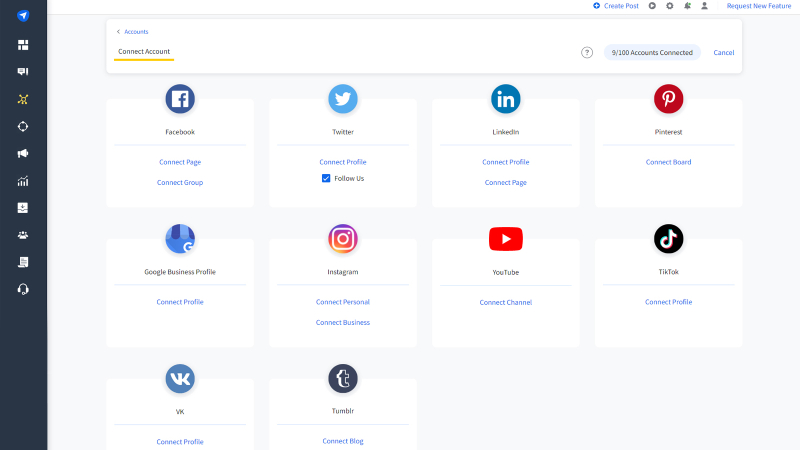
A social media automation solution for small to enterprise-sized enterprises is called SocialPilot. Expect to take advantage of a tonne of features with this adaptable platform, including social media scheduling, calendar management, content curation, powerful analytics, client administration, and more.
Furthermore, SocialPilot can meet your needs regardless of the social media platform you are utilizing. Having said that, the application allows you to simultaneously merge accounts from LinkedIn, Facebook, Pinterest, Twitter, YouTube, Instagram (Direct Publishing), and TikTok.
SocialPilot facilitates collaboration when it comes to managing social media as a team. You don’t have to transfer to another app to connect with other colleagues because the approval and feedback workflow is seamless.
You can keep track of your social media initiatives using SocialPilot’s useful social media calendar function. Your calendars can include filters, and groups and accounts can be used to track the success of your social media initiatives.
Finally, SocialPilot users can assess their social media post-performance based on the level of engagement of their competitors, influencers, and demographics.
2. ContentStudio

A well-known all-in-one social media management application called ContentStudio provides analytics, a social inbox, content planning, social media scheduling, content automation, and content discovery.
Additionally, you may use the Content Planner feature of ContentStudio to schedule, organize, and control where and when information is shared or published.
A social media content calendar is offered by ContentStudio, which makes it simple to examine, accept, reject, and amend posts. This lessens the possibility of sending out content that is inaccurate or contains errors. Also, team members can simply work together. For instance, your social media manager, designer, and copywriter can all offer ideas, add images, and immediately produce captions.
You can also think of your material as a part of a well-organized list to lessen clutter. You can organize postings in the content calendar by type, status, member, and even labels for convenience.
3. Hootsuite

A well-liked social media automation tool for marketers is Hootsuite. It is compatible with a wide range of social media sites because of its powerful features. Due to the complicated features and wide price range, it mostly targets large businesses and large-sized agencies.
Moreover, Hootsuite’s social media streams let you keep an eye on several social media sites at once. And sure, with its real-time updates, you can use it to keep a watch on all of your businesses.
4. Buzzsumo

If you want to better understand your content marketing methods, BuzzSumo is a vital social media search tool. Use BuzzSumo to find some of the trending keywords in your market instead of wasting time speculating on the content themes.
Due to its capacity to offer comprehensive insights into what your competitors are doing, BuzzSumo has become one of the most well-liked social media marketing tools over time.
By typing a keyword or domain name into the search bar, BuzzSumo can assist you in finding the most popular content,. Will help you become a clever content marketer and keep one step ahead of your rivals.
Depending on your preferences, you can restrict your results by everything from location to duration. In addition, BuzzSumo can gather data from well-known social media sites including Facebook, Pinterest, LinkedIn, and Twitter.
5. Sprout Social
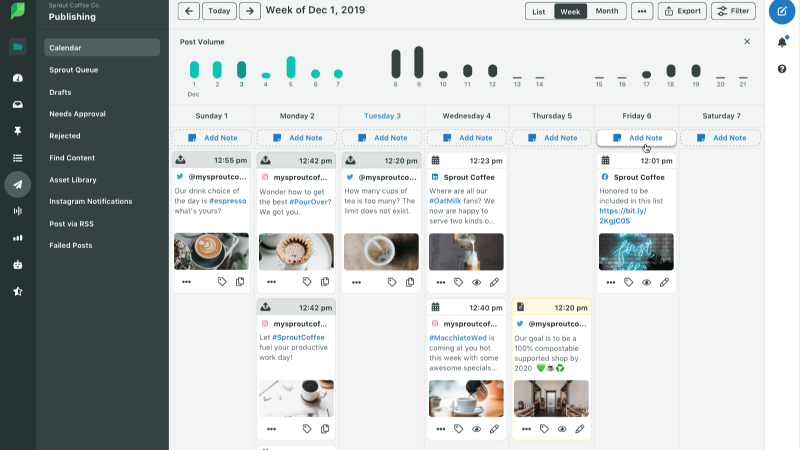
Another social media engagement tool you may utilize to master social media marketing is Sprout Social. Users of Sprout Social can plan tasks and assign them to group members. Also, using this technology makes it easier to run advertisements on specific social media networks.
You may schedule your posts or campaigns using this application, which also offers statistics and social listening capabilities. What else? Small and large businesses of all sizes are served by Sprout Social.
6. Buffer
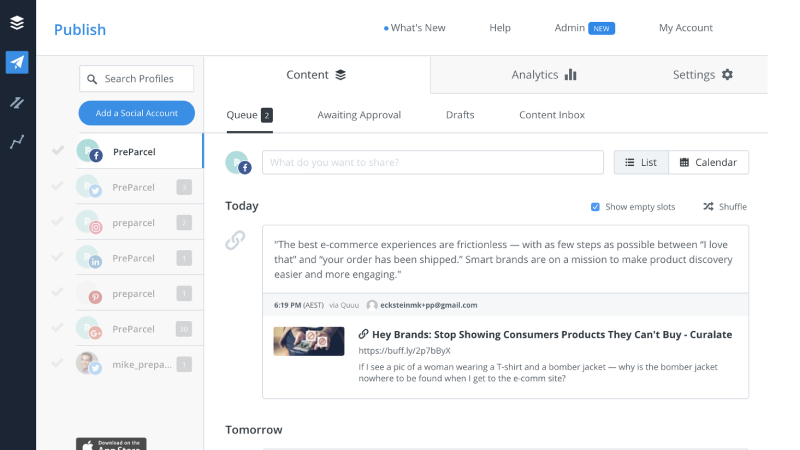
One of the well-known social media marketing automation platforms with scheduling capabilities is Buffer. Users of LinkedIn, Twitter, Instagram, and Facebook will find this tool useful. The Pinterest feature is available to customers that have the pro plan as well. Those with lower packages, however, will only be able to join a small number of social network accounts.
As a new user, you may decide whether to use Buffer’s preset scheduling options or modify your automation to suit your requirements. Users of this social media automation service are automatically given four slots every day. Depending on how many campaigns you need to post each day, you can choose to either eliminate or add spaces.
There is a Buffer browser plugin for Chrome, Safari, and Firefox. By selecting the Buffer symbol to add the post to your queue, you can schedule posts using these extensions. There are also mobile applications available for iOS and Android.
7. CoSchedule

CoSchedule’s main objective is to increase efficiency for both solopreneurs and marketing businesses. As you click “publish” for each article, this social media automation tool that is integrated with WordPress helps push material to your chosen social media account.
The best feature of all is that CoSchedule provides customers with a “. Top content report,” which provides users with information about the social engagement of the social media campaigns you send out. For content marketers that are interested in how their marketing initiatives are performing and want to make adjustments as needed, this function is helpful.
CoSchedule concentrates on content and social performance, in contrast to other social media solutions. It has functions like “ReQueue,” which enables users to rearrange the timetable of their best material. This will make it such that your audience’s feeds contain more recent content.
8. Scoop.it

For content marketers, Scoop.it is a social network and content curation tool. With a free plan available to customers, it is also among the top free social media automation tools. You can develop specialized themes with Scoop.it, express your thoughts and get in touch with people who share your interests.
Users can curate material from any other source using the scoop.it is a content director. With just a click of a button, you can also share your ideas on all of your favorite social networking channels.
Users of this social media automation application can also use keywords to come up with ideas. As a result, scoop.it will assist content marketers to keep current and constantly be aware of what to share with their audiences.
9. Sendible

Sendible is yet another excellent solution for managing and automating social media networks. Sendible not only enables one-by-one campaign scheduling across various social media accounts. Also helps you control the distribution of your campaigns directly from your dashboard.
The ability to produce material and schedule it for a week, a month, or however long you need is its strongest feature. Furthermore, you may use tools like emoticons, attachments, and more to adapt your material to other social media networks.
10. Meetedgar
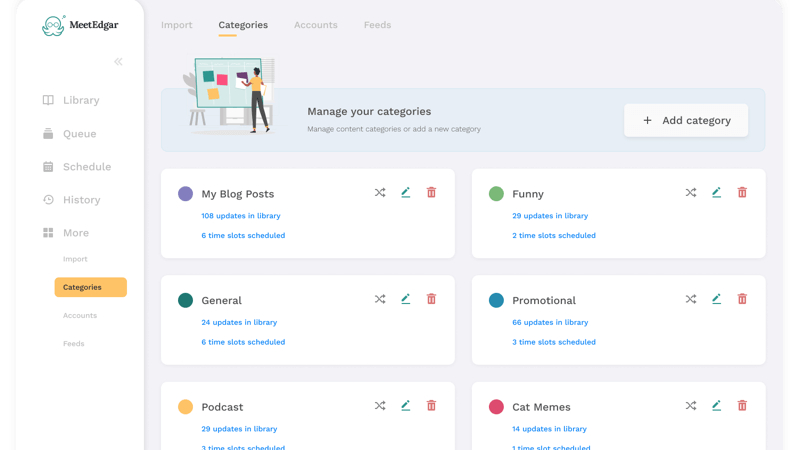
Meetedgar is distinct from other market-available social media automation solutions. With its publishing capability, it provides better service and aids in specifically arranging content.
When you schedule a post in Meetedgar, you have the option to save it in the library for later use. On social networking sites like Facebook, Twitter, Instagram, Pinterest, and LinkedIn, this tool supports and helps you.
11. Zoho Social

Zoho Social was created to effectively meet the needs of organizations that are expanding at an exponential rate. You may collaborate with your team and keep an eye on social conversations and brand mentions using our social media automation tool.
It generates a personalized report to examine your social media and provides an infinite social media scheduling capability. You can manage social networking sites like Facebook, Twitter, LinkedIn, Instagram, and Google My Business with the help of Zoho Social.
12. Agorapulse
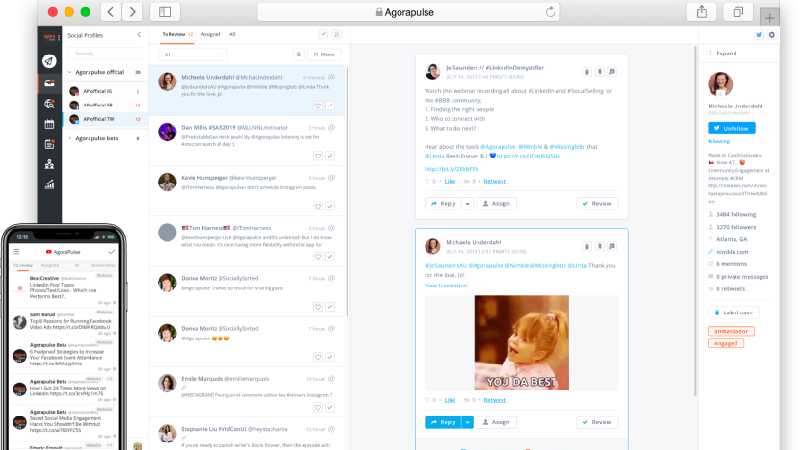
Agorapulse is a comprehensive social media automation program that promotes team collaboration. They have a tonne of choices to fill your content calendar, whether you’re wanting to bulk upload, queue, or schedule your posts.
It also offers customers one-click reports and a social mailbox to catch every discussion. Platforms for social media like Facebook, Twitter, LinkedIn, Youtube, and Instagram are supported by Agorapulse.
13. Napoleon Cat
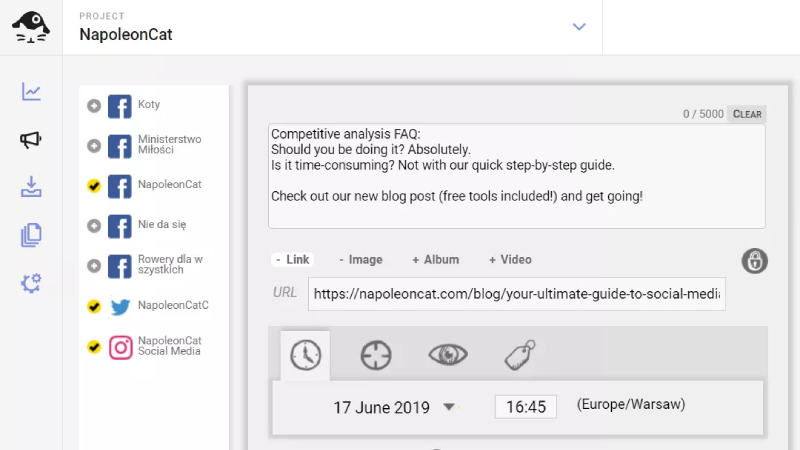
In addition to content scheduling, NapoleonCat also provides content moderation for social media. On Facebook and Instagram direct messaging and comment threads, you can program prepared responses to frequently asked queries.
For comments on Facebook and Instagram advertising, the automation rules also apply. To make your remarks appear genuine and not robotic, you can create up to 20 alternative responses to the same trigger.
Also, you won’t need to repeat the process manually every week or month if you spend hours battling the Excel sheet to display your data. NapoleonCat allows you to automate and schedule expert social media reports that are delivered right to the inboxes of you or other stakeholders.
Wrapping up!
With time, social media marketing has changed. You must maintain a steady commitment if you want to stay relevant to your audience. You need the greatest social media automation tools to leave a lasting impression if you want to make this happen.
All the above tools are good for automating most social media activities. But, you still need some essential tools to calculate marketing budget, earnings, scope, and marketing expert to achieve your goals. That’s where OTT SEO comes to your rescue with a range of social media tools and marketing services. So, if you need help in social media marketing visit the official website for tools and contact us directly for services.
The Evolution of Digital Marketing: From Traditional to Modern Approaches
Digital marketing has undergone a remarkable transformation over the past two decades, evolving from simple banner advertisements. Email campaigns to sophisticated, data-driven strategies that leverage artificial intelligence and machine learning. Understanding this evolution provides valuable context for developing effective modern marketing strategies that resonate with today’s consumers.
The early days of digital marketing were characterized by interruptive advertising tactics that prioritized visibility over relevance. Companies spent significant budgets on display ads that reached broad audiences but delivered limited engagement. As consumer behavior shifted and technology advanced, marketers began recognizing the value of permission-based marketing. Targeted approaches that delivered personalized messages to specific audience segments.
Today’s digital marketing landscape demands integrated approaches that combine multiple channels and tactics into cohesive customer experiences. The most successful businesses recognize that modern consumers interact with brands through complex, non-linear journeys that span multiple devices and platforms. Meeting customers where they are requires sophisticated targeting capabilities, real-time personalization, and seamless cross-channel experiences.
The integration of marketing technology has enabled unprecedented levels of automation. Optimization, allowing marketers to deliver the right message to the right person at the right time. These capabilities have transformed marketing from an art to a science, enabling continuous improvement based on real-time performance data and predictive analytics.
Strategic Content Development for Search Engine Success
Content remains the foundation of successful digital marketing, serving as the primary mechanism for attracting organic traffic, building brand authority, and engaging target audiences. Developing a comprehensive content strategy requires understanding search intent, creating valuable resources, and optimizing for both search engines and human readers.
Effective content addresses specific search queries while providing genuine value to readers. This requires deep understanding of your audience’s needs, questions, and pain points. The best content answers questions comprehensively, provides actionable insights, and offers unique perspectives that readers cannot find elsewhere.
Content optimization extends beyond keyword placement to include structural elements, readability, and multimedia integration. Well-structured content with clear headings, bullet points, and visual elements performs better in search results while delivering superior user experiences. Mobile optimization is particularly critical as mobile traffic continues growing.
Content promotion and distribution are equally important as creation. Even excellent content delivers limited results if target audiences cannot discover it. Strategic distribution leverages social media, email marketing, influencer partnerships, and paid promotion to maximize content reach and impact.
Data Analytics and Performance Measurement Fundamentals
Modern marketing success depends heavily on sophisticated analytics capabilities that enable data-driven decision making. Understanding which metrics matter most and how they connect to business outcomes allows continuous optimization of marketing efforts and improved return on investment.
Essential marketing metrics include traffic volume and sources, engagement rates, conversion rates, customer acquisition costs, and lifetime value. Each metric provides insights into different aspects of marketing performance, and comprehensive analysis reveals the full picture of marketing effectiveness.
Attribution modeling helps marketers understand how different touchpoints contribute to conversions. Multi-touch attribution provides more accurate pictures of customer journeys than last-click attribution, enabling better allocation of marketing budgets across channels and campaigns.
Advanced analytics approaches segment data by multiple dimensions to identify patterns and opportunities that aggregate data might miss. Understanding audience segments, channel performance, and campaign effectiveness enables continuous optimization and improved results over time.
Building Brand Authority Through Thought Leadership
Establishing thought leadership in your industry provides significant competitive advantages, including increased brand awareness, customer trust, and organic visibility. Thought leadership requires consistent creation of valuable content that demonstrates expertise and unique insights.
Effective thought leadership content addresses emerging trends, challenges conventional wisdom, and provides actionable guidance that readers can apply to their own situations. This type of content positions your brand as an authority that audiences can trust for reliable information and guidance.
Building thought leadership requires sustained effort over time, with consistent publication of high-quality content that addresses relevant industry topics. The most successful thought leadership strategies identify unique perspectives and expertise areas that differentiate your brand from competitors.
Distribution amplifies thought leadership impact. Strategic promotion through social media, email marketing, industry publications, and speaking opportunities extends reach and builds recognition among target audiences.
Maximizing Return on Marketing Investment
Proving and maximizing marketing return on investment requires clear objectives, sophisticated tracking, and continuous optimization. The most successful marketing organizations treat marketing as an investment that must deliver measurable returns rather than an expense that cannot be quantified.
ROI calculation requires understanding customer lifetime value, acquisition costs, and the contribution of marketing activities to revenue generation. These calculations enable informed budget allocation decisions and help identify the most effective marketing tactics for your specific business.
Continuous testing and optimization improve marketing performance over time. A/B testing, multivariate testing, and iterative improvement processes enable identification of optimal approaches and continuous enhancement of marketing effectiveness.
Marketing automation improves efficiency while enabling personalization at scale. Automating routine tasks frees marketing teams to focus on strategic initiatives while maintaining consistent customer experiences across touchpoints.
Future-Proofing Your Digital Marketing Strategy
The digital marketing landscape continues evolving rapidly, with emerging technologies, changing consumer behaviors, and new platforms creating both challenges and opportunities. Future-proofing your strategy requires staying current with trends while maintaining focus on fundamental marketing principles.
Artificial intelligence and machine learning continue transforming marketing capabilities, enabling more sophisticated targeting, personalization, and optimization. Businesses that embrace these technologies gain competitive advantages through improved efficiency and effectiveness.
Privacy regulations and changes to third-party cookies require adaptation of tracking and targeting approaches. First-party data strategies and consent-based marketing become increasingly important as the industry transitions to a privacy-focused environment.
Voice search, visual search, and AI-powered search experiences create new optimization requirements. Adapting content and technical strategies for these emerging search modalities positions businesses for success in evolving search environments.
Frequently Asked Questions
How does digital marketing drive business growth?
Digital marketing enables businesses to reach targeted audiences with personalized messages at scale. Through search engine optimization, content marketing, social media engagement, and paid advertising, businesses attract qualified leads, build brand awareness, and generate measurable revenue. The data-driven nature of digital marketing enables continuous optimization for improved results over time.
What is the ideal budget for digital marketing?
Digital marketing budgets vary significantly based on business size, industry, and objectives. Most businesses allocate 7-12% of revenue to marketing, with digital typically representing an increasing share. The key is investing enough to achieve meaningful reach and frequency while maintaining positive return on investment.
How long until we see results from digital marketing?
Timelines vary by tactic. Paid advertising generates immediate traffic, while search engine optimization typically requires 3-6 months for meaningful results. Content marketing and brand building efforts compound over time, with most businesses seeing significant returns within 6-12 months of consistent effort.
Which digital marketing channels should we prioritize?
Prioritization depends on your audience, objectives, and resources. Most businesses benefit from integrated approaches combining search engine optimization, content marketing, social media, and paid advertising. Channel selection should be based on where your target audience spends time and the types of results you want to achieve.
How do we measure digital marketing success?
Success measurement involves tracking key performance indicators aligned with business objectives. Essential metrics include traffic, engagement, conversion rates, customer acquisition costs, and return on investment. Regular analysis and reporting enable optimization and continuous improvement.
Should we handle digital marketing internally or hire an agency?
Decision depends on expertise, resources, and objectives. Agencies provide specialized skills, proven processes, and scale that may be difficult to achieve internally. Internal teams offer deeper industry knowledge and more direct control. Many businesses benefit from hybrid approaches combining internal teams with external expertise.
How important is mobile marketing?
Mobile marketing is essential, with mobile devices accounting for the majority of digital interactions. Mobile-first design, fast loading speeds, and responsive experiences are requirements. Neglecting mobile risks alienating the majority of your potential audience.
What role does content play in digital marketing?
Content is the foundation of effective digital marketing, enabling organic traffic generation, brand authority building, and audience engagement. Quality content attracts backlinks, satisfies search intent, and provides value that keeps audiences returning. Without compelling content, other marketing tactics have limited effectiveness.

Best Twitter Alternatives for Business and Marketing Success
Many Twitter alternatives have gained popularity ever since massive changes happened in the most popular…
Read More →
Mastering LinkedIn Lead Generation: A Comprehensive Guide
LinkedIn has emerged as the premier platform for B2B lead generation, offering unparalleled access to…
Read More →
Why Content Curation is a Must-Have in Your Digital Strategy
Content curation is more than just sharing. Finding the best material that appeals to your…
Read More →
Snapchat for Business: An Ultimate Guide to Promote Your Brand
Launched in 2011, Snapchat. Snapchat is still in the top 15 most popular social media…
Read More →
Social Listening: Stay Ahead of Your Competitors
Without a social listening plan, you’re passing up some of the most important information to…
Read More →-
 By Guy Sheetrit
- Mar 1, 2023
 By Guy Sheetrit


