
It can be difficult to launch an Internet store. There are a lot of things to consider, like picking the best products and setting up your payment and shipping procedures. Yet, managing your eCommerce data is one of the most crucial components of having an online store.
It can be tempting to only concentrate on increasing sales while you’re just getting started. Yet if you want your business to expand, you must begin monitoring important data right now. By doing this, you will be able to see clearly how your company is doing and where changes may be made.
eCommerce metrics are essential statistics that monitor the success of your online store. You can pinpoint places where changes need to be made and assess the impact of those changes by monitoring these indicators. We’ll talk about some of the most important indicators that any business owner should monitor in this article.
Explore more in our digital marketing guide and social media marketing resources.
What Are eCommerce Metrics?
eCommerce metrics are performance indicators that companies use to gauge the effectiveness of their online marketing campaigns.
From website traffic and conversion rates to customer happiness and average purchase value, they can cover a wide range of topics. Businesses may find out where they are doing well and where they have room for development by measuring important data.
While the eCommerce goals of each firm will vary, there are some common statistics and analytics that are worthwhile monitoring. Traffic to websites, conversion rates, cart abandonment rates, average order values, and customer happiness are a few of these metrics. Businesses can enhance their outcomes by measuring these indicators to gain a better picture of how well their online sales are performing. For a deeper dive, explore our guide on Pricing Psychology Ecommerce Websites.
What is the Difference Between a KPI and a Metric?
Both names refer to marketing, but a Key Performance Indicator (KPI) is a particular figure you wish to raise. For instance, you might want to boost conversion rates on your website by 2%. The conversion rate would be your KPI in this scenario.
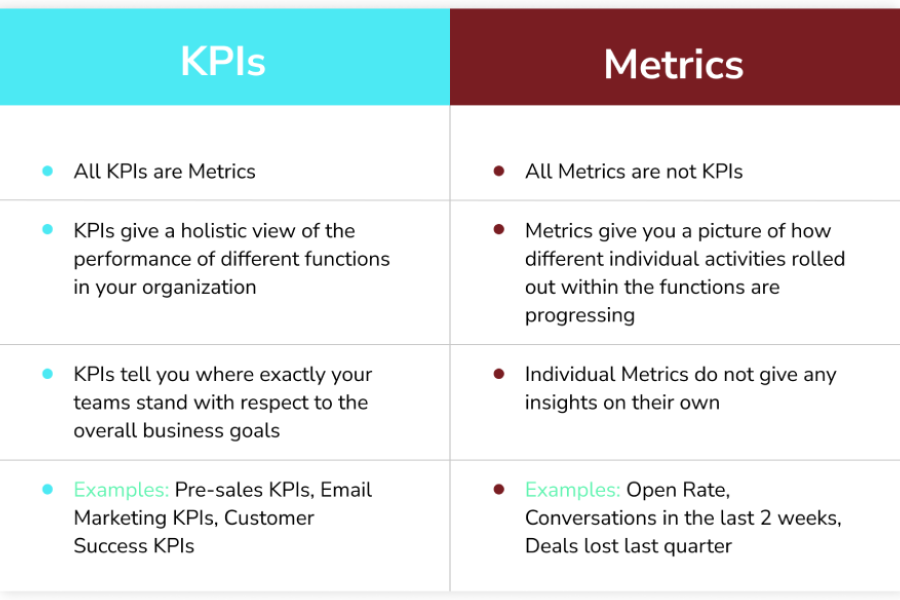
A metric is a unit of measurement. The metric in the aforementioned illustration would be website traffic. Because they can provide you with various insights into the functioning of your company, it is crucial to monitor both KPIs and metrics.
Let’s imagine, for illustration, that you want to raise the conversion rate on your website. It’s possible that while having a high traffic volume on your website, your conversion rate is low. This could indicate that your product pages aren’t compelling or that your website isn’t well-designed for conversions.
On the other hand, you can see that while your website traffic is modest, your conversion rate metric is high. This can indicate that your main goal should be to increase website visitors.
Metrics are measures that can help you understand what you need to do to enhance your KPIs, whereas KPIs are particular figures that you wish to increase.
Top 4 Key Metrics For eCommerce
Businesses can monitor a wide range of different eCommerce indicators. Yet, not all of them hold the same significance. We’ll talk about some important indicators that every company should monitor in this part.
1. Customer Lifetime Value
The sum of money a customer will spend on your goods or services over the course of their association with your company is known as customer lifetime value or CLV. This crucial indicator is crucial because it enables you to evaluate the long-term worth of your consumers.
How to calculate CLV?
To calculate CLV, experiment with several methods. The most popular approach is still to multiply the average order value by the typical number of purchases made by a single customer.
The formula to determine client lifetime value is as follows:
Average Order Value x Average Number of Purchases equals Customer Lifetime Value. Let’s imagine, for illustration, that the typical consumer makes 3 transactions on your website per year and the average order value is $100. The lifetime value of this consumer would be $300.
This indicator is crucial since it enables you to evaluate your clients’ long-term worth. You can be more aggressive in your marketing and customer acquisition efforts if you know that the typical customer is worth $300 to your company.
How to improve CLV?
The most typical strategy for raising CLV is to raise the average order value. On your website, you can achieve this via cross-selling and upselling products. Increasing the number of purchases made by consumers is another strategy to raise client lifetime value. This can be accomplished by developing loyalty programs or launching advertising efforts that motivate clients to make more regular purchases.
2. Customer Retention Rate
It represents the proportion of customers that make subsequent purchases from you. This measure is crucial since it enables you to evaluate how successfully you are keeping your consumers.
How to measure customer retention rate?
The simplest way to compute rates is to divide the total number of customers at the beginning of a period by the total number of customers at the conclusion of that period.
The formula for calculating the client retention rate is as follows:
Customers at the beginning of the period divided by customers at the end are the customer retention rate.
Let’s take the scenario where you started the year with 100 consumers and completed it with 80. Your client retention rate would be 80% in this scenario.
This measure is crucial since it enables you to evaluate how successfully you are keeping your consumers. You’re doing an excellent job of maintaining your clients’ satisfaction if you have a high customer retention rate.
E-Commerce SEO Services: A Comprehensive Guide to Boost Your Sales
Why is customer retention rate important?
The following list includes a few of the factors that make the client retention rate so crucial:
- Keeping current consumers is simpler and less expensive than finding new ones.
- Established clients are more inclined to make another purchase from you.
- Referrals from current clients are more likely to result in new business.
- Established clients are more likely to offer insightful criticism.
Now is the perfect time to start tracking your customer retention rate, if you aren’t already. One of the most crucial indicators for eCommerce companies, it may help you understand the state of your company.
3. Sales Conversion Rate
The proportion of website visitors who actually make a purchase is known as the sales conversion rate. This number is perhaps the most crucial for any eCommerce site since it shows how well your online store turns visitors into paying clients.
The following are some wise suggestions to raise your sales conversion rate:
- Enhancing the appearance and usability of your website
- Ensuring that your charges are reasonable
- Presenting specials and promotions
- Enhancing the descriptions of your products
- Facilitating the discovery of desired content on your website for users.
How to calculate the sales conversion rate?
Simply divide the total number of sales by the number of website visitors to determine your sales conversion rate. Your sales conversion rate would be 10%, for instance, if you had 100 visits to your website and 10 of them made a purchase.
Calculating sales conversion rate is as follows:
The sales Conversion Rate is calculated as the Number of Sales / Number of Visitors.
Why is the sales conversion rate important?
Your website’s ability to turn visitors into paying customers may be determined by looking at your sales conversion rate, which is significant. A poor sales conversion rate indicates that the majority of website visitors are not making any purchases from you. This may result from many things, including exorbitant costs, inadequate product descriptions, or a perplexing user interface.
One of the best strategies to boost revenue for your company is to enhance your sales conversion rate. Your bottom line can be significantly impacted by even a minor increase in conversion rate. For a deeper dive, explore our guide on Boost Sales.
What is a good sales conversion rate?
When it comes to the sales conversion rate, there is no magic figure. For eCommerce websites, the typical sales conversion rate is between 2 and 3%. The top-performing websites, however, have conversion rates of 10% or more.
4. Bounce Rate
A “bounce” occurs when a user accesses your website and then leaves without taking any further action. The percentage of visitors to your site who come, “bounce,” and leave again is known as the bounce rate.

Why is a high bounce rate bad?
A high bounce rate means that visitors to your website are arriving but leaving without finding what they’re looking for. This can be the result of someone having trouble navigating your website or your material not being pertinent to their needs. In either case, it’s critical to make an effort to lower your bounce rate if you want to enhance the functionality of your website.
How to calculate your bounce rate?
Divide the total number of visitors to your site by the number of people that “bounce” away to determine your bounce rate. Your bounce rate would be 60%, for instance, if 100 individuals visited your site and 60 of them left without taking any further action.
Here is the equation:
The bounce rate is calculated by: (Number of people who bounce away / Total number of people who visit your site) x 100
What is a good bounce rate?
The definition of a “good” bounce rate is ill-defined. It will differ based on your industry, your business objectives, and other elements. According to SEMRush, a greater bounce rate (over 40%) is typically regarded as undesirable, but a low bounce rate (between 26%. 40%) is typically regarded as positive.
How can I reduce my bounce rate?
You can try a number of strategies to lower your bounce rate, such as:
- Ensuring that your material is pertinent to and helpful to your intended audience.
- Enhancing your website’s usability and navigation
- To persuade visitors to stay on your website and take further action, use compelling calls to action.
- Trying out various design components to determine which ones your visitors respond to the best
You may enhance the overall functionality of your website by monitoring the bounce rate and taking measures to lower it.
How Should You Use All of This Information?
It’s time to start putting your understanding of the important eCommerce metrics you should be tracking into practice. Use these analytics to monitor the effectiveness of your website and pinpoint areas that want improvement. For instance, test various design components or enhance your product descriptions if your sales conversion rate is poor to see if you can increase conversions. For a deeper dive, explore our guide on Pricing Psychology Improved Ecommerce.
The important thing to keep in mind is to frequently monitor these metrics. Utilize the information to guide your decisions about how to enhance your website. You can make sure your company is headed in the correct direction for success by monitoring these eCommerce KPIs.
Consider collaborating with OTT SEO,. Has a team of knowledgeable individuals from each industry, if you need assistance starting or are unsure of which metrics are most crucial for your organization. We can provide you with advice on how to enhance the performance of your website. Assist you to determine the important eCommerce indicators you should be monitoring. For a more effective operation, we can also provide useful insights into automation and time-saving solutions.
Frequently Asked Questions
Q: What is this guide about?
This comprehensive guide provides strategies and best practices for achieving success in your marketing efforts. Following these approaches can help improve your results and competitive advantage.
Q: How long does it take to see results?
Results vary depending on consistency and implementation quality. Most strategies require 3-6 months of dedicated effort before significant improvements become visible. Ongoing optimization is essential.
Q: Do I need professional help?
While basic implementation can be done independently, professional guidance often accelerates results and helps avoid common mistakes. Consider experts if you lack internal resources.
Q: What are the most important factors for success?
Key success factors include thorough research, consistent execution, quality over quantity, regular performance monitoring, and adapting to industry changes.
Q: How do I measure success?
Success depends on your goals but typically involves tracking KPIs like traffic, conversions, revenue, and engagement rates. Regular analysis helps identify improvements.
Q: What digital marketing channels should I focus on?
The best channels depend on your audience. Most businesses benefit from SEO, content marketing, social media, and paid advertising. Start where your audience is most active.
The Evolution of Digital Marketing: From Traditional to Modern Approaches
Digital marketing has undergone a remarkable transformation over the past two decades, evolving from simple banner advertisements. Email campaigns to sophisticated, data-driven strategies that leverage artificial intelligence and machine learning. Understanding this evolution provides valuable context for developing effective modern marketing strategies that resonate with today’s consumers.
The early days of digital marketing were characterized by interruptive advertising tactics that prioritized visibility over relevance. Companies spent significant budgets on display ads that reached broad audiences but delivered limited engagement. As consumer behavior shifted and technology advanced, marketers began recognizing the value of permission-based marketing. Targeted approaches that delivered personalized messages to specific audience segments.
Today’s digital marketing landscape demands integrated approaches that combine multiple channels and tactics into cohesive customer experiences. The most successful businesses recognize that modern consumers interact with brands through complex, non-linear journeys that span multiple devices and platforms. Meeting customers where they are requires sophisticated targeting capabilities, real-time personalization, and seamless cross-channel experiences.
The integration of marketing technology has enabled unprecedented levels of automation. Optimization, allowing marketers to deliver the right message to the right person at the right time. These capabilities have transformed marketing from an art to a science, enabling continuous improvement based on real-time performance data and predictive analytics.
Strategic Content Development for Search Engine Success
Content remains the foundation of successful digital marketing, serving as the primary mechanism for attracting organic traffic, building brand authority, and engaging target audiences. Developing a comprehensive content strategy requires understanding search intent, creating valuable resources, and optimizing for both search engines and human readers.
Effective content addresses specific search queries while providing genuine value to readers. This requires deep understanding of your audience’s needs, questions, and pain points. The best content answers questions comprehensively, provides actionable insights, and offers unique perspectives that readers cannot find elsewhere.
Content optimization extends beyond keyword placement to include structural elements, readability, and multimedia integration. Well-structured content with clear headings, bullet points, and visual elements performs better in search results while delivering superior user experiences. Mobile optimization is particularly critical as mobile traffic continues growing.
Content promotion and distribution are equally important as creation. Even excellent content delivers limited results if target audiences cannot discover it. Strategic distribution leverages social media, email marketing, influencer partnerships, and paid promotion to maximize content reach and impact.
Data Analytics and Performance Measurement Fundamentals
Modern marketing success depends heavily on sophisticated analytics capabilities that enable data-driven decision making. Understanding which metrics matter most and how they connect to business outcomes allows continuous optimization of marketing efforts and improved return on investment.
Essential marketing metrics include traffic volume and sources, engagement rates, conversion rates, customer acquisition costs, and lifetime value. Each metric provides insights into different aspects of marketing performance, and comprehensive analysis reveals the full picture of marketing effectiveness.
Attribution modeling helps marketers understand how different touchpoints contribute to conversions. Multi-touch attribution provides more accurate pictures of customer journeys than last-click attribution, enabling better allocation of marketing budgets across channels and campaigns.
Advanced analytics approaches segment data by multiple dimensions to identify patterns and opportunities that aggregate data might miss. Understanding audience segments, channel performance, and campaign effectiveness enables continuous optimization and improved results over time.
Building Brand Authority Through Thought Leadership
Establishing thought leadership in your industry provides significant competitive advantages, including increased brand awareness, customer trust, and organic visibility. Thought leadership requires consistent creation of valuable content that demonstrates expertise and unique insights.
Effective thought leadership content addresses emerging trends, challenges conventional wisdom, and provides actionable guidance that readers can apply to their own situations. This type of content positions your brand as an authority that audiences can trust for reliable information and guidance.
Building thought leadership requires sustained effort over time, with consistent publication of high-quality content that addresses relevant industry topics. The most successful thought leadership strategies identify unique perspectives and expertise areas that differentiate your brand from competitors.
Distribution amplifies thought leadership impact. Strategic promotion through social media, email marketing, industry publications, and speaking opportunities extends reach and builds recognition among target audiences.
Maximizing Return on Marketing Investment
Proving and maximizing marketing return on investment requires clear objectives, sophisticated tracking, and continuous optimization. The most successful marketing organizations treat marketing as an investment that must deliver measurable returns rather than an expense that cannot be quantified.
ROI calculation requires understanding customer lifetime value, acquisition costs, and the contribution of marketing activities to revenue generation. These calculations enable informed budget allocation decisions and help identify the most effective marketing tactics for your specific business.
Continuous testing and optimization improve marketing performance over time. A/B testing, multivariate testing, and iterative improvement processes enable identification of optimal approaches and continuous enhancement of marketing effectiveness.
Marketing automation improves efficiency while enabling personalization at scale. Automating routine tasks frees marketing teams to focus on strategic initiatives while maintaining consistent customer experiences across touchpoints.
Future-Proofing Your Digital Marketing Strategy
The digital marketing landscape continues evolving rapidly, with emerging technologies, changing consumer behaviors, and new platforms creating both challenges and opportunities. Future-proofing your strategy requires staying current with trends while maintaining focus on fundamental marketing principles.
Artificial intelligence and machine learning continue transforming marketing capabilities, enabling more sophisticated targeting, personalization, and optimization. Businesses that embrace these technologies gain competitive advantages through improved efficiency and effectiveness.
Privacy regulations and changes to third-party cookies require adaptation of tracking and targeting approaches. First-party data strategies and consent-based marketing become increasingly important as the industry transitions to a privacy-focused environment.
Voice search, visual search, and AI-powered search experiences create new optimization requirements. Adapting content and technical strategies for these emerging search modalities positions businesses for success in evolving search environments.
Frequently Asked Questions
How do I increase eCommerce conversion rates?
Conversion rate optimization priorities for eCommerce: (1) Page speed — every 1-second improvement increases conversions 2–5%. Target lcp under 2.5 seconds on mobile; (2) product photography — high-quality multi-angle photos with lifestyle imagery and zoom functionality reduce purchase hesitation; (3) social proof — star ratings and review counts on product pages increase conversion by 20–30%; (4) checkout optimization — offer guest checkout, reduce form fields to 5 maximum, display trust badges (ssl, payment methods, money-back guarantee); (5) mobile ux — if your mobile conversion rate is below 50% of desktop, your mobile experience needs urgent improvement; (6) abandoned cart sequences — 3-email series recovers 5–15% of abandoned carts at minimal cost.
What is customer lifetime value and why does it matter?
Customer Lifetime Value (CLV or LTV) is the total revenue a business can expect from a single customer account throughout their relationship. CLV formula: Average Order Value × Purchase Frequency per Year × Customer Relationship Length in Years. CLV drives every major business decision: how much you can spend to acquire a customer (CAC should be no more than CLV÷3 for healthy unit economics), which customer segments to prioritize (CLV varies dramatically by acquisition channel, product category, and customer demographics), and when a customer is ‘. At risk’ of churning (monitoring clv trajectory per cohort). A business with $800 average CLV can profitably spend $200–$250 to acquire each customer — one with $150 CLV cannot.
How do I create a loyal customer base?
Customer loyalty-building tactics: (1) First purchase experience — the onboarding/unboxing experience creates the emotional foundation for repeat purchase. Invest in packaging, delivery experience, and post-purchase communication; (2) loyalty program — points, tiers, and exclusive benefits reduce price sensitivity and increase purchase frequency (starbucks rewards members visit 2.5x more frequently than non-members); (3) proactive communication — value-add emails (usage tips, new features, exclusive content) between purchase cycles maintain brand presence without being purely promotional; (4) community building — facebook groups, discord communities, or user forums create social investment beyond the product relationship; (5) exceptional service recovery — customers who experience a problem handled well are 17% more loyal than those who never had a problem.
What is the average customer acquisition cost by marketing channel?
Customer acquisition cost (CAC) benchmarks by channel: Content marketing/SEO ($10–50 at scale after 12+ months of investment), Email marketing to owned list ($1–10 per conversion), Referral program ($20–80 including incentives), Google Search Ads ($50–200 for most B2B, $20–100 for e-commerce), Meta/Instagram Ads ($30–150 for e-commerce, $50–300 for B2B), LinkedIn Ads ($100–400 for enterprise B2B), Trade shows ($500–2,000+ per qualified lead including all event costs), Cold outbound ($200–500+ including SDR time and tools). Evaluate CAC against CLV — not in isolation. A $300 CAC is excellent if CLV is $3,000; it’s catastrophic if CLV is $200.
How does personalization increase marketing performance?
Personalization impact across marketing channels: Email: personalized subject lines increase open rates 26%; personalized email content increases CTR 14% and conversion 10%. Website: personalized homepages for returning visitors increase engagement 40% and conversion 20%. Recommendations: 35% of Amazon’s revenue comes from its recommendation algorithm — product suggestions based on purchase and browse history. Ad creative: dynamically personalized ad creative (different visuals and copy per audience segment) improves ROAS 30–50% vs. single static creative. The personalization ROI case is clear; the barrier is data and technology infrastructure. Start with email personalization (name, past purchase-based recommendations) using Klaviyo or ActiveCampaign before investing in website personalization technology.

Bigcommerce Strategies to Optimize Your Online Store in 2023
BigCommerce is a cloud-based platform that allows businesses to create and operate online stores. It…
Read More →
Boost Your Sales: Essential SEO Tips for Bonanza Marketplace
As an e-commerce seller on Bonanza, your success depends on your relationship with search engines.…
Read More →
Etsy SEO Tips: How to Rank Higher in Search Results
Your Etsy shop is part of a marketplace with over 89.1 million buyers in the…
Read More →
Best Payment Gateway Providers for Online Business in 2023
Payment gateways serve as the critical infrastructure enabling online transactions between merchants and customers. Understanding…
Read More →
Content Management System: Top 6 CMS You Need to Know
A Content Management System (CMS) forms the backbone of modern website management, enabling businesses to…
Read More →-
 By Guy Sheetrit
- Mar 9, 2023
 By Guy Sheetrit


