
Businesses can use a variety of marketing strategies to entice clients to make purchases in the business realm. One effective technique for acquiring data to segment and target customers is behavioral marketing.
Moreover, behavioral marketing helps shield customers from irrelevant or unwelcome advertisements. In order to determine the unique demands of their clients, firms use this sort of marketing to concentrate on individual patterns of engagement.
You’ll discover what behavioral marketing is, its advantages, and instances of how organizations now employ the tactic in this piece.
For more technical SEO insights, explore our Core Web Vitals checklist and SEO fundamentals guide.
Behavioral marketing: What is it?
The process through which businesses target customers based on their behavior, interests, intents, geolocation and other information is known as behavioral marketing.
Web analytics, cookies, search history, and other methods are used to collect this information.
Organizations can deliver appropriate content and offer rather than blanket communications by carefully segmenting audiences based on particular behaviors or user profiles.
Types of Behavioral Marketing
There are numerous tactics that a business can use when it comes to behavioral marketing.
While some strategies work, many can be used to build a strong behavioral marketing strategy. Let’s examine a couple of the most common categories of strategies.
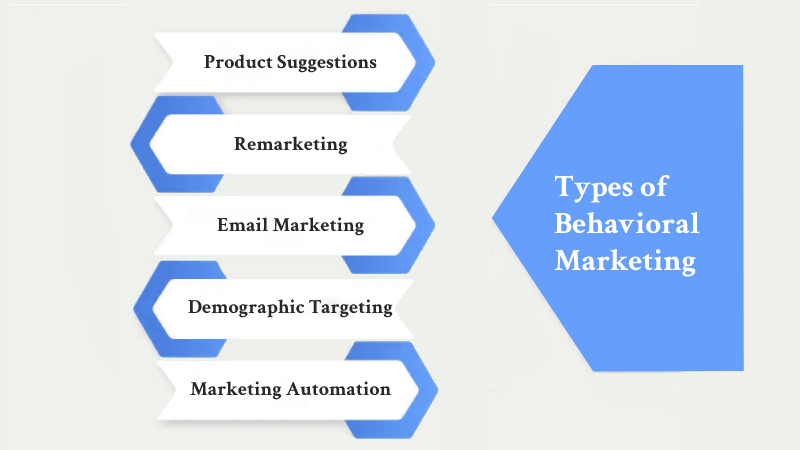
1. Product Suggestions
Everyone has experienced this when buying online: As you proceed to the checkout, a window displaying products that are frequently purchased along with the ones in your cart appears. A great method to involve potential consumers in cross-selling or up-selling opportunities is this suggested selling strategy.
Also, this strategy is really powerful. According to McKinsey & Company, cross-selling and category-penetration strategies like product recommendations can boost sales by 20% and profitability by 30%.
Product recommendations fall under behavioral marketing since putting something in a cart triggers specific selling recommendations.
2. Remarketing
Remarketing and retargeting methods may be novel ways to increase sales for businesses that use Google and Facebook for marketing purposes.
When a potential customer leaves the website, remarketing methods focus on presenting them with the pages or products they previously visited. This second chance for customers to see your products once more may increase website traffic or result in product purchases.
Say you go to the Asian Art Museum’s website to make travel arrangements for your upcoming vacation to San Francisco.
A few minutes later, you encounter an ad for the museum when you’re scrolling on Facebook. Your Facebook advertisement is based on past behavior (visiting a website). Remarketing is being used there.
3. Email Marketing
Currently, email marketing is used by many companies as a part of their marketing strategy, but few make use of the effectiveness of behavioral segmentation. Abandoned cart emails are a great illustration of a behavioral segmentation email marketing approach.
Your team can send emails and information relating to those products or categories to customers who have things in their basket that have been there for a while.
In the end, this gives the consumer a more customized experience.
4. Demographic Targeting
Demographic targeting is one of the behavioral marketing strategies that are most frequently applied in the commercial world. In the end, corporations use parameters like a user’s age, geography, education level, and even gender to develop an impression of them.
Even now, businesses are beginning to consider more factors, such as the websites you frequent, to help them develop a more accurate picture of the kinds of things you might be interested in.
5. Marketing Automation
Data is valuable to marketers, and when businesses create enormous information caches, they may improve the creation and delivery of pertinent material to customers.
With marketing automation and machine learning technology, businesses can leverage their databases to forecast consumer behavior even months in advance.
The topic of data collecting is multifaceted and varied, and as audience listening tools progress, online privacy is becoming more and more crucial.
Behavioral Marketing Segmentation
Thinly segmenting consumers is an essential component of the behavioral marketing approach. Depending on the marketing objectives and target market of your company, behavioral segmentation may be decided in a different way.
Nonetheless, there are a few typical methods used by businesses to divide up markets, such as:
- Customer loyalty
- Purchase behavior
- Benefits sought
- Engagement level
- Customer journey stage
- Occasion
- Usage
Behavioral Marketing Examples
1. Liquor Loot
Segmented email marketing that works isn’t always serious. Just take a look at this abandoned cart email from Liquor Loot. The email’s tone is lighthearted as it enumerates the advantages of purchasing a whisky bottle.
In fact, by offering lighthearted justifications for why a potential consumer might think about purchasing a Whiskey Loot Box, they are more likely to engage with visitors who browsed the store but did not make a purchase.
2. Dyson
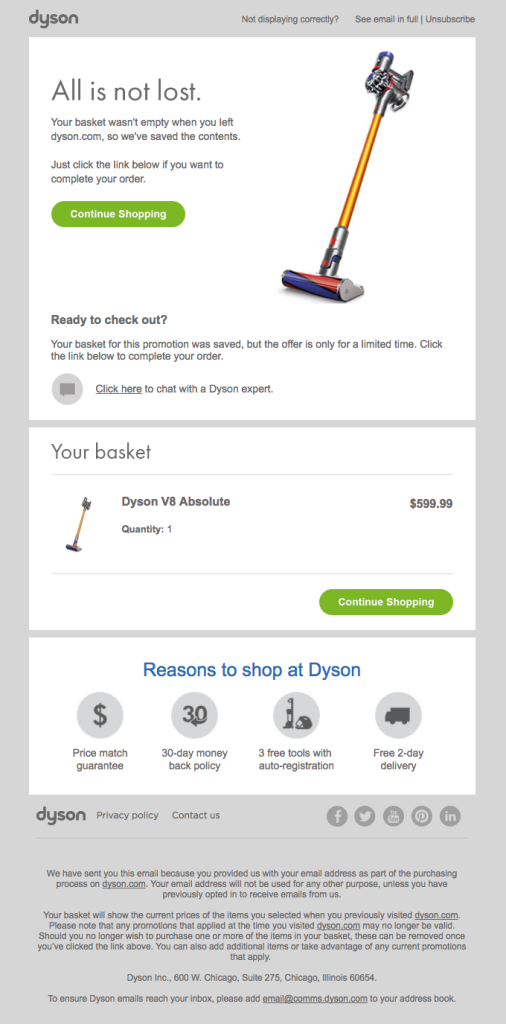
Dyson, a company well-known for its incredible selection of vacuums and sweepers, has excelled at using behavioral marketing. A sample of one of their abandoned cart emails is shown in the image above.
Dyson can recover lost sales before they are permanently lost by giving customers a recap of the things they were considering purchasing and making it simple for them to go back to the checkout screen.
3. Nike

Nike has long been regarded as a pioneer in the field of marketing. Most people are aware of the company’s innovative use of athlete endorsements in advertising efforts to motivate millions of children and adults to move around.
But, Nike has also developed a fantastic digital marketing plan.
The retargeting advertisement seen above appears straightforward but has the potential to be a formidable tool for bringing potential shoe buyers back to the Nike website.
4. Trivago
Nowadays, it’s typical for customers to return to a business’ website several times before making a decision. Remarketing advertising is crucial because this trend is particularly relevant to companies with a focus on travel and transportation.
Many individuals use Trivago’s website to check vacation spots, but most people don’t often book on their first visit.
Trivago uses remarketing advertisements on Facebook and Google to provide new, updated offers for hotels in the locations where a customer was previously browsing in order to keep the business top of mind.
5. Amazon
Amazon has a monopoly on clever provocative advertising. You’ll find adverts and content on its website that suggest products based on things you’ve looked at, bought in the past, or have in your shopping cart.
In addition, you may view what other customers bought to complement the item in your cart.
By adding this level of customization, Amazon has persuaded customers to shop with them for the majority of their purchases instead of just one item.
Facts on Behavioral Marketing
Do you need further evidence of the effectiveness of behavioral marketing? These figures illustrate the rising acceptance and advantages of behavioral marketing.
- According to Microsoft, businesses that use consumer behavior data to produce insights outperform their rivals in terms of sales growth by 85%.
- When making the decision to buy from a brand or retailer, 92% of consumers concur that it is crucial that every connection they have with the brand be exceptional.
- According to Segment’s 2022 State of Personalization research, 49% of customers think they are likely to make another purchase from a retail company after having a personalized shopping experience.
- In accordance with real-time behavior, 47% of businesses personalize messages, according to Segment.
- According to McKinsey & Company research from 2021, businesses with higher growth derive 40% more of their revenue from personalization than their competitors.
- 71% of consumers, according to McKinsey & Company, demand customization. That includes product suggestions and focused advertising.
Implementing Behavioral Marketing
Your clients anticipate a tailored experience. One approach to getting there is through behavioral marketing. As you go out on your adventure, keep transparency in mind.
Consumers should be informed about the purposes for which your brand is collecting and using their data. You’ll be well on your way to developing a successful behavioral marketing plan if you keep these factors in mind.
Frequently Asked Questions
Q: What is this guide about?
This comprehensive guide provides strategies and best practices for achieving success in your marketing efforts. Following these approaches can help improve your results and competitive advantage.
Q: How long does it take to see results?
Results vary depending on consistency and implementation quality. Most strategies require 3-6 months of dedicated effort before significant improvements become visible. Ongoing optimization is essential.
Q: Do I need professional help?
While basic implementation can be done independently, professional guidance often accelerates results and helps avoid common mistakes. Consider experts if you lack internal resources.
Q: What are the most important factors for success?
Key success factors include thorough research, consistent execution, quality over quantity, regular performance monitoring, and adapting to industry changes.
Q: How do I measure success?
Success depends on your goals but typically involves tracking KPIs like traffic, conversions, revenue, and engagement rates. Regular analysis helps identify improvements.
Q: What digital marketing channels should I focus on?
The best channels depend on your audience. Most businesses benefit from SEO, content marketing, social media, and paid advertising. Start where your audience is most active.
The Evolution of Digital Marketing: From Traditional to Modern Approaches
Digital marketing has undergone a remarkable transformation over the past two decades, evolving from simple banner advertisements and email campaigns to sophisticated, data-driven strategies that leverage artificial intelligence and machine learning. Understanding this evolution provides valuable context for developing effective modern marketing strategies that resonate with today’s consumers.
The early days of digital marketing were characterized by interruptive advertising tactics that prioritized visibility over relevance. Companies spent significant budgets on display ads that reached broad audiences but delivered limited engagement. As consumer behavior shifted and technology advanced, marketers began recognizing the value of permission-based marketing and targeted approaches that delivered personalized messages to specific audience segments.
Today’s digital marketing landscape demands integrated approaches that combine multiple channels and tactics into cohesive customer experiences. The most successful businesses recognize that modern consumers interact with brands through complex, non-linear journeys that span multiple devices and platforms. Meeting customers where they are requires sophisticated targeting capabilities, real-time personalization, and seamless cross-channel experiences.
The integration of marketing technology has enabled unprecedented levels of automation and optimization, allowing marketers to deliver the right message to the right person at the right time. These capabilities have transformed marketing from an art to a science, enabling continuous improvement based on real-time performance data and predictive analytics.
Strategic Content Development for Search Engine Success
Content remains the foundation of successful digital marketing, serving as the primary mechanism for attracting organic traffic, building brand authority, and engaging target audiences. Developing a comprehensive content strategy requires understanding search intent, creating valuable resources, and optimizing for both search engines and human readers.
Effective content addresses specific search queries while providing genuine value to readers. This requires deep understanding of your audience’s needs, questions, and pain points. The best content answers questions comprehensively, provides actionable insights, and offers unique perspectives that readers cannot find elsewhere.
Content optimization extends beyond keyword placement to include structural elements, readability, and multimedia integration. Well-structured content with clear headings, bullet points, and visual elements performs better in search results while delivering superior user experiences. Mobile optimization is particularly critical as mobile traffic continues growing.
Content promotion and distribution are equally important as creation. Even excellent content delivers limited results if target audiences cannot discover it. Strategic distribution leverages social media, email marketing, influencer partnerships, and paid promotion to maximize content reach and impact.
Data Analytics and Performance Measurement Fundamentals
Modern marketing success depends heavily on sophisticated analytics capabilities that enable data-driven decision making. Understanding which metrics matter most and how they connect to business outcomes allows continuous optimization of marketing efforts and improved return on investment.
Essential marketing metrics include traffic volume and sources, engagement rates, conversion rates, customer acquisition costs, and lifetime value. Each metric provides insights into different aspects of marketing performance, and comprehensive analysis reveals the full picture of marketing effectiveness.
Attribution modeling helps marketers understand how different touchpoints contribute to conversions. Multi-touch attribution provides more accurate pictures of customer journeys than last-click attribution, enabling better allocation of marketing budgets across channels and campaigns.
Advanced analytics approaches segment data by multiple dimensions to identify patterns and opportunities that aggregate data might miss. Understanding audience segments, channel performance, and campaign effectiveness enables continuous optimization and improved results over time.
Building Brand Authority Through Thought Leadership
Establishing thought leadership in your industry provides significant competitive advantages, including increased brand awareness, customer trust, and organic visibility. Thought leadership requires consistent creation of valuable content that demonstrates expertise and unique insights.
Effective thought leadership content addresses emerging trends, challenges conventional wisdom, and provides actionable guidance that readers can apply to their own situations. This type of content positions your brand as an authority that audiences can trust for reliable information and guidance.
Building thought leadership requires sustained effort over time, with consistent publication of high-quality content that addresses relevant industry topics. The most successful thought leadership strategies identify unique perspectives and expertise areas that differentiate your brand from competitors.
Distribution amplifies thought leadership impact. Strategic promotion through social media, email marketing, industry publications, and speaking opportunities extends reach and builds recognition among target audiences.
Maximizing Return on Marketing Investment
Proving and maximizing marketing return on investment requires clear objectives, sophisticated tracking, and continuous optimization. The most successful marketing organizations treat marketing as an investment that must deliver measurable returns rather than an expense that cannot be quantified.
ROI calculation requires understanding customer lifetime value, acquisition costs, and the contribution of marketing activities to revenue generation. These calculations enable informed budget allocation decisions and help identify the most effective marketing tactics for your specific business.
Continuous testing and optimization improve marketing performance over time. A/B testing, multivariate testing, and iterative improvement processes enable identification of optimal approaches and continuous enhancement of marketing effectiveness.
Marketing automation improves efficiency while enabling personalization at scale. Automating routine tasks frees marketing teams to focus on strategic initiatives while maintaining consistent customer experiences across touchpoints.
Future-Proofing Your Digital Marketing Strategy
The digital marketing landscape continues evolving rapidly, with emerging technologies, changing consumer behaviors, and new platforms creating both challenges and opportunities. Future-proofing your strategy requires staying current with trends while maintaining focus on fundamental marketing principles.
Artificial intelligence and machine learning continue transforming marketing capabilities, enabling more sophisticated targeting, personalization, and optimization. Businesses that embrace these technologies gain competitive advantages through improved efficiency and effectiveness.
Privacy regulations and changes to third-party cookies require adaptation of tracking and targeting approaches. First-party data strategies and consent-based marketing become increasingly important as the industry transitions to a privacy-focused environment.
Voice search, visual search, and AI-powered search experiences create new optimization requirements. Adapting content and technical strategies for these emerging search modalities positions businesses for success in evolving search environments.
Conclusion: Embracing Digital Marketing for Sustainable Business Growth
The digital marketing landscape presents unprecedented opportunities for businesses willing to invest in building their online presence. Success requires strategic approach, consistent effort, and willingness to adapt to changing technologies and consumer behaviors. By focusing on delivering genuine value to your audience and continuously optimizing based on data, your business can achieve sustainable growth through digital marketing.
Remember that digital marketing is an ongoing commitment rather than a one-time effort. The businesses that succeed view marketing as a strategic investment that delivers compounding returns over time. Stay focused on your objectives, measure results consistently, and maintain patience required for building lasting success in the dynamic digital environment.
The Evolution of Digital Marketing Strategy
Digital marketing has transformed dramatically over the past decade, evolving from simple banner advertisements to sophisticated, data-driven strategies that leverage artificial intelligence and machine learning.
Modern digital marketing requires integrated approaches combining multiple channels into cohesive customer experiences.
Content Marketing Best Practices
Content remains the foundation of successful digital marketing, serving as the primary mechanism for attracting organic traffic, building brand authority, and engaging target audiences.
Data-Driven Marketing Decisions
Modern marketing success depends on sophisticated analytics enabling data-driven decisions.
Building Brand Authority
Establishing thought leadership provides significant competitive advantages including increased brand awareness and customer trust.
Maximizing Marketing ROI
Proving marketing ROI requires clear objectives, sophisticated tracking, and continuous optimization.
Learn More: Home
🚀 Ready to Dominate Your Niche?
Over The Top SEO has helped 500+ businesses achieve first-page rankings and exponential traffic growth. Our data-driven approach, proven track record, and dedicated team are ready to put your brand at the top — where it belongs.
- ✓ Free SEO Audit (valued at $500)
- ✓ Custom strategy tailored to your industry
- ✓ Transparent reporting & real results

Schema Markup Guide: Every Type That Matters for SEO in 2026
Schema markup is no longer optional - it is the difference between showing up in…
Read More →
Core Web Vitals 2026: The Ultimate Technical SEO Checklist
Table of Contents Toggle Table of Contents Understanding the 2026 Core Web Vitals Framework LCP…
Read More →
Social Media Strategy That Actually Drives Revenue: The 2026 Framework
Table of Contents Toggle Table of Contents The Revenue-First Mindset Stop Optimizing for Engagement Map…
Read More →
Title Tag Optimizer
✏️ Table of Contents Toggle Title Tag Optimizer Optimization Checks How to Write SEO-Optimized Title…
Read More →
Structured Data Tester
🏗️ Table of Contents Toggle Structured Data Tester 📋 JSON-LD Input ✅ Validation Results 🔍…
Read More →-
 By SEO
- Mar 22, 2023
 By SEO